Top 8 best clay court tennis shoes 2026
The Nike Vapor 12 is the best clay court tennis shoe in this ranking (9.2/10), and its Clay version is sold at Tennis-Point, Passasports, TennisDirect, Zalando and on nike.com/be. The GP Challenge 1.5 (9.1/10) and the Vapor Pro 3 (9.0/10) follow, with harder-wearing outsoles. In Belgium, more than eight courts in ten are crushed brick: a full-length herringbone outsole makes the difference there. Most of the models listed come in men's and women's versions with a clay outsole.
Updated 29 September 2026
Why is the Nike Vapor 12 the best shoe for crushed brick?
Because it combines the best grip in the selection (9.4/10) with lightness rated 9.3/10, and it comes in a Clay version from Belgian retailers. Tennis Warehouse weighs it at 414 g in a US 10.5, with a 9.9 mm drop. Its Hart rubber outsole is split into herringbone sections, with Air Zoom in the heel.
Its weak point matters less on clay. To save weight, Nike removed a large share of the rubber, which is why it only scores 7.2/10 for durability in this ranking. Yet crushed brick wears an outsole far less than a hard court, according to Tennis Companion. A player who spends the summer on clay therefore gets the Vapor 12's grip while wearing down its rubber more slowly than on a hard surface.
The GP Challenge 1.5 (9.1/10) and the Vapor Pro 3 (9.0/10) are right behind. Both score 8.6/10 for durability, against 7.2 for the Vapor 12. If you slide a lot, if you are a heavier player or if you keep the same pair for winter on hard courts, they are the more sensible choice. The overall ranking of the best tennis shoes, across all surfaces, has the same three models at the top.
What makes a clay outsole different from an all-court outsole?
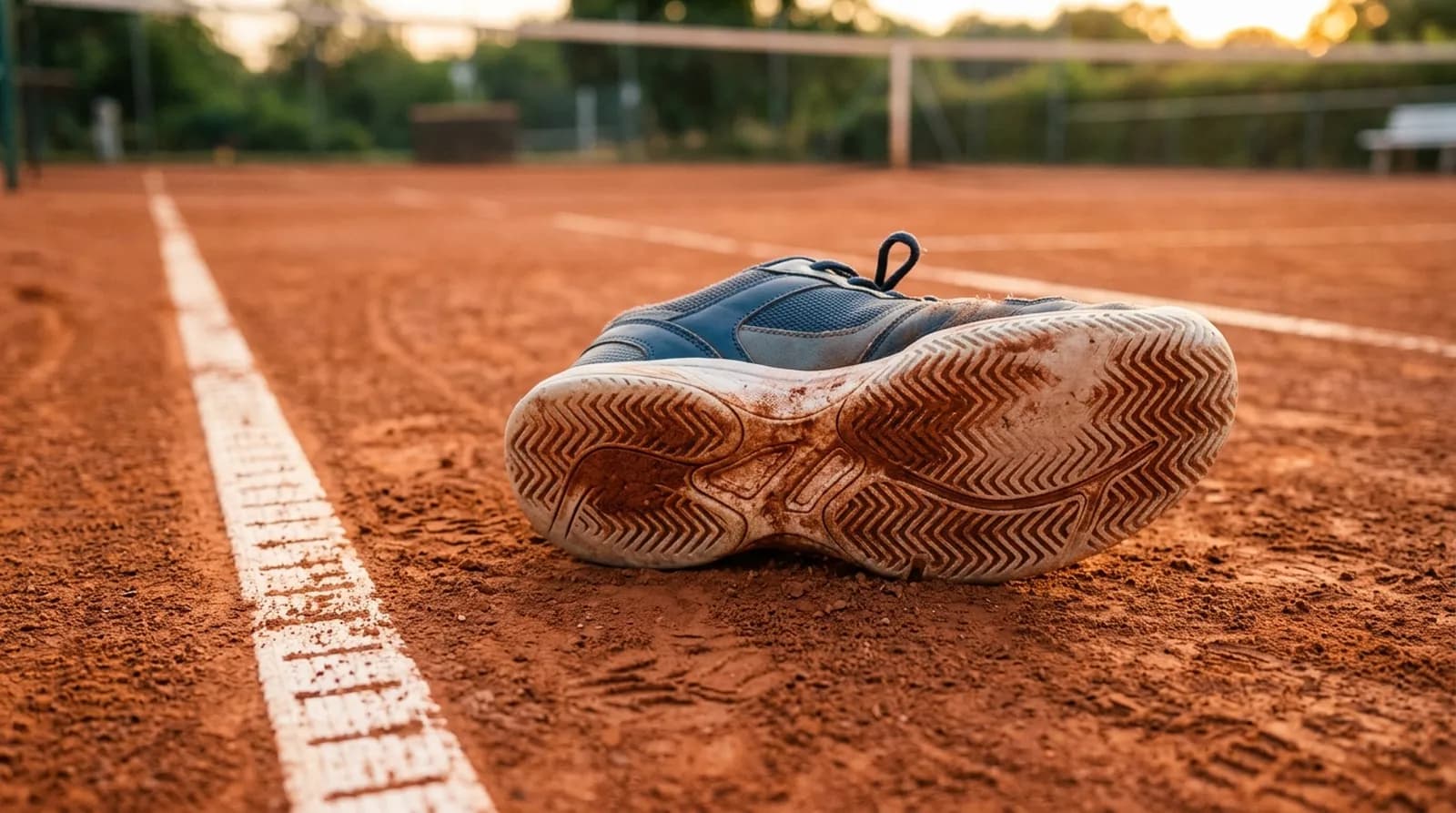
The tread pattern. A clay outsole has deep herringbone grooves along its whole length, which grip the brick and shed the clay instead of holding on to it, according to Head. An all-court outsole has modified herringbone, rounder and shallower: it works everywhere, but it is less effective on clay.
The difference shows in slides and recoveries. On crushed brick, you brake by sliding. An outsole whose grooves fill up with clay grips less, and that is exactly what deep herringbone prevents. The Asics Gel-Resolution X, for example, comes in a Clay version with full-length herringbone.
Sources disagree on rubber hardness. Tennis Companion describes clay models as often using softer rubber, while Tennis-Point.be presents its gravelschoenen with harder rubber. Stick to the criterion everyone agrees on: deep herringbone, from heel to toe.
Sliding also has a physical benefit. A 1995 ATP study, cited by Sportzorg, counted 0.20 physio call-outs per match on clay, against 0.42 on hard courts.
Does clay wear outsoles less?
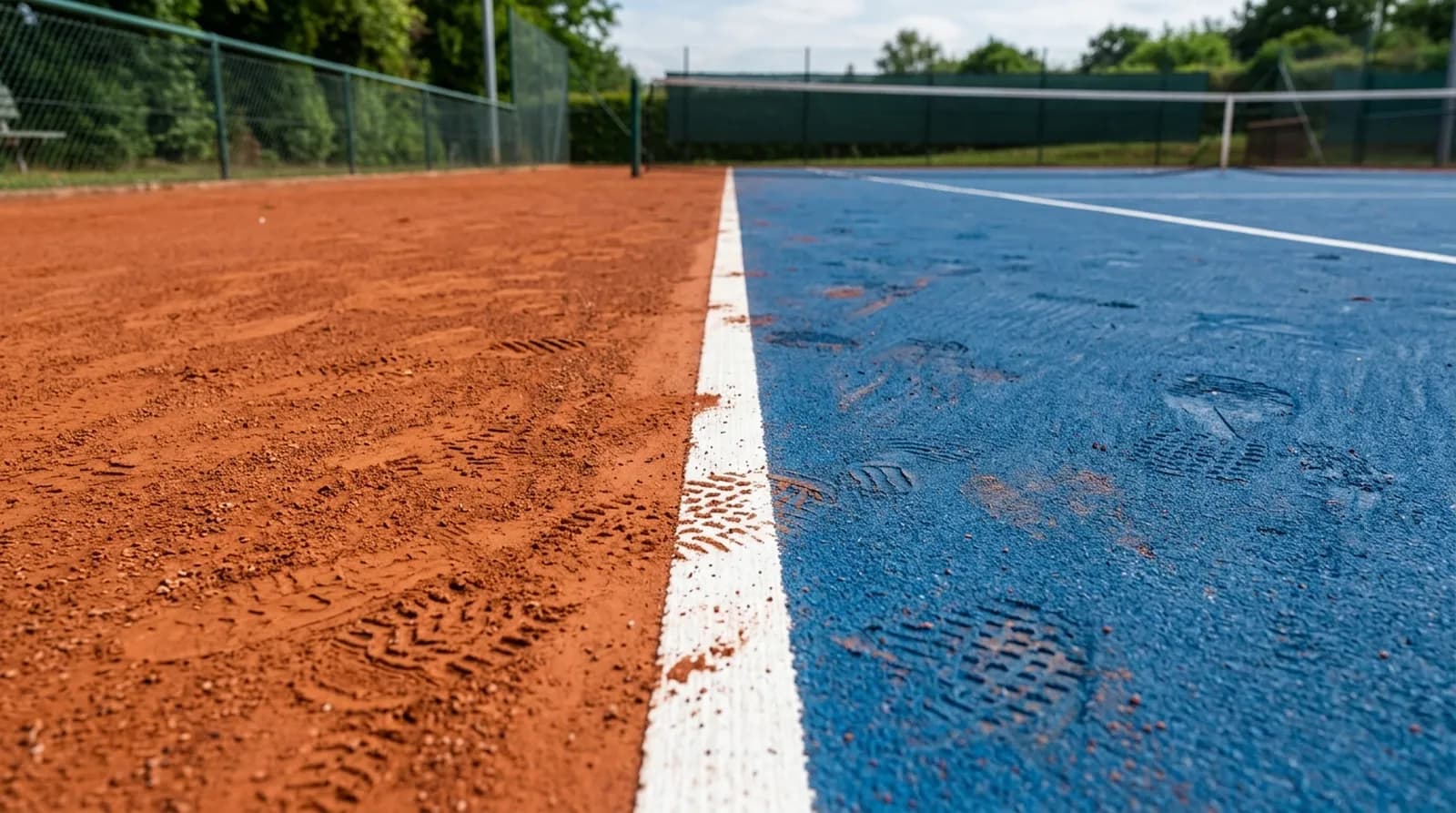
Yes, clearly. Hard courts are very abrasive, clay is much softer, and it wears rubber far less, according to Tennis Companion. The USTA points the same way: a baseliner who plays on hard courts several times a week wears shoes out much faster than a recreational doubles player on clay.
Cushioning, however, wears out on every surface. The AAPSM estimates that a tennis midsole is worn out after 45 to 60 hours of play. An outsole with plenty of tread left does not mean the shoe still cushions like on day one. Deep creases in the foam, or a shoe that tilts when placed on a flat surface, are signs it needs replacing, again according to the AAPSM.
That is why durability is still scored in this ranking, even on crushed brick. The Vapor Cage 4 (9.4/10), the Asics Gel-Resolution X (9.0/10) and the Barricade 13 (9.0/10) have the hardest-wearing rubber in the selection. The Vapor 12 (7.2/10) and the Barricade 14 (7.0/10) bring up the rear, but on clay that gap matters less than on hard courts.
A right-hander wears the inside of the right shoe first, because the back foot drags on the serve. On crushed brick as anywhere else, that is where to look first.
Can you wear clay court shoes in winter?
Rarely, and not on every surface. In Belgium, clubs mostly keep clay for the summer, according to the RTBF. Winter tennis is played under domes or indoors, on GreenSet, carpet or sand-filled artificial grass.
On carpet you need a completely smooth, non-marking sole. Deep herringbone grips too much there: the foot locks and the risk of a sprained ankle goes up, according to Decathlon. On sand-filled artificial grass, Sportzorg explicitly advises against clay shoes because of the injury risk, and recommends an omni outsole with small nubs.
The most common Belgian solution is therefore two pairs: a Clay version for summer, and an all-court or smooth-soled pair for winter. Alternating the two also gives the foams about 48 hours to decompress, according to ASICS. To choose your winter pair, the overall ranking of the best tennis shoes covers the all-court models.
How much does a good clay court shoe cost in Belgium?
Between 97 and 160 € for the models in this ranking, based on prices recorded in Belgium between June and September 2026, excluding the Vapor Cage 4, whose price is not disclosed. The GP Challenge Pro is the cheapest (≈ 97 €), ahead of the Barricade 13 (≈ 109 €), the Vapor Pro 3 (≈ 117 €) and the GP Challenge 1.5 (≈ 125 €). The Vapor 12, the Gel-Resolution X and the Barricade 14 sit around 160 € at list price.
The Barricade 13 shows how a model change works in your favour: since the 14 came out, it sells for around 109 €, with Adiwear 2.0 rubber rated 9.0/10 for durability. The Gel-Resolution X Clay, listed at around 160 €, has been seen at 99.99 € at Decathlon Austria.
Promotions can appear all year round in Belgium since the Council of State overturned fines linked to the word "sales". Summer sales start on 1 July, in the middle of the crushed-brick season.
Comparison table
Methodology : This ranking is a synthesis, not an in-house test bench. Julien S. compiled the manufacturers' spec sheets, RunRepeat's lab measurements, the reviews of Tennis Warehouse and Tennis Companion, and the listings of Belgian retailers. Only models sold in a clay (Clay) version are included. They are sorted by their overall score out of 10, which combines five criteria: durability, grip, comfort, stability and lightness. No pair is judged without the lifespan of its outsole: the durability score out of 10 is given for every model. Prices are list prices or averages recorded in Belgium between June and September 2026.
Sources : RTBF: clay at the heart of Belgian tennis · Tennis Companion: clay court tennis shoes · Head: everything you need to know about clay court tennis shoes · Tennis-Point.be: clay court shoes (gravelschoenen) · Sportzorg: tennis shoes and court types · RunRepeat: Nike Vapor 12, lab measurements · Tennis Warehouse: Nike Vapor 12 review · Tennis Warehouse: Nike Air Zoom Vapor Cage 4 review · AAPSM: when to replace your athletic shoes
Frequently asked questions
How good is the Nike Vapor 12 Clay in 2026?
It is the highest-rated shoe in this ranking (9.2/10), with 9.4/10 for grip. Its pared-down rubber only scores 7.2/10 for durability, a weakness that matters less on crushed brick than on hard courts. The Clay version is sold at Tennis-Point, Passasports, TennisDirect, Zalando and on nike.com/be.
Nike, Asics or Adidas: which brand for clay?
Nike takes the top four places, from the Vapor 12 to the Vapor Cage 4, and five of the eight places in the ranking. Asics follows with the Gel-Resolution X Clay (8.9/10) and its full-length AHAR Plus rubber. Adidas closes the ranking with the Barricade 14 (8.7/10) and the Barricade 13 (8.6/10), two very stable shoes laterally.
Which clay court shoe lasts the longest?
The Nike Air Zoom Vapor Cage 4 (9.4/10 for durability), but it is an older generation: check availability in Belgium. Among current models, the Asics Gel-Resolution X and the Barricade 13 score 9.0/10, the GP Challenge 1.5 and the Vapor Pro 3 8.6/10.
How much does a clay court tennis shoe cost in Belgium?
Expect around 97 € for a GP Challenge Pro and 117 to 125 € for a Vapor Pro 3 or a GP Challenge 1.5, based on average prices recorded in Belgium. The Vapor 12 and the Gel-Resolution X are listed at around 160 €.
Can you play on crushed brick in padel shoes?
At a push, yes: a padel shoe with herringbone will hold on clay. But it is reinforced on the outer side and the midfoot, not for the foot that drags on the serve, and Wilson advises against swapping the two. If you play tennis every week, get a tennis shoe in a Clay version.
Do you need clay shoes on artificial grass?
No. Sportzorg advises against clay shoes on sand-filled artificial grass because of the injury risk. You need an omni outsole with small nubs, such as the Adidas GameCourt 2 Omnicourt or the K-Swiss BigShot Light 3 Omni.