Buying guides
How to Choose Tennis Shoes: The 6 Criteria That Matter
Choose your tennis shoes by surface, playing style, outsole durability, cushioning, size and budget, in that order. A practical guide for players in Belgium.

Contents · 13 sections
- Key takeaways
- What surface do you play on, and which outsole does it need?
- Are you quick around the court or solid from the baseline?
- How many hours should your outsole last?
- Should you prioritise cushioning or court feel?
- What size and width should you go for?
- How much does a good pair cost in Belgium?
- Nike, Asics, Adidas or On: which brand should you choose?
- Which mistakes cost you a pair?
- Which Nike suits which player, and what are the alternatives?
- Sources
- FAQ
- Related articles
Choosing tennis shoes comes down to this order: the surface you play on, the way you move, how hard-wearing the outsole is, cushioning, size and width, then budget. Price comes last for a simple reason. A pair that does not suit your court wears out quickly or makes you slip, and ends up costing more than a good pair bought at full price.
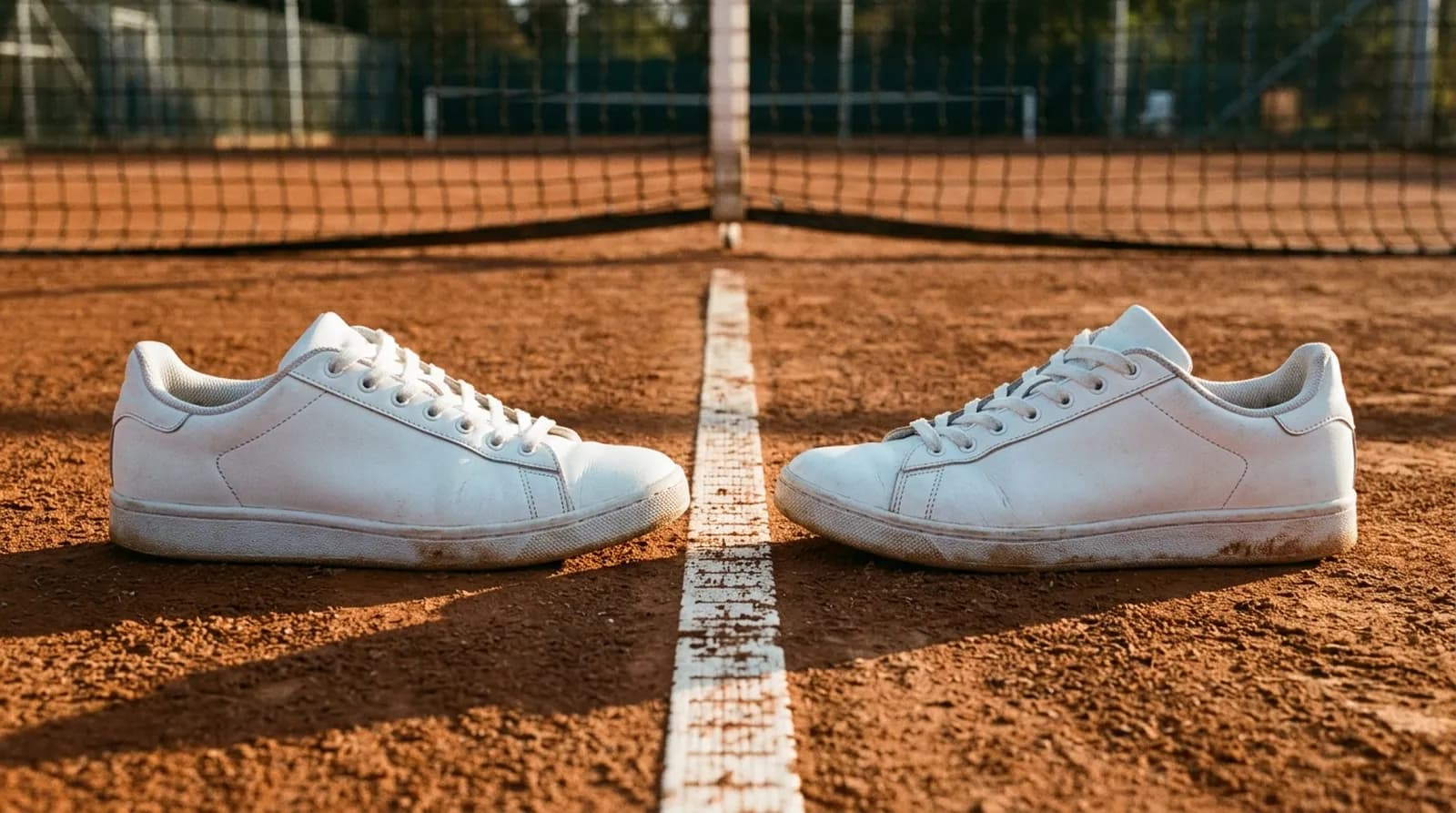
In Belgium, the first criterion carries more weight than elsewhere. More than eight courts in ten are crushed brick, according to RTBF, compared with 16 % in France. And when winter arrives, clubs move under domes or indoors, onto GreenSet or carpet.
What surface do you play on, and which outsole does it need?
The surface determines the outsole pattern, and it is the criterion that is hardest to make up for later. A clay-court shoe has deep herringbone along its entire length: it clears the crushed brick and lets you slide in a controlled way. An all-court shoe has modified herringbone, rounder and shallower. It works everywhere, but grips less well on clay, according to the guide published by Head.
Indoors, the logic is reversed. On carpet, Decathlon Belgium recommends a completely smooth, non-marking sole: too much tread grips the floor, and that is when the ankle rolls. Sand-filled artificial grass needs an omni sole with small nubs. Sportzorg, the Dutch sports injury prevention body, explicitly advises against wearing clay-court shoes on it.
| Surface | When it is played in Belgium | Outsole to choose | Models mentioned |
|---|---|---|---|
| Crushed brick (clay) | Mostly summer, outdoors | Deep herringbone across the whole sole | Nike Vapor 12 Clay, Nike GP Challenge 1.5 Clay, Asics Gel-Resolution X Clay, Adidas Barricade Clay |
| Hard court and acrylic (GreenSet) | Indoor halls and domes in winter, a few outdoor courts | All-court, hard rubber, toe reinforcement | Nike Vapor Pro 3, Nike GP Challenge Pro, Asics Gel-Resolution X, Adidas Barricade 14, Wilson Rush Pro 5 |
| Carpet | Winter indoor halls | Smooth, no tread, non-marking | Asics Gel-Dedicate 9 carpet version, the "tapijt" section on TennisDirect.be |
| Sand-filled artificial grass | Some clubs | Omni, small nubs | Adidas GameCourt 2 Omnicourt, K-Swiss BigShot Light 3 Omni |
A single all-court pair can cover summer on crushed brick and winter under a dome, but only moderately well.
Are you quick around the court or solid from the baseline?
Two families share the market. Speed shoes are light, low and responsive. Stability shoes are heavier, wider at the base and handle lateral braking better.
At Nike, the Vapor 12 is the archetype of the first family: around 414 g in a men's US 10.5 according to Tennis Warehouse, a 9.9 mm drop and Air Zoom cushioning in the heel. It suits the attacking player who comes to the net and wants to feel the court. At the other end, the GP Challenge 1.5 weighs around 456 g in the same size, with Air Zoom in the heel and forefoot and a TPU plate for stability; it is Frances Tiafoe's shoe. In between, the Vapor Pro 3 (around 425 g, 8.6 mm drop) is the range's middle ground.
At Asics, the Solution Speed FF 4 (around 371 g) goes for speed and the Gel-Resolution X for stability. At Adidas, the Adizero Ubersonic 5 (around 388 g) faces off against the Barricade 14. Babolat offers the Jet Mach 4 (around 369 g) for speed and the Propulse Fury 3 for stability.
One thing product pages stay quiet about: lightness comes at the cost of lifespan. Tennis Companion says it bluntly: lightweight shoes generally do not last as long, and a heavy or powerful player is better off choosing a stable base. If you weigh 90 kilos and hit hard from the back of the court, the lightest shoe on the shelf is not the shoe for you.
How many hours should your outsole last?
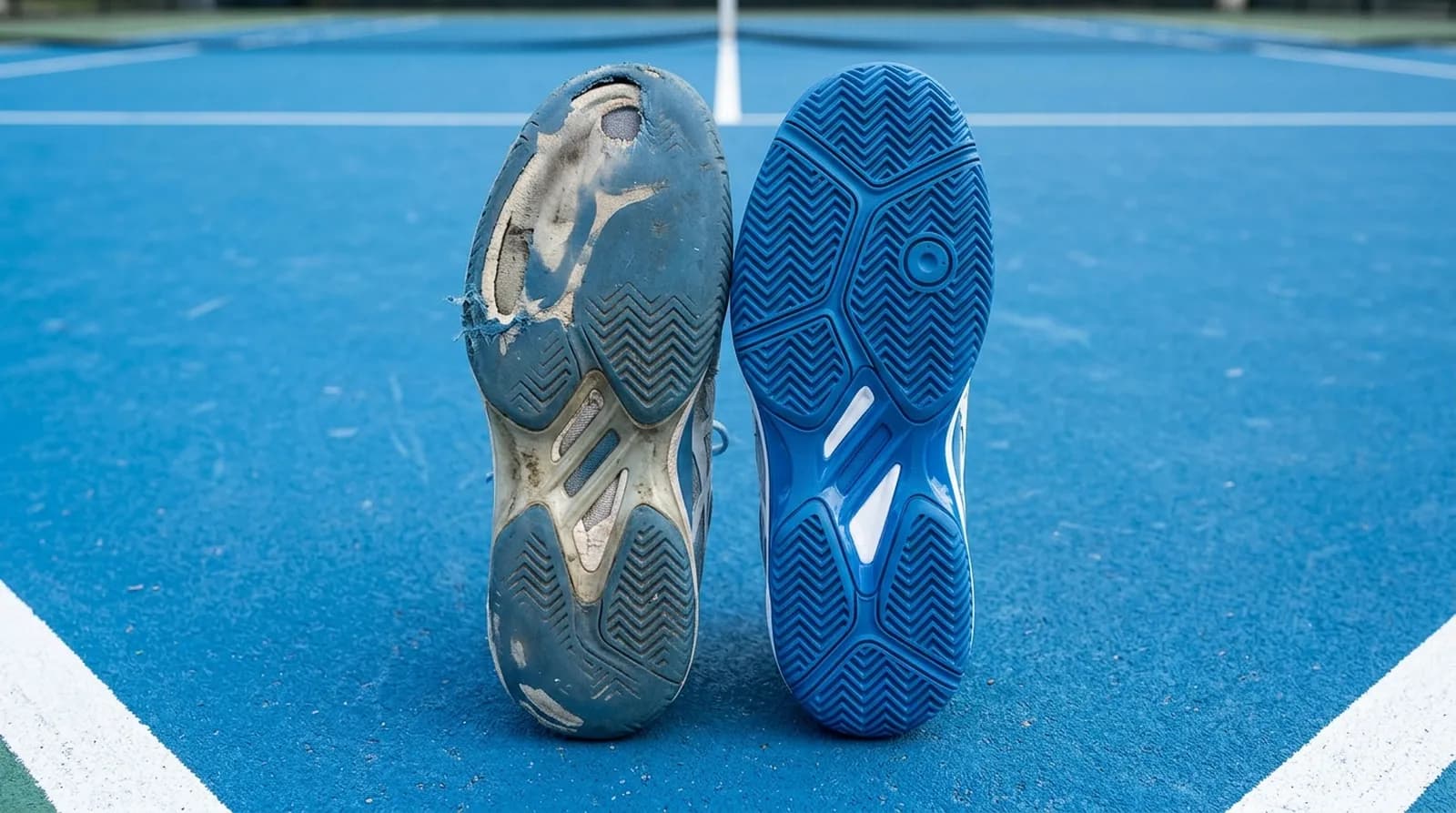
This is the criterion that weighs most over a year, and the one product pages highlight least. The American Academy of Podiatric Sports Medicine considers a midsole worn out after 45 to 60 hours of tennis. The USTA draws a simple rule from that: one hour of play a week means at least one pair a year. The signs of wear and the calculations for each type of player are set out in our article on how long tennis shoes last.
The outsole, meanwhile, does not wear at the same pace for everyone. Three factors speed it up: the player's weight, sliding on hard courts, and toe drag, when the back foot drags on the serve and scrapes the toe (for a right-hander, the inside of the right shoe goes first). On this front, Nike models are not all equal.
- The Vapor Cage 4 scores 4.5/5 for outsole durability and 4.5/5 for the toe at Tennis Warehouse, which calls it the most durable Nike in the range. Its outsole wraps up over the toe and the inner side. The only catch: it is an older generation, sold as end-of-line stock, with limited availability in Belgium.
- The GP Challenge 1.5 has denser high-abrasion rubber under the inner forefoot, plus a rubber reinforcement on the inside of the toe cap.
- The Vapor Pro 3 uses Hart rubber on the outsole, toe and eyelets, at an average price seen of around €117.
- The GP Challenge Pro shows a 0.6 mm dent in RunRepeat's Dremel test, around average, with hard 87.5 HC rubber.
- Finally, the Vapor 12 has lost a good deal of its rubber to save weight. It keeps a large drag guard on the toe cap and remains tougher than most lightweight shoes, but it is not designed to last the longest.
Among other brands, the Asics Gel-Resolution X wears 0.3 mm less than average in the same test, thanks to its AHAR Plus rubber. The Adidas Barricade 14 splits opinion: Tennis Companion finds its new Lighttraxion outsole less hard-wearing, while RunRepeat measures a good score (0.6 mm against an average of 0.8 mm on the same page). Babolat's Propulse Fury 3 relies on Michelin rubber.
Be wary of the "6-month outsole warranty" argument. It is mainly offered by Tennis Warehouse, for purchases from that retailer, and the toe cap and upper are excluded. Tennis Warehouse Europe refers you to the manufacturer's warranty, which covers defects and not normal wear. Babolat is the only brand with its own programme, on the Propulse Fury All Court, with no confirmation that it applies in Belgium.
Should you prioritise cushioning or court feel?
It depends on your level and your joints. Decathlon points out that a tennis shoe has a thinner midsole than a standard trainer, so you can feel the ground and control your footwork. For a beginner, the retailer recommends a flexible, comfortable shoe; for an experienced player, durability and cushioning.
The GP Challenge 1.5 puts Air Zoom in the heel and forefoot, on a TPU plate. The Vapor 12 gives a close-to-the-ground feel, with no break-in period according to RunRepeat. Outside Nike, the New Balance Fresh Foam X CT-Rally v2 takes cushioning a long way, with a 13.1 mm drop and a thick platform that dulls some of the court feel. At the opposite end, the Adizero Ubersonic 5 has almost no cushioning, and your knees will notice.
Sensitive knees or plantar fasciitis? Look for a firm heel counter, a rigid midfoot and good arch support. Asics' Gel-Resolution series and New Balance's CT-Rally come up often in these recommendations.
And foam, however good, compresses. Squeeze the back of your old pair: if the two sides of the heel counter touch, it no longer holds your heel.
What size and width should you go for?
Leave about a thumb's width, or 0.9 to 1.3 cm, between your longest toe and the end of the shoe. The rest comes down to a few rules.
- Try shoes on at the end of the day, when your feet have swollen, and with your tennis socks.
- Check each brand's size guide, including width: the same size does not fit the same from one brand to the next.
- The Nike Vapor 12 is true to size in length but narrow, with a low arch. RunRepeat advises against the Vapor Lite 3 for wide feet. The GP Challenge Pro, with its wider base, is better suited to a foot that needs room.
- Wide versions available: Asics Gel-Resolution X in 2E, Adidas Barricade 14 in Wide, New Balance 996 and CT-Rally in 2E, New Balance 806 in 2E and 4E. The Babolat SFX 4 has a roomier forefoot.
- Adidas recommends going up half a size for the Adizero Ubersonic 5, and some reviewers do the same for the Yonex Eclipsion 5.
Women's models are not simply smaller men's models: they are built on their own last, with a narrower heel and a lower instep, which reduces heel slip. For children, Asics offers the Gel-Resolution X GS on a last designed for growing feet.
How much does a good pair cost in Belgium?
Expect to pay between €60 and €190 depending on the range. Here are the average prices seen on the Belgian market between June and September 2026, Nike first, then Asics, Adidas and the other brands.
| Model | Profile | Average price seen in BE | Cost per hour (45 to 60 h) |
|---|---|---|---|
| NikeCourt Lite 4 | Occasional recreational player | €67 | €1.10 to €1.50 |
| Nike Vapor Lite 3 | Beginner, club player on a tight budget | €70 | €1.15 to €1.55 |
| Nike GP Challenge Pro | Regular club player, stability | €97 | €1.60 to €2.15 |
| Nike Vapor Pro 3 | Hard-court slider | €117 | €1.95 to €2.60 |
| Nike GP Challenge 1.5 | Powerful baseliner | €125 | €2.10 to €2.80 |
| Nike Vapor 12 | Fast attacking player | €159 | €2.65 to €3.55 |
| Asics Gel-Dedicate 9 | Beginner | €61 | €1.00 to €1.35 |
| Asics Gel-Resolution X | Baseliner, bigger build | €130 | €2.15 to €2.90 |
| Adidas Barricade 14 | Baseliner, stability | €117 | €1.95 to €2.60 |
| On The Roger Pro 3 | Fast, premium range | €187 | €3.10 to €4.15 |
Cost per hour divides the price by the average lifespan of the midsole. It does not account for an outsole worn through early: for a player who drags their foot, a lightweight pair can give up sooner and push the bill up.
There are three ways to pay less. The winter sales ran from 3 to 31 January 2026 and the summer sales start on 1 July; in any case, discounts are possible all year round since the Council of State overturned fines linked to the word "sales". A new version brings the old one down in price: the Barricade 13 was selling for around €109, against €117 for the 14. Finally, TennisDirect.be has an outlet section for shoes and Decathlon Belgium sells second-hand.
Zalando cut its return window in Belgium from 100 to 30 days in February 2025, so try your shoes on promptly.
Nike, Asics, Adidas or On: which brand should you choose?
Choose a model rather than a brand: each one has a speed shoe and a stability shoe, and it is the rubber that makes the difference in lifespan. Here is what published tests say about each.
Nike has the widest range, from the NikeCourt Lite 4 (67 € on average in Belgium) to the Vapor 12 (159 €). Tennis Warehouse names the Vapor Cage 4 as the brand's most durable model, and RunRepeat rates the durability of the GP Challenge Pro on a par with more expensive models.
Asics relies on AHAR Plus rubber and PGUARD reinforcement: the Gel-Resolution X wears 0.3 mm less than average in RunRepeat's test, at the cost of being one of the heaviest shoes on the market.
Adidas relies on the Adiwear rubber of the Barricade. The Barricade 14 splits testers on durability, and the Barricade 13 is sold as containing at least 20% recycled materials.
On sells The Roger Pro 3 at around 187 € in Belgium, the highest average price in the price table above. A Gear Patrol review of the first-generation Roger Pro reported an outsole that wore faster than expected on hard courts.
Which mistakes cost you a pair?
One is enough to undo every other choice you made.
- Buying a clay-court shoe to play all winter on sand-filled artificial grass.
- Picking the lightest model on the shelf when you are heavy or slide a lot on hard courts.
- Trying shoes on in the morning, barefoot or in everyday socks.
- Counting on a 6-month outsole warranty for a pair bought in a Belgian shop.
- Keeping the same pair for more than a year: the AAPSM recommends replacing any sports shoe older than a year, even if it looks intact, because the materials dry out.
Which Nike suits which player, and what are the alternatives?
The models are rated one by one in the tennis shoe rankings, and you can put several side by side in the comparison tool. If you are still unsure, the quiz asks three questions (profile, surface, budget) and our choosing guide goes through each player profile. The Nike Vapor 12 review and the Nike Vapor 12 vs Asics Solution Speed FF 4 head-to-head complete the picture for fast players. The full range is on the Nike page.
Sources
- AAPSM, When to replace athletic shoes
- USTA, When is it time to buy a new pair of tennis shoes
- RTBF, Clay at the heart of Belgian tennis (in French)
- Head, Clay court tennis shoes
- Sportzorg, Tennis shoes and court types (PDF, in Dutch)
- Decathlon Belgium, Men's tennis shoes
- Tennis Warehouse, Nike Vapor Cage 4 review
- Tennis Warehouse, Nike Vapor 12 review
- Tennis Warehouse, Nike GP Challenge 1.5
- RunRepeat, Nike GP Challenge Pro
- RunRepeat, Nike Vapor 12
- Tennis Companion, Lightweight tennis shoes
- Tennis Companion, Adidas Barricade 14
- Tennis Warehouse, Wide tennis shoes
- Tennis Warehouse Europe, Warranties
- Babolat, Six-month outsole warranty
- ASICS, Shoe care tips
- Test-Achats, Sales all year round in Belgium (in French)
- Adidas, Barricade 13
- Gear Patrol, On The Roger Pro review
Your questions
Frequently asked questions
Can you play tennis in running shoes?
No. A running shoe is built to move in a straight line and does not give the lateral support that tennis footwork demands. It puts you at risk of an ankle sprain.
Do you really need two pairs of tennis shoes in Belgium?
For a regular player, yes. Summer is mostly played on crushed brick, which needs deep herringbone, and winter indoors, on carpet or GreenSet, which need a smooth or all-court sole. A single pair for both seasons is a compromise on one of the two surfaces.
Which Nike tennis shoe should you choose if you wear out outsoles quickly?
The GP Challenge 1.5, with its denser rubber under the inner forefoot and reinforced toe, or the Vapor Pro 3. The Vapor Cage 4, rated 4.5/5 for outsole durability by Tennis Warehouse, remains the brand's benchmark, but availability in Belgium is limited.
How many hours does a tennis shoe last?
The AAPSM and the USTA put it at 45 to 60 hours of play before the midsole is worn out. The outsole can go sooner for a player who drags their foot on the serve.
Do tennis shoes run small?
It depends on the model. Adidas recommends going up half a size for the Adizero Ubersonic 5, and the Nike Vapor 12 is true to size in length but narrow. Check each brand's size guide, including width.
Does the 6-month outsole warranty apply in Belgium?
Rarely. The most widely cited warranty is Tennis Warehouse's in the United States, valid for purchases from that retailer. Babolat has a brand programme on the Propulse Fury All Court, but it is not confirmed to apply in Belgium.
Which tennis shoes should a beginner choose?
A flexible, comfortable shoe, which is what Decathlon recommends for beginners. In the Nike range, the NikeCourt Lite 4 (67 € on average in Belgium) and the Vapor Lite 3 (70 €) target this profile; from Asics, the Gel-Dedicate 9 sits around 61 €. Still buy a proper tennis shoe, never a running shoe.
Which tennis shoe offers the best value for money?
The Nike GP Challenge Pro is a strong candidate: RunRepeat rates its durability on a par with more expensive models while it costs less than average, and its average price observed in Belgium is around 97 €. Always compare the cost per hour of play, not just the price tag.
Is a 70 € pair better value than a 160 € pair?
It depends on how many hours you play. Over 45 to 60 hours, a 70 € pair works out at roughly 1.15 to 1.55 € per hour and a 160 € pair at roughly 2.65 to 3.55 €. For beginners and recreational players, an entry-level pair is enough; a heavy player or one who drags their foot on the serve should pay for more rubber.