Buying guides
Tennis Shoes for Artificial Grass: Which Outsole to Pick?
Tennis shoes for sand-filled artificial grass need an omni outsole with small studs, not herringbone. Models, prices and lifespan: 45 to 60 hours of play.
Contents · 12 sections
- Key takeaways
- Which tennis shoes for artificial grass, in short?
- Sand-filled artificial grass: what surface are we talking about?
- Why an omni outsole with small studs?
- Can you play on it in all-court, clay or padel shoes?
- Does Nike make a tennis shoe for artificial grass?
- Which omni tennis shoes can you find in Belgium?
- How long does an outsole last on artificial grass?
- Which pair for your situation?
- Sources
- FAQ
- Related articles
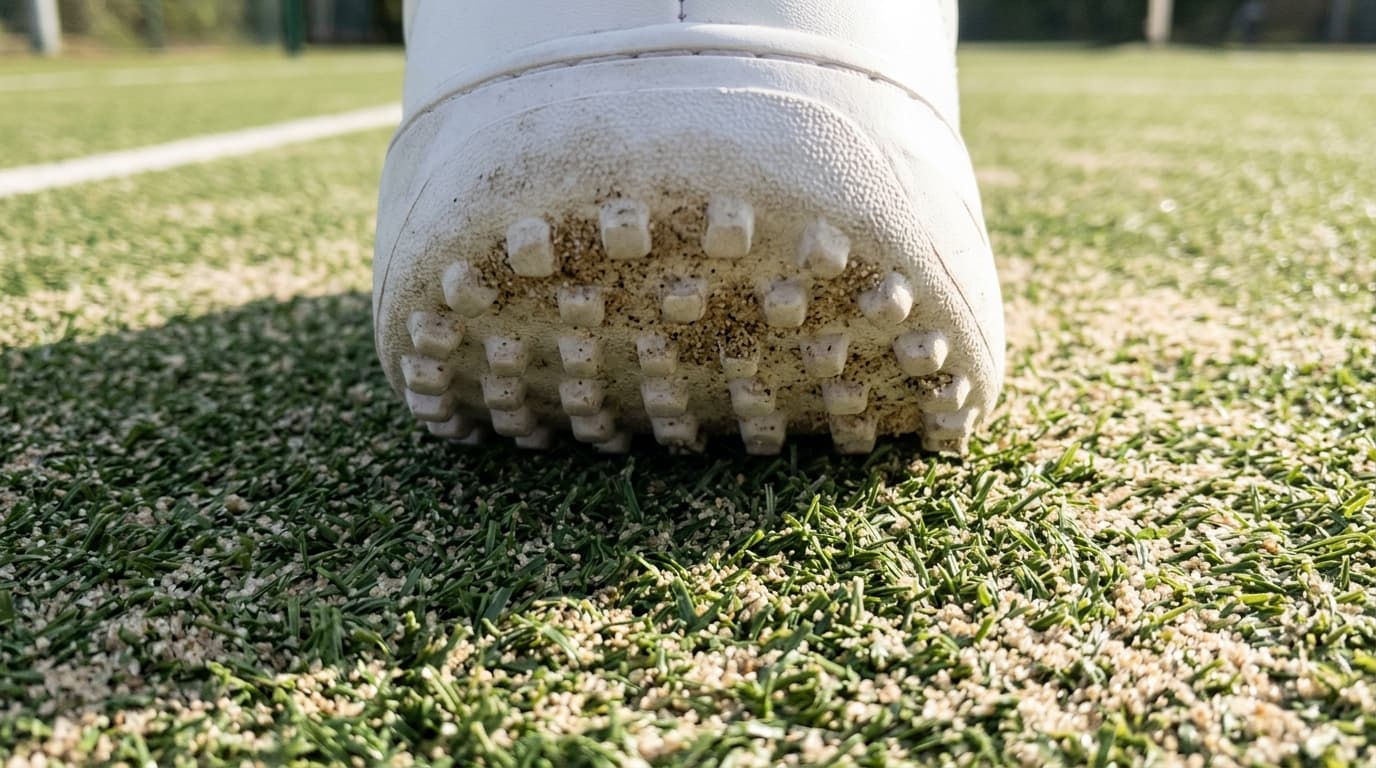
On sand-filled artificial grass, a tennis shoe needs an omni outsole: small studs across the whole sole, in place of herringbone. That is the outsole the Dutch organisation Sportzorg recommends for this often slippery surface. It is rare on Belgian shelves, and no Nike in our database offers it.
That is the answer. The rest of the page is there to help you find the pair.
Which tennis shoes for artificial grass, in short?
Six rows, Nike first as always, even when the row is empty.
| Model | Outsole | Durability of the model | Average price in Belgium (June-Sept. 2026) |
|---|---|---|---|
| Nike (the 7 models in our database) | no omni or grass version listed | not applicable | not applicable |
| Adidas GameCourt 2 Omnicourt | omni, small studs | not rated (previous generation) | to be checked |
| Adidas Barricade 14, grass version | grass | 7.0/10 | around €117 |
| K-Swiss BigShot Light 3 Omni | omni, Aosta 7.0 rubber | not rated | to be checked |
| Wilson Rush Pro 5, grass version | grass | 7.4/10 | around €107 |
| Babolat Jet Mach 4, grass version | grass | 6.4/10 | around €104 |
The scores come from our editorial grid, compiled from the tests published by RunRepeat, Tennis Warehouse and Tennisnerd. They apply to the model, all outsoles combined, and the prices are averages across versions. I have not worn any of these pairs.
Two omni models are not rated: they are not among the 37 models in our database. I prefer an empty cell to an invented score.
Sand-filled artificial grass: what surface are we talking about?
A carpet of synthetic fibres weighted down with sand, which is grass in name only. The ITF makes it a family of its own in its classification of surfaces, category C, separate from natural grass, carpet and clay.
It is a fast surface. The same body places it at level 5 of its pace scale, the highest, with grass and carpet. Clay is at level 1.
In Belgium, it remains a minority surface. More than eight courts in ten are clay, notes the RTBF. So if you are reading this page, your club is probably one of the exceptions, or you play regularly in the Netherlands, where the clearest source on the subject comes from.
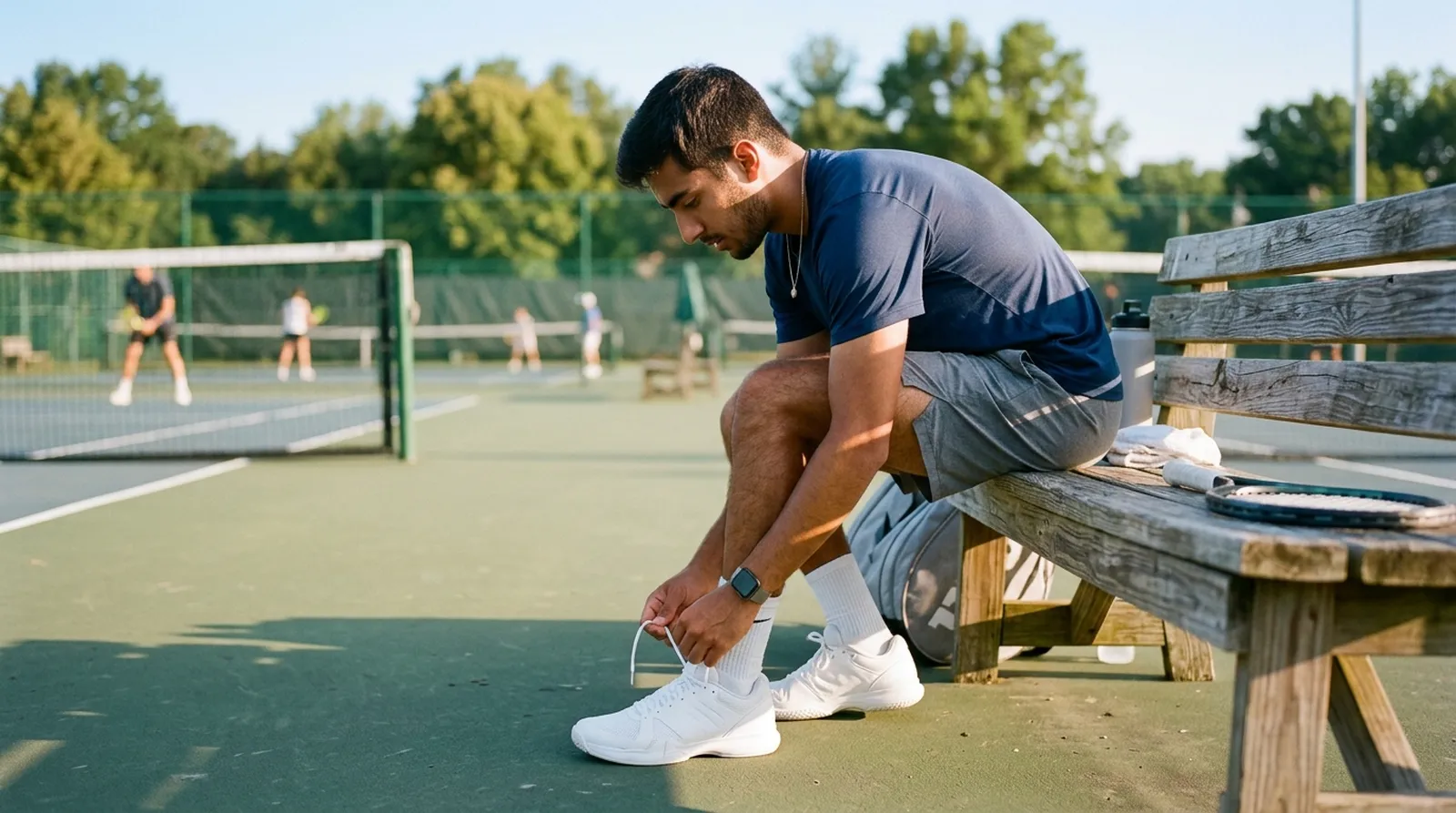
Why an omni outsole with small studs?
Because the surface is slippery, and studs bite where herringbone skates.
The fact sheet from the Dutch organisation Sportzorg puts it simply: grass, natural or artificial, is often slippery, and small studs under the shoe give extra grip. It points out that there are shoes designed for these surfaces, with small studs, precisely to stop you from slipping.
You can understand the mechanism by looking at the ground. On clay, herringbone clears the clay and lets the foot slide in a controlled way. On sand-filled artificial grass, there is nothing to clear: the sand stays between the fibres. You need short, numerous contact points that sink a few millimetres into the carpet. That is exactly what an omni outsole does.
The same sheet adds a sentence that applies to this whole page. Each type of court calls for a different outsole, and a competitive player generally needs several pairs.
That leaves the question of injury. Sportzorg cites an ATP study from 1995: the physiotherapist was called 0.42 times per match on hard courts, 0.37 times on grass and 0.20 times on clay. These figures concern the professional tour and natural grass, not the artificial grass of a club. They say one thing: the surface matters, and the outsole is part of the surface.
Can you play on it in all-court, clay or padel shoes?
An all-court shoe will do in a pinch. A clay shoe is not made for it. A padel shoe is a different object.
The all-court tennis shoe. Its herringbone is modified, more rounded and shallower than that of a clay outsole, explains Head. It is drawn for hard courts, versatile elsewhere, a specialist nowhere. For an hour now and then on an artificial grass court, it does the job if the club accepts it. For playing there every week, no.
The clay shoe. Its deep herringbone is made to clear the clay, and its rubber is often softer, notes Tennis Companion. Neither quality is of any use on a sand-filled carpet.
The padel shoe. The subject is confusing, because padel courts are sand-filled artificial grass too. A specialist retailer, Padelshop, in fact presents herringbone as the first choice on this surface, when tennis sources recommend omni. The two sports do not ask for the same footwork. According to Wilson, the difference between the two shoes lies in the outsole and in where the reinforcements sit, and the brand advises against swapping one for the other.
I am not settling that disagreement on behalf of your club. I note that Sportzorg, which writes for tennis players, talks about studs.
Does Nike make a tennis shoe for artificial grass?
Not in our records.
The seven Nikes in our database exist in an all-court version, six of them in a clay version too. None is listed in an omni version, or in a grass version. On this surface, then, the right shoe is not a Nike, and it is better to write that than to recommend a Vapor where it has no business.
Nike keeps its place on your other courts. For a recreational player on a tight budget who alternates clay in summer and artificial grass for part of the year, the Nike Vapor Lite 3, around €70 in Belgium, exists in all-court and in clay, and the Nike Court Lite 4, around €67, in all-court. Either one makes the main pair. The omni pair comes on top.
Which omni tennis shoes can you find in Belgium?
Few, and you have to read the product pages closely. Here are the ones I was able to identify.
Adidas GameCourt 2 Omnicourt. The small-stud version of Adidas's entry-level shoe. It is the previous generation: the GameCourt 3 in our database, rated 6.8/10 overall and 5.5 for durability, is listed in all-court, for around €62 in Belgium. Those scores do not carry over as they stand to another generation and another outsole. Ask the retailer whether any Omnicourt is left in your size, or whether an omni version exists for the current generation.
K-Swiss BigShot Light 3 Omni. An omni outsole in Aosta 7.0, the rubber the brand uses on its hard court models. The British retailer Tennisnuts lists it. The K-Swiss page details the range.
K-Swiss Receiver V Omni. This is the Belgian lead: TennisDirect.be lists it in men's and women's. It is not in our database, so I give it no score, and its price is to be read on the page on the day you buy.
Three models in our database also exist in a grass version: the Adidas Barricade 14, the Wilson Rush Pro 5, which Tennis-Point.be displays as a ‘grasschoen’, and the Babolat Jet Mach 4. A grass outsole has studs too, and Sportzorg puts grass shoes and artificial grass shoes in the same sentence. It is still not an omni outsole in the strict sense: it is drawn for natural grass. Before buying one for a sand-filled carpet, put the question to the club.
In every case, read the title of the product page before paying. The same model, in the same colourway, often exists in three or four outsoles. Only the words ‘omni’, ‘omnicourt’, ‘kunstgras’ or ‘sand-filled’ guarantee the studs.
How long does an outsole last on artificial grass?
The cushioning decides, not the rubber: 45 to 60 hours of play.
No pair is judged without the lifespan of its outsole, and here the data is missing. None of the sources consulted publishes a wear measurement on sand-filled artificial grass. RunRepeat's abrasion tests and Tennis Warehouse's scores concern hard court outsoles. So I am not going to give you a number of hours for studs.
What is established holds for every surface. The AAPSM, the American academy of podiatric sports medicine, considers a midsole worn out after 45 to 60 hours of tennis. The USTA uses the same range and adds a warning sign: grip that drops off.
On an omni outsole, that sign is visible. Turn the shoe over once a month. Studs worn flat under the forefoot, a patch gone smooth, and the pair no longer does its job, even if the upper looks new.
If your club plays outdoors all year round on this surface, the calendar is simple:
| Playing rhythm | Hours per year | Pairs per year |
|---|---|---|
| 1 hour a week | around 52 h | 1 |
| 2 hours a week | around 104 h | 2 |
| 3 hours a week | around 156 h | 3 |
The price that matters is the price per hour of play. On the basis of 45 to 60 hours, with the average prices recorded in Belgium:
| Model | Average price | Cost per hour of play |
|---|---|---|
| Adidas Barricade 14 | €117 | €1.95 to €2.60 |
| Wilson Rush Pro 5 | €107 | €1.80 to €2.40 |
| Babolat Jet Mach 4 | €104 | €1.75 to €2.30 |
| An omni pair at €60 | €60 | €1.00 to €1.35 |
Which pair for your situation?
- Your club has sand-filled artificial grass and you play there every week: a pair with an omni outsole. Adidas GameCourt 2 Omnicourt if you can find it, otherwise a K-Swiss omni.
- You play there a few times a year, at away matches: your all-court pair, after a phone call to the club you are visiting.
- You alternate clay and artificial grass: two pairs. A Nike Vapor Lite 3 in the clay version for the summer, around €70, and an entry-level omni.
- You also play on natural grass: a grass version, Adidas Barricade 14, Wilson Rush Pro 5 or Babolat Jet Mach 4.
- You come from padel: keep your padel shoes for padel.
✓ Pros
- Short, numerous studs, made for a slippery surface
- Outsole recommended by Sportzorg for grass and artificial grass
- Exists at entry level from Adidas and K-Swiss
✗ Cons
- No version from Nike in our records
- Few models on the shelf in Belgium, prices to be checked page by page
- No published measurement of the lifespan of the studs
The other surfaces have their own page: which shoes to choose on clay, indoors on carpet, and wear on clay and on hard courts. On a tight budget, the best-value ranking and the beginners ranking order the cheapest models, and the overall ranking puts it all in context. The six basic criteria are in how to choose tennis shoes, and the buying guide sorts by profile.
Sources
- Sportzorg, tennis shoes and court types
- ITF, surface types
- ITF, surfaces classified by pace
- RTBF, clay at the heart of Belgian tennis
- Head, everything you need to know about clay court tennis shoes
- Tennis Companion, clay court tennis shoes
- Padelshop, outsole types: herringbone, omni, hybrid
- Wilson, padel shoes vs tennis shoes
- Tennisnuts, K-Swiss BigShot Light 3 Omni
- TennisDirect.be, K-Swiss Receiver V Omni
- Tennis-Point.be, Wilson Rush Pro 5 grass version
- AAPSM, when to replace your sports shoes
- USTA, when is it time to buy a new pair of tennis shoes
Your questions
Frequently asked questions
Which tennis shoes do you need on artificial grass?
A shoe with an omni outsole, covered in small studs. According to Sportzorg, grass, natural or artificial, is often slippery, and the studs stop you from slipping. The omni models identified are the Adidas GameCourt 2 Omnicourt and the K-Swiss BigShot Light 3 Omni and Receiver V Omni.
Can you play on artificial grass in all-court tennis shoes?
They will do in a pinch, but they are not made for it. Their modified herringbone is designed for hard courts. Sportzorg notes that each type of court calls for a different outsole: if you play on sand-filled artificial grass every week, get an omni outsole.
Does Nike make tennis shoes for artificial grass?
None of the seven Nikes in our database is listed in an omni version or a grass version: they exist in all-court, and six of them in clay. On this surface, the right shoe is not a Nike in our records.
How long do tennis shoes last on artificial grass?
Count 45 to 60 hours of play for the cushioning, according to the AAPSM. None of the sources consulted publishes a measurement of rubber wear on artificial grass. The sign to watch for is simple: studs worn flat under the forefoot.
How much does a pair of tennis shoes for artificial grass cost?
The three models in our database that exist in a grass version cost around €104 to €117 in average prices recorded in Belgium between June and September 2026, or €1.75 to €2.60 per hour of play. The price of omni versions has to be checked on the retailer's page.