Buying guides
Tennis Shoes for Clay Courts: Which Ones to Choose?
Tennis shoes for clay courts need a deep herringbone outsole: Nike Vapor 12 first, Vapor Lite 3 from €70. Cushioning wears out after 45 to 60 hours.
Contents · 14 sections
- Key takeaways
- Which shoes for red clay, in short?
- Why do you need a special outsole on red clay?
- Can you wear all court or hard court shoes on clay?
- Which Nike shoes come in a clay version?
- Nike, Asics or Adidas: which brand for red clay?
- How long does an outsole last on red clay?
- Will a padel shoe do the job?
- And in winter, indoors?
- How do you look after the outsole after red clay?
- Which shoe for which clay court player?
- Sources
- FAQ
- Related articles
For tennis shoes for clay courts, take the clay version of the model that fits you: an outsole with deep herringbone from heel to toe. At Nike, the Vapor 12 is the top-rated shoe in that version, and the Vapor Lite 3 the cheapest, at around €70. At Asics, look at the Gel-Challenger 15 and the Gel-Resolution X.
The model matters less than the outsole. A €70 pair in a clay version grips better on your club court than a €160 pair built for hard courts.
Which shoes for red clay, in short?
Five models sold in a clay version in Belgium, Nike first. Prices are averages recorded in Belgium between June and September 2026.
| Model | Clay version | Grip | Durability | Weight (men's) | Average price in Belgium |
|---|---|---|---|---|---|
| Nike Vapor 12 | yes, herringbone across the whole outsole | 9.4/10 | 7.2/10 | 414 g (US 10.5) | around €159 |
| Nike GP Challenge Pro | yes | 8.8/10 | 8.2/10 | not disclosed | around €97 |
| Nike Vapor Lite 3 | yes | 8.2/10 | 7.0/10 | not disclosed | around €70 |
| Asics Gel-Resolution X | yes, Clay version sold separately | 8.8/10 | 9.0/10 | 425 g (US 9) | around €130 |
| Asics Gel-Challenger 15 | yes | 8.2/10 | 8.0/10 | 414 g (US 10.5) | around €109 |
These ratings come from our editorial grid, compiled from the tests published by RunRepeat, Tennis Warehouse and Tennis Companion. I have not worn any of these pairs.
The table stops at five models because it answers one profile: the club player who plays one or two hours a week, in summer, without wanting to pay for the top of the range. The eight models ranked by overall score are in the clay court tennis shoes ranking.
Why do you need a special outsole on red clay?
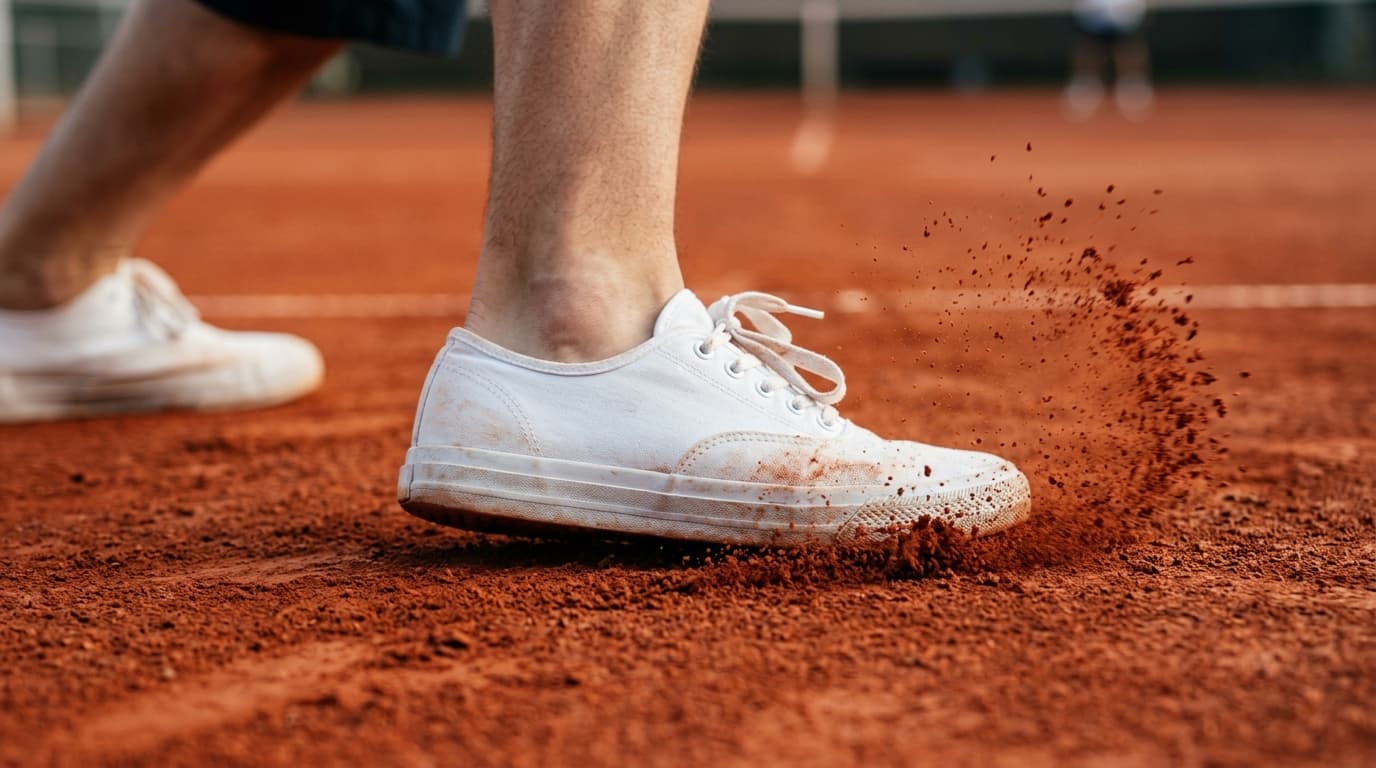
Because you brake by sliding, on a layer of loose clay.
According to HEAD, clay court tennis shoes have deep herringbone across the whole outsole, which clears the clay. Herringbone is a zigzag groove. When it is deep, the clay falls out at every step; when it is shallow, it clogs, and the outsole becomes a smooth surface resting on dust.
The question matters more in Belgium than elsewhere. More than eight courts out of ten there are red clay, against 16% in France, according to RTBF. If you play at a Belgian club between April and September, it is almost certainly on this surface.
On the rubber itself, sources do not say the same thing. Tennis Companion describes clay models as often having softer rubber, since the surface causes little wear; Tennis-Point.be, on the other hand, presents its clay shoes ("gravelschoenen") with harder rubber, to grip without the clay sticking. Everyone agrees on the deep herringbone pattern.
Can you wear all court or hard court shoes on clay?
Yes, as a fallback. Not for a whole season.
A hard court or all court tennis shoe has modified herringbone, rounder and shallower. HEAD describes it as versatile but less effective on clay. For one hour a month with friends, the difference is bearable. At two hours a week all summer, you might as well play on the outsole designed for that court.
The other way round causes more trouble:
- on hard courts (GreenSet, acrylic), a clay outsole is out of place: this is the most abrasive surface, and it calls for an all-court version;
- on carpet, you need a completely smooth, non-marking outsole, according to Decathlon Belgium: too much tread locks the foot and raises the risk of a sprain;
- on sand-filled artificial grass, you need an "omni" outsole with small studs, according to the Sportzorg sheet on shoes and court types.
The wear on the two surfaces is compared in the article clay or hard court: where does the outsole wear out.
Which Nike shoes come in a clay version?
Almost the whole range, from €70 to €160. Nike clay does not have to mean top of the range.
The Vapor 12 is the reference. Its clay version has herringbone across the whole outsole, and it scores 9.4/10 for grip, the best rating on our grid. It weighs 414 g in a US 10.5 and costs around €159 on average. Its limit is well known: Nike removed a large part of the rubber to make it lighter, hence 7.2/10 for durability. On red clay, that flaw weighs less than on hard courts. The Nike Vapor 12 review goes through this trade-off.
The GP Challenge Pro, at around €97, is the sensible middle: 8.8/10 for grip, 8.2/10 for durability, a widened base that adds stability. Tennis-Point.be lists it as a clay shoe. Its mesh damages easily, according to the reviews collected by RunRepeat.
The Vapor Lite 3 is the Nike for a tight budget. Around €70, 8.2/10 for grip, 7.0/10 for durability, and a clay version sold by Passasports. RunRepeat advises against it for wide feet. The Vapor Lite 3 review and the GP Challenge Pro review give the details.
Two other Nike shoes come in a clay version, the Vapor Pro 3 (around €117) and the GP Challenge 1.5 (around €125), both rated 8.6/10 for durability. They are aimed at the interclub player who keeps the pair for hard courts in winter. The Court Lite 4, for its part, is presented by Nike as an all-court shoe; Passasports lists a Clay version, to be checked in store: the outsole must have herringbone along its whole length.
The gap shows in grip and comfort, not in the rubber: 7.2 against 7.0. For a difference of €89.
Nike, Asics or Adidas: which brand for red clay?
Nike for choice, Asics for rubber, Adidas for stability.
Nike covers every budget in a clay version, and puts the Vapor 12 on top for grip. On the other hand, no outsole warranty has been identified for these models.
Asics has two candidates. The Gel-Resolution X is sold in a separate Clay version, with herringbone across the whole outsole and AHAR Plus rubber rated 9.0/10 for durability. It is heavy: 425 g in a US 9. The Gel-Challenger 15, at around €109, uses the same family of rubber with 8.0/10 for durability and comes in all-court and clay versions. For a recreational player, it is the most reasonable Asics clay shoe. See the Gel-Challenger 15 review and the Gel-Resolution X review.
Adidas offers the Barricade 14 (around €117), very stable (9.3/10) but with a Lighttraxion rubber that divides opinion, at 7.0/10 for durability. The Barricade 13, the previous generation, can be found at around €109 with Adiwear 2.0 rubber rated 9.0/10.
Men's or women's clay court tennis shoes: most of these models exist in both, with the same outsole. Women's versions are built on their own last, with a narrower heel.
To find clay versions in Belgium, two shops sort by surface: the "gravelschoenen" section of Tennis-Point.be and the clay section of Decathlon.be.
How long does an outsole last on red clay?
Longer than the cushioning, in most cases. No pair is judged without the lifespan of its outsole, and on this surface the answer is good news for a small budget.
Hard courts are very abrasive. Clay, which is softer, wears the outsole far less, according to Tennis Companion. The rubber of a pair played only on red clay therefore keeps its tread for a long time, even on a model rated 7.0/10.
The cushioning sets the limit. The AAPSM, the American Academy of Podiatric Sports Medicine, considers a midsole (the foam between your foot and the rubber) worn out after 45 to 60 hours of tennis. At two hours a week, that is five to seven months, roughly one summer season. At one hour a week, the pair lasts the year; the AAPSM then advises replacing it after a year anyway, because foams age even when resting.
The price that counts is the price per hour of play. On that basis of 45 to 60 hours:
| Model | Average price | Cost per hour of play |
|---|---|---|
| Nike Vapor Lite 3 | €70 | €1.15 to €1.55 |
| Nike GP Challenge Pro | €97 | €1.60 to €2.15 |
| Nike Vapor 12 | €159 | €2.65 to €3.55 |
| Asics Gel-Challenger 15 | €109 | €1.80 to €2.40 |
| Asics Gel-Resolution X | €130 | €2.15 to €2.90 |
On hard courts, a better-rated rubber justifies paying more. On red clay it does not: all five pairs run up against the same clock.
A word on the six-month outsole warranty you see quoted everywhere. It comes from the American retailer Tennis Warehouse, which covers the Gel-Resolution X for a purchase made from it, in the United States. It does not apply in Belgium, where the two-year legal guarantee covers defects, not wear.
Will a padel shoe do the job?
It can stand in on red clay, nothing more.
Many padel shoes have a herringbone outsole, close to that of a clay court shoe. The Gel-Resolution X and the Gel-Challenger 15 also exist in a padel version. But Wilson advises against swapping pairs: a padel shoe is reinforced on the outer side and at the midfoot, for rotations, whereas a tennis shoe is reinforced for lateral sprints and for the toe dragging on serve.
If you play both sports once a week, the padel pair will cope on red clay. It is made neither for hard courts nor for a heavy serve.
And in winter, indoors?
You need a second pair, or nearly.
Belgian clubs keep red clay mostly for summer, according to RTBF. Winter is played under a dome or indoors, on GreenSet or on carpet. On carpet, the outsole must be smooth: your deep herringbone grips too much there. On GreenSet, a hard surface, you need an all-court version.
On a small budget, the sums still work. Two pairs do not cost more per hour: each keeps its 45 to 60 hours, and you wear them out one after the other. TennisDirect.be even has a separate section for "tapijt" shoes, the ones made for carpet.
How do you look after the outsole after red clay?
Dry, before you leave the club. Knock the outsoles together, then run a brush through the grooves: clogged herringbone no longer clears anything.
After a damp clay court, take out the insole and stuff the shoe with newspaper, away from the radiator. The rest is in how to care for tennis shoes.
Which shoe for which clay court player?
- One or two hours a week, tight budget: Nike Vapor Lite 3 in a clay version, around €70, or €1.15 to €1.55 per hour.
- Same rhythm, looking for stability: Nike GP Challenge Pro, around €97, 8.8/10 for grip.
- Attacking game, bigger budget: Nike Vapor 12 in a clay version, 9.4/10 for grip, around €159.
- Loyal to Asics, mid price: Gel-Challenger 15, around €109, 8.0/10 for durability.
- Same pair for hard courts in winter: Asics Gel-Resolution X (9.0/10) or Nike Vapor Pro 3 (8.6/10), in an all-court version for indoor play.
✓ Pros
- Clay version sold in Belgium
- Around €70, or €1.15 to €1.55 per hour of play
- 8.2/10 for grip and 8.6/10 for lightness
- Rubber rated 7.0/10, enough on a surface that causes little wear
✗ Cons
- Not recommended for wide feet by RunRepeat
- Comfort rated 7.6/10, behind the Vapor 12 (8.8/10)
- Men's weight not disclosed
- No outsole warranty identified
The clay court tennis shoes ranking orders the eight models by overall score, and the overall ranking sets them against all-court models. To sort by criterion, use the comparison tool, the buying guide or the quiz. The six basic criteria are in how to choose tennis shoes.
Sources
- RTBF, clay at the heart of Belgian tennis
- HEAD, everything you need to know about clay court tennis shoes
- Tennis Companion, clay court tennis shoes
- Tennis-Point.be, clay court shoes
- Decathlon Belgium, clay court tennis shoes
- Decathlon Belgium, men's tennis shoes
- Sportzorg, tennis shoes and court types
- TennisDirect.be, carpet shoes
- Wilson, padel shoes vs tennis shoes
- Wilson, comparing padel shoes and tennis shoes
- AAPSM, when to replace athletic shoes
- Tennis Warehouse, Nike Zoom Vapor 12 review
- RunRepeat, Nike GP Challenge Pro
- RunRepeat, Nike Vapor Lite 3
- RunRepeat, Asics Gel-Resolution X
- Tennis Warehouse, Asics Gel-Resolution X product page
- Tennis Companion, Adidas Barricade 14
- Tennis Warehouse, 6-month outsole warranty
Your questions
Frequently asked questions
What outsole do you need for clay courts?
A herringbone outsole with deep grooves along its whole length. That pattern grips the clay and clears it instead of holding it, according to HEAD. An all-court outsole has modified herringbone, rounder and shallower: it will do as a fallback, but it is less effective on clay.
Can you wear hard court or all court shoes on clay?
Yes, as a fallback, for a few hours a month. Their modified herringbone fills with clay faster and grips less when you slide. The reverse is more of a problem: a clay outsole is not made for hard courts, carpet or sand-filled artificial grass.
Nike or Asics: which brand for clay courts?
Nike has the most models in a clay version, from the Vapor Lite 3 (around €70) to the Vapor 12 (around €159, 9.4/10 for grip). Asics has the best-rated rubber for durability with the Gel-Resolution X (9.0/10), and the Gel-Challenger 15 at around €109.
How long do tennis shoes last on clay?
The cushioning is worn out after 45 to 60 hours of tennis according to the AAPSM, whatever the surface. At two hours a week, that is five to seven months. The rubber wears far less on clay than on hard courts, according to Tennis Companion: it often still has tread when the pair needs replacing.
Do you need to spend €160 on shoes for clay?
No, not for one or two hours a week. A Nike Vapor Lite 3 at around €70 costs €1.15 to €1.55 per hour of play, a Vapor 12 at around €159 costs €2.65 to €3.55. On clay, the cushioning of both pairs reaches the same limit of 45 to 60 hours.