Buying guides
Tennis Shoes for Flat Feet: Which Model Should You Pick?
Tennis shoes for flat feet: firm heel counter, rigid midfoot, removable insole. Three models rated 7.8 to 9.3/10 for stability, from €125 in Belgium.
Contents · 12 sections
- Key takeaways
- Which tennis shoe for flat feet, in short?
- What should a tennis shoe have for flat feet?
- Which models to choose in 2026?
- Which shoes should you avoid?
- How do you try on a shoe with an orthotic insole?
- Are orthopaedic insoles refunded in Belgium?
- How long does the pair last when you wear an orthotic?
- The verdict
- Sources
- FAQ
- Related articles
For flat feet, choose a stable tennis shoe, not a soft one: firm heel counter, a midfoot that does not twist, arch support, a removable insole. Three models in our database tick those boxes, from 7.8 to 9.3/10 for stability, between €125 and €132 in Belgium.
One point before going further. I compile spec sheets and published tests, I am not a podiatrist. Lasting pain or the choice of an orthotic is a matter for a professional.
Which tennis shoe for flat feet, in short?
| Your situation | What to look for | Model in our database |
|---|---|---|
| Flat feet, no orthotic, baseline game | maximum stability, rigid plate at the midfoot | Nike GP Challenge 1.5 |
| Flat feet and orthotic insoles | removable original insole, enough inner volume | Nike GP Challenge 1.5 or Asics Gel-Resolution X |
| Flat and wide feet | 2E width | Asics Gel-Resolution X 2E, New Balance Fresh Foam X CT-Rally v2 |
| Cushioning above all | thick platform, high comfort | New Balance Fresh Foam X CT-Rally v2 |
| You wear through outsoles in three months | rubber rated 8.6/10 or higher | Nike GP Challenge 1.5, Nike Air Zoom Vapor Cage 4 |
| Pain that will not go away | an appointment, not a shoe | podiatrist or doctor |
The scores quoted on this page come from our editorial grid, compiled from tests published by RunRepeat, Tennis Warehouse and Tennis Companion.
What should a tennis shoe have for flat feet?
Four things, and none of them is cushioning.
The podiatrists at Michigan Foot Doctors set out the list in their 2026 guide to shoes for flat feet:
- A firm heel counter. That is the shell wrapping the back of the foot. Pinch it: if the two sides touch, it no longer holds the heel.
- A midfoot that resists twisting. The practice talks about a solid shank that resists torsion: the shoe bends at the front, not in the middle.
- A medial post and arch support. Denser foam on the inner side of the midsole slows the foot's collapse inwards.
- A removable insole, to take an orthotic, and several widths on offer. The same guide points out that a flat foot spreads sideways under load.
Tennis adds its own demand. You move sideways, brake, push off again. A running shoe, built to go in a straight line, does not have the lateral support required, flat feet or not.
Tennis Warehouse reaches the same conclusion by another route, in its guide to the most stable tennis shoes: stability models are heavier, wider at the base and firmer at the heel.
Which models to choose in 2026?
Nike first, then Asics, then New Balance.
| Model | Stability | Comfort | Durability | Weight | Widths | Average price in Belgium | Cost per hour of play |
|---|---|---|---|---|---|---|---|
| Nike GP Challenge 1.5 | 9.0/10 | 9.4 | 8.6 | 456 g in US 10.5 | standard | around €125 | €2.10 to €2.80 |
| Asics Gel-Resolution X | 9.3/10 | 8.4 | 9.0 | 425 g in US 9 | standard and 2E | around €130 | €2.15 to €2.90 |
| New Balance Fresh Foam X CT-Rally v2 | 7.8/10 | 8.8 | 7.2 | around 388 g | D and 2E | around €132 | €2.20 to €2.95 |
The Nike GP Challenge 1.5 is the first choice. Its midsole houses a TPU plate, its hold is described as locked-in, and it scores 9.0/10 for stability with the best comfort score in our database, 9.4. It weighs 456 g in a men's US 10.5: that is heavy, and it is the price of the support. Its fit is standard, with no wide version identified.
The Asics Gel-Resolution X is the most stable of the 37 models, at 9.3/10, level with the Adidas Barricade 14. Its Dynawall side reinforcement was extended on this generation, and it comes in a 2E width. It keeps turning up in guides on plantar pain, alongside the CT-Rally.
The New Balance Fresh Foam X CT-Rally v2 plays a different card. It is less stable, at 7.8/10, but more cushioned, with the thickest platform in its category according to RunRepeat, and it comes in D and 2E widths. For a flat foot that mostly needs room and foam, it makes sense. For a heavy player who changes direction hard, less so.
Two other leads. The Nike Air Zoom Vapor Cage 4, 9.2/10 for stability, is an older generation whose availability in Belgium needs checking. The K-Swiss Ultrashot 4 is the only model on this page for which I found an arch support score: 8.3/10 from the playtesters at Tennis Warehouse, who also describe it as wider than previous versions. It costs around €156.
Which shoes should you avoid?
Speed models, most of the time.
They are built to hug the foot and flex quickly. The Nike Vapor 12 is true to size in length, tight in width, with a low arch: it is an excellent shoe, 9.2/10 overall, and a poor candidate for a thick orthotic. The same reservation applies to very snug shoes, such as the Babolat Propulse Fury 3, whose strap tightens the midfoot.
Also avoid the shoe bought too big "for the insole". A foot that floats lengthwise slides at every stop.
How do you try on a shoe with an orthotic insole?
With the insole, precisely. In this order:
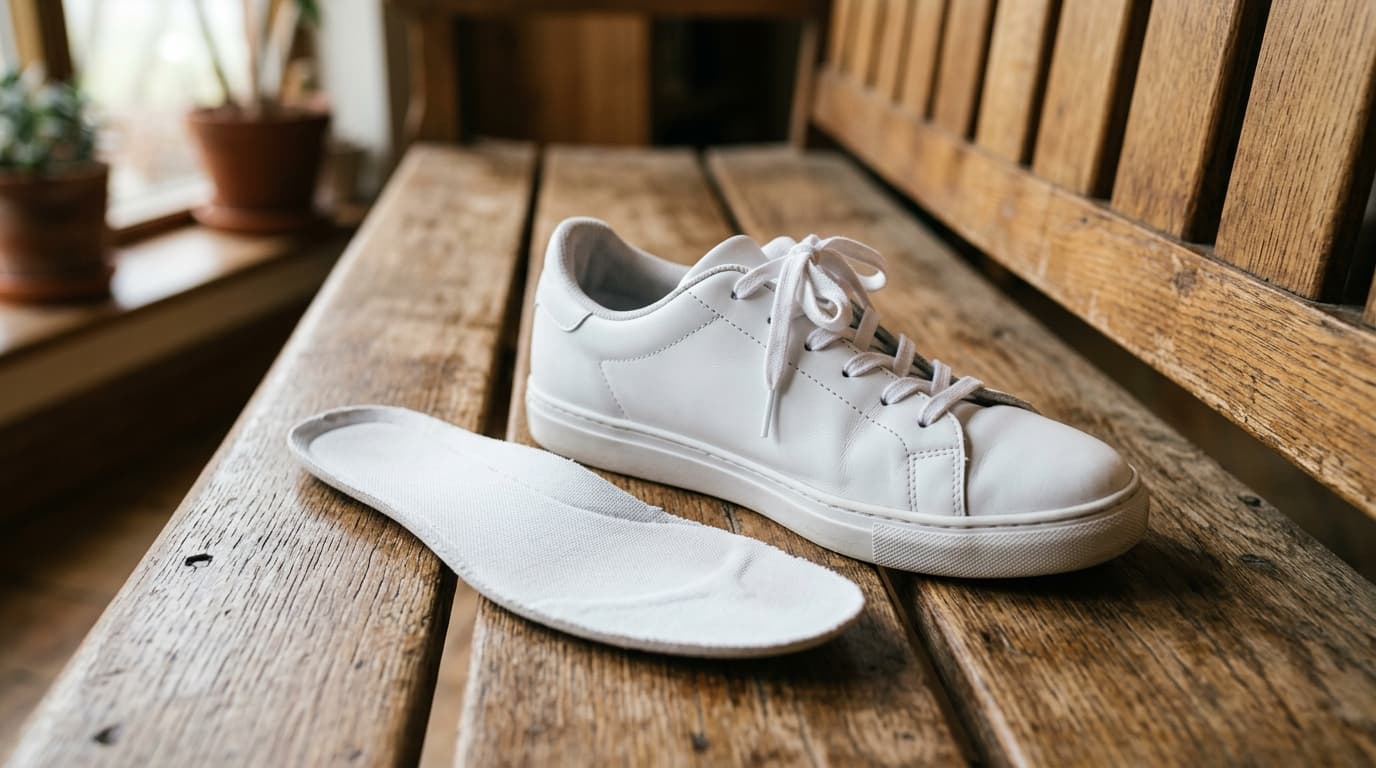
- Take out the original insole. If it is glued in, pick another model.
- Slide your orthotic in its place and check that it lies flat, without buckling at the heel.
- Try the shoe at the end of the day, when your foot has swollen, in your tennis socks.
- Check the length: a thumb's width, 0.9 to 1.3 cm, between your longest toe and the end.
- Take a few steps sideways. Your heel must not lift out of the counter.
An orthotic raises the foot inside the shoe. If your heel slips out, the model does not have enough volume, and a longer size solves nothing. Look for a 2E width.
Are orthopaedic insoles refunded in Belgium?
Partly, and it all depends on the type of insole.
The Test-Achats report, dated January 2024, separates two cases. Orthopaedic insoles, prescribed by a specialist doctor and supplied by an orthopaedic technologist, are refunded by compulsory insurance: €54.18 a pair from a contracted provider, €36.40 from a non-contracted one, renewable every two years for an adult and every year under 18. Podiatric insoles, made by a podiatrist without a prescription, are not. Some health insurance funds contribute through their supplementary cover, from €15 to €50 depending on the fund.
Those amounts date from 2024. Ask your health insurance fund for the current rate before ordering.
How long does the pair last when you wear an orthotic?
Not as long as the orthotic, and that is the good news.
A standard insole lasts 1 to 2 years, a custom orthotic far longer, according to Neo G. The shoe's cushioning, for its part, is worn out after 45 to 60 hours of tennis according to the AAPSM. At two hours a week, that means a pair every six months. You keep the orthotic and change the shoe around it.
No pair is judged without the lifespan of its outsole, and a flat foot adds two things to check. Look at the inner edge of the rubber, under the forefoot: a smooth patch on one side only shows where the foot is pressing. Then set the shoe on a table. The AAPSM considers that a shoe that leans needs replacing, whatever the state of the rubber.
On clay, the rubber wears little and the foam gives up first. Indoors on a hard court, a heavy player can reverse the order.
The verdict
To continue: the guide for seniors uses the same support criteria, the one for wide feet covers 2E widths in detail, and the comfort ranking orders the best-cushioned models. Shoe care explains how to dry a pair without damaging the foam, while how long tennis shoes last and the signs that tell you when to replace them complete the sum. The overall ranking places these models among the rest, and the quiz sorts by profile in two minutes.
Sources
- Michigan Foot Doctors, best shoes for flat feet 2026
- Tennis Warehouse, most stable tennis shoes
- Tennis Warehouse, K-Swiss Ultrashot 4 review
- Test-Achats, refund of orthopaedic and podiatric insoles
- Neo G, orthotic insoles
- AAPSM, when to replace your sports shoes
- Foot.it, reading a shoe's wear pattern
- Vionic, how sneakers should fit
- Tennis Warehouse, wide tennis shoes
- RetailDetail, Zalando return period in Belgium
Your questions
Frequently asked questions
Which tennis shoes are best for flat feet?
A stable shoe: firm heel counter, midfoot that resists twisting, arch support and a removable insole. In our database, the Nike GP Challenge 1.5 (9.0/10 for stability), the Asics Gel-Resolution X (9.3) and the New Balance Fresh Foam X CT-Rally v2 (D and 2E widths) match those criteria.
Can you put an orthotic insole in a tennis shoe?
Yes, provided you take out the original insole. An orthotic takes up volume: try the shoe with yours in place. Check on the product page or in the shop that the insole is not glued in.
Should you go up a size with orthotic insoles?
Not automatically. The benchmark is still a thumb's width, 0.9 to 1.3 cm, between your longest toe and the end of the shoe, measured with the orthotic in place. If your foot is squeezed at the sides, look for a 2E width rather than a longer size.
Are orthopaedic insoles refunded in Belgium?
Partly. According to the Test-Achats report of January 2024, compulsory insurance contributes to orthopaedic insoles prescribed by a specialist doctor, at €54.18 a pair from a contracted provider, every two years for an adult. Podiatric insoles are not refunded by compulsory insurance.
Is a lightweight tennis shoe suitable for flat feet?
Rarely. Speed models are more flexible and narrower. The Nike Vapor 12, for example, fits tight in width with a low arch, which leaves little room for an orthotic. The three models recommended here weigh 388 to 456 g.
How long does a tennis shoe last when you wear an orthotic?
Like any other: 45 to 60 hours of play for the cushioning, according to the AAPSM. The orthotic moves from one pair to the next. Watch the inner edge of the outsole and the heel counter, and replace a shoe that leans when you set it down flat.
When should you see a podiatrist?
As soon as foot or leg pain persists despite a change of shoes, according to Michigan Foot Doctors. A stable shoe helps, it does not treat. Choosing an orthotic is a job for a podiatrist or a doctor, not for a product page.