Durability & wear
When to Replace Tennis Shoes: 7 Signs of Wear to Check
When to replace tennis shoes? After 45 to 60 hours of play or one year, even with no hole. The 7 signs of wear, and where to drop old pairs in Belgium.
Contents · 11 sections
- Key takeaways
- When should you replace tennis shoes, in hours of play?
- What are the 7 signs of wear to check?
- Intact outsole, worn-out shoes: is that possible?
- Who needs to replace sooner than everyone else?
- What can you do with old tennis shoes in Belgium?
- Does a shoe made with recycled materials wear out faster?
- What should you replace a worn-out pair with?
- Sources
- FAQ
- Related articles
When should you replace tennis shoes? After 45 to 60 hours of play, or after one year if you play little. That is the point at which the cushioning is worn out, according to two American bodies, and it almost always comes before the hole in the outsole.
Waiting for the hole means playing for weeks on foam that no longer protects anything. Seven signs of wear can be checked in two minutes, shoe in hand.
When should you replace tennis shoes, in hours of play?
Between 45 and 60 hours. The AAPSM, the American Academy of Podiatric Sports Medicine, considers the midsole worn out at that stage. The midsole is the layer of foam between the rubber, which touches the court, and your foot: it does the cushioning. The USTA, the US tennis federation, uses the same range and puts it plainly: one hour a week means at least one pair a year.
| Your schedule | 45 to 60 hours means | What decides |
|---|---|---|
| 1 hour a week | 10 to 14 months | the age of the pair: one year |
| 2 hours a week | 5 to 7 months | the cushioning |
| 3 hours a week | 4 to 5 months | the cushioning |
| 4 hours a week | 11 to 15 weeks | the cushioning, or the rubber on hard courts |
| 6 hours a week | about 2 months | the rubber on hard courts, the cushioning on clay |
That calendar shifts with the player. According to the USTA, a baseliner who trains on hard courts several times a week wears shoes out far faster than a recreational doubles player on clay. The full calculation, schedule by schedule, is in the article on how long tennis shoes last.
What are the 7 signs of wear to check?
Two show under the shoe, three in its structure, two are felt while playing. None needs a tool.
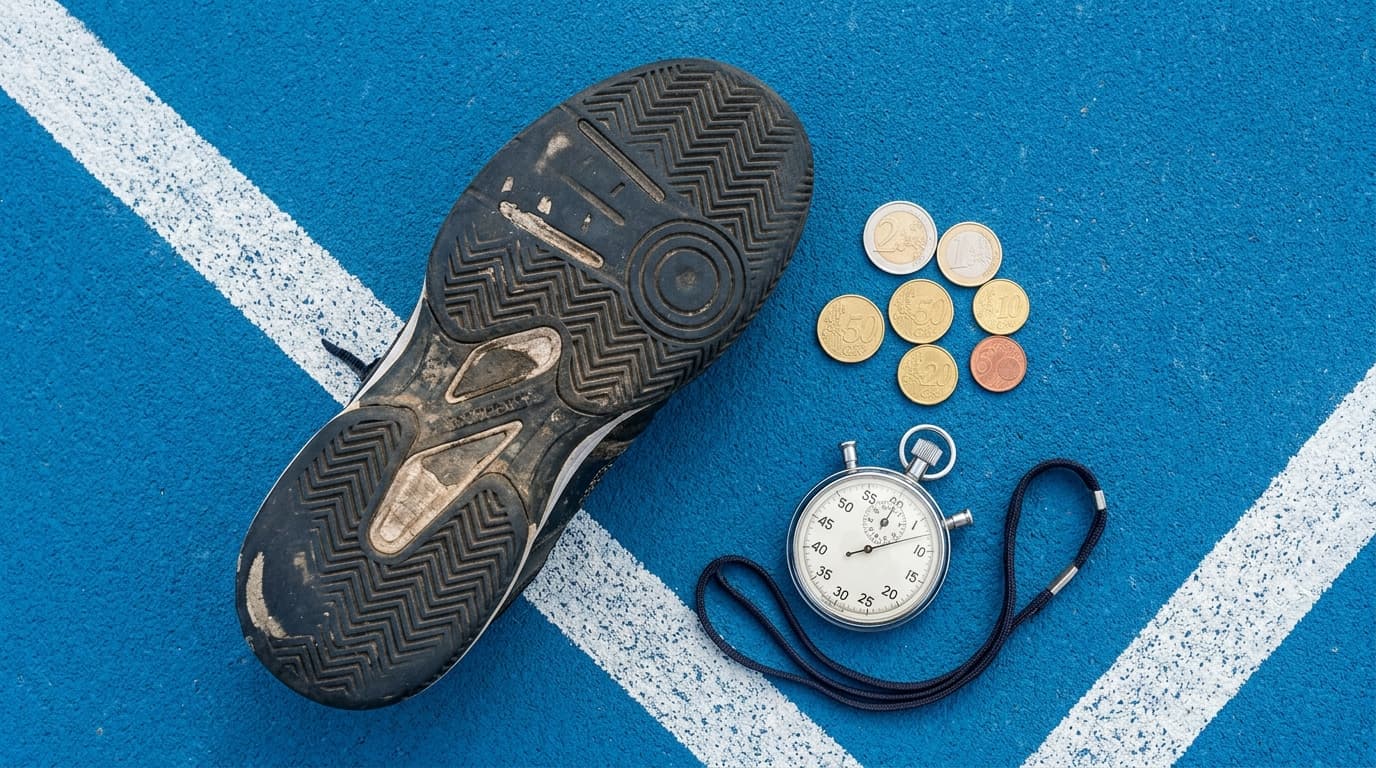
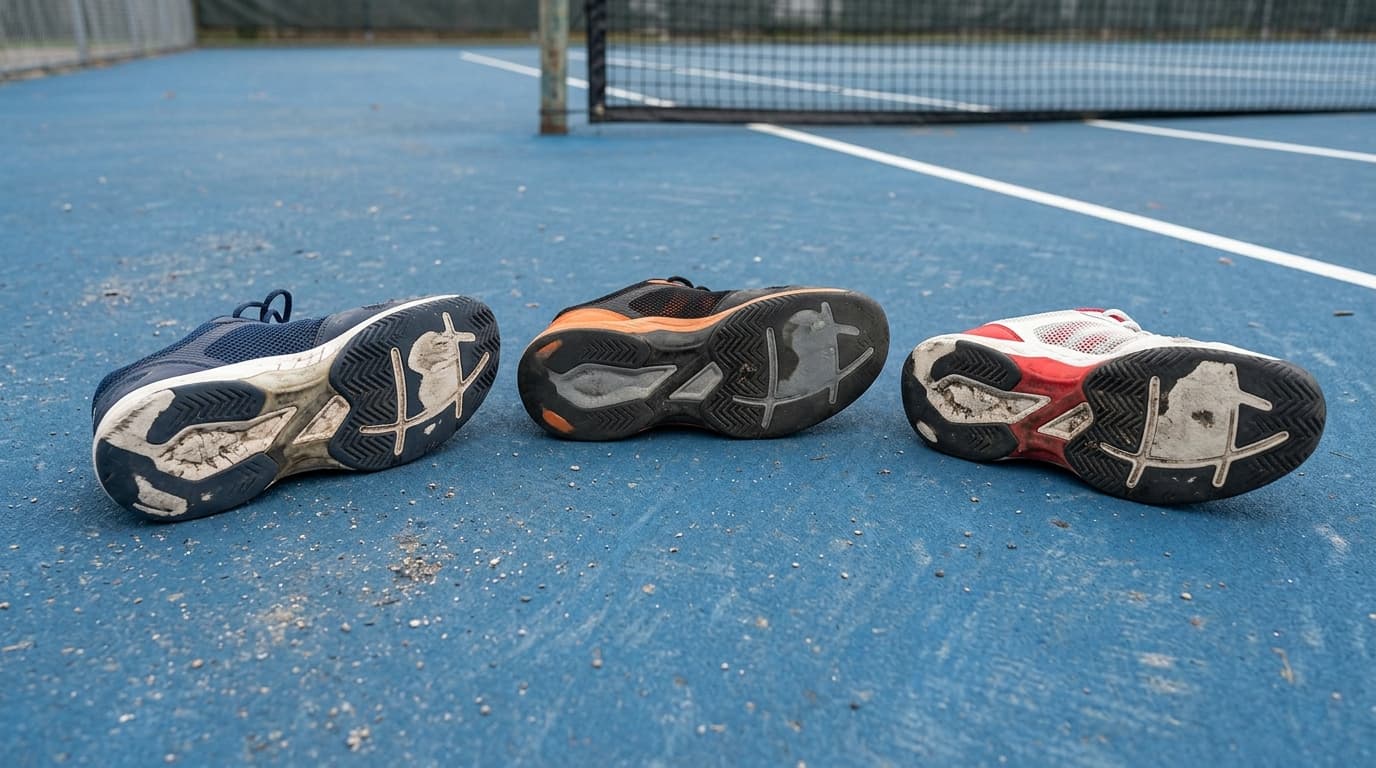
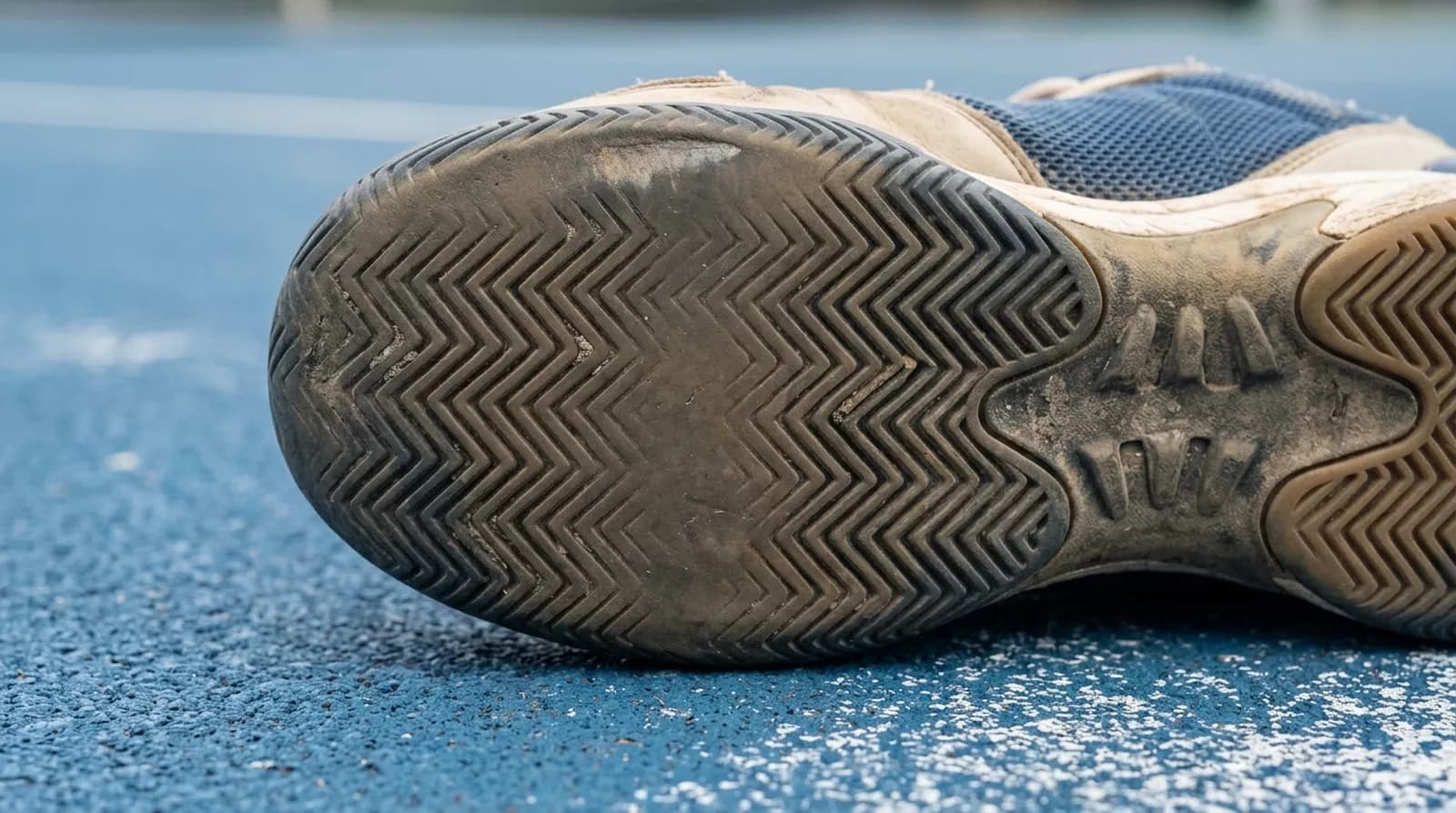
1. The rubber is smooth under the forefoot. Turn the pair over. The herringbone, the zigzag tread that gives grip, fades first under the big toe and at the tip of the foot. Tennis Server puts it down to the serve: the back foot drags across the court, and a right-hander mostly scuffs the inside of the right shoe. As long as some rubber is left, this sign alone does not call for a new pair. It tells you what is coming.
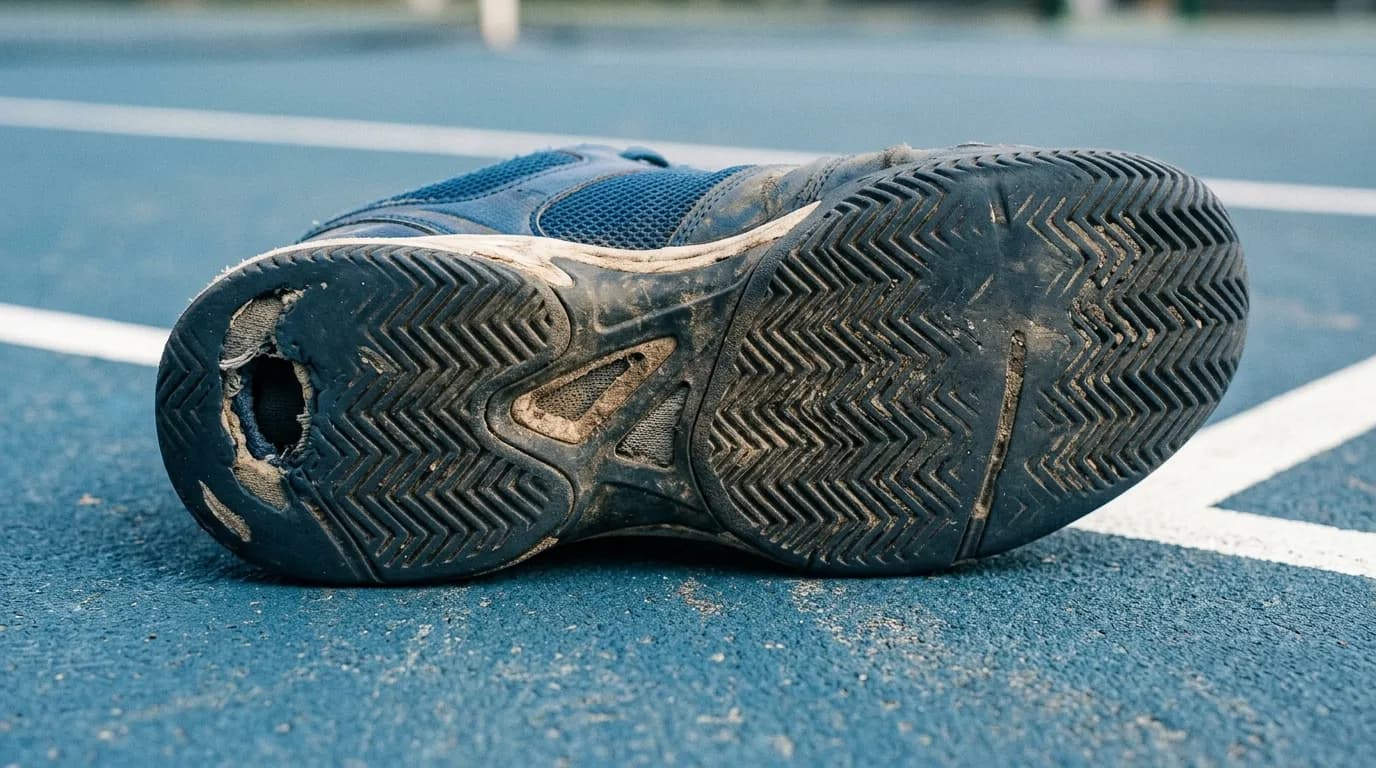
2. The foam is showing. When a paler, softer material appears under the rubber, the outsole is worn through. Wear guides list exposed foam, holes and cuts among the signs that are no longer up for debate. Glue can patch a scuffed toe, not an open outsole: the article on repairing a tennis shoe outsole covers what holds and what does not.
3. The foam is creased. Look at the shoe side-on, at the heel and under the forefoot. Deep creases in the midsole mean, for the AAPSM, that it should be replaced. Foam that creases no longer springs back between two steps.
4. The shoe leans. Set it on a table and look at it from behind. If it tilts inwards or outwards, the foam has packed down on one side. This is the AAPSM's second criterion, and the one people find last, because nobody looks at their shoes from the back.
5. The heel counter collapses. The heel counter is the stiff cup around the heel. Pinch it between thumb and forefinger: if the two sides touch, it no longer holds the foot on changes of direction.
6. The pair no longer squeaks. On a hard court, a shoe in good condition squeaks under braking. The USTA lists that silence, along with fading grip, among the signals to replace. On clay, where you slide, the test does not apply.
7. Your feet tell you. Feet and ankles that hurt more than before after a match of the same level: this is the USTA's last sign, and the only one you cannot see. If the pain continues in a new pair, the question is no longer about the shoe. It is one for a podiatrist or a physiotherapist.
An eighth clue helps you read the other seven: compare left and right. Very uneven wear comes from your movement, not from a manufacturing defect.
| Sign | Where to look | Decision |
|---|---|---|
| Smooth rubber under the forefoot | under the outsole, big-toe side | watch it, count your hours |
| Exposed foam, hole, cut | under the outsole | replace |
| Creases in the midsole | side-on | replace |
| Shoe that leans | from behind, on a flat surface | replace |
| Heel counter that collapses | heel, by pinching | replace |
| No more squeak, fading grip | while playing on hard courts | replace |
| Feet or ankles that hurt more | after the match | replace, then seek advice if it lasts |
Six rows out of seven lead to the same word. Only the first leaves you time.
For a sense of normal wear, Tennis Warehouse notes in its Yonex Eclipsion 5 review that after about 20 hours of play the front of the outsole still had plenty of tread, with light wear under the toes. Rubber that is already smooth at 20 hours is therefore ahead of schedule.
Intact outsole, worn-out shoes: is that possible?
Yes, and it is the most common case in Belgium.
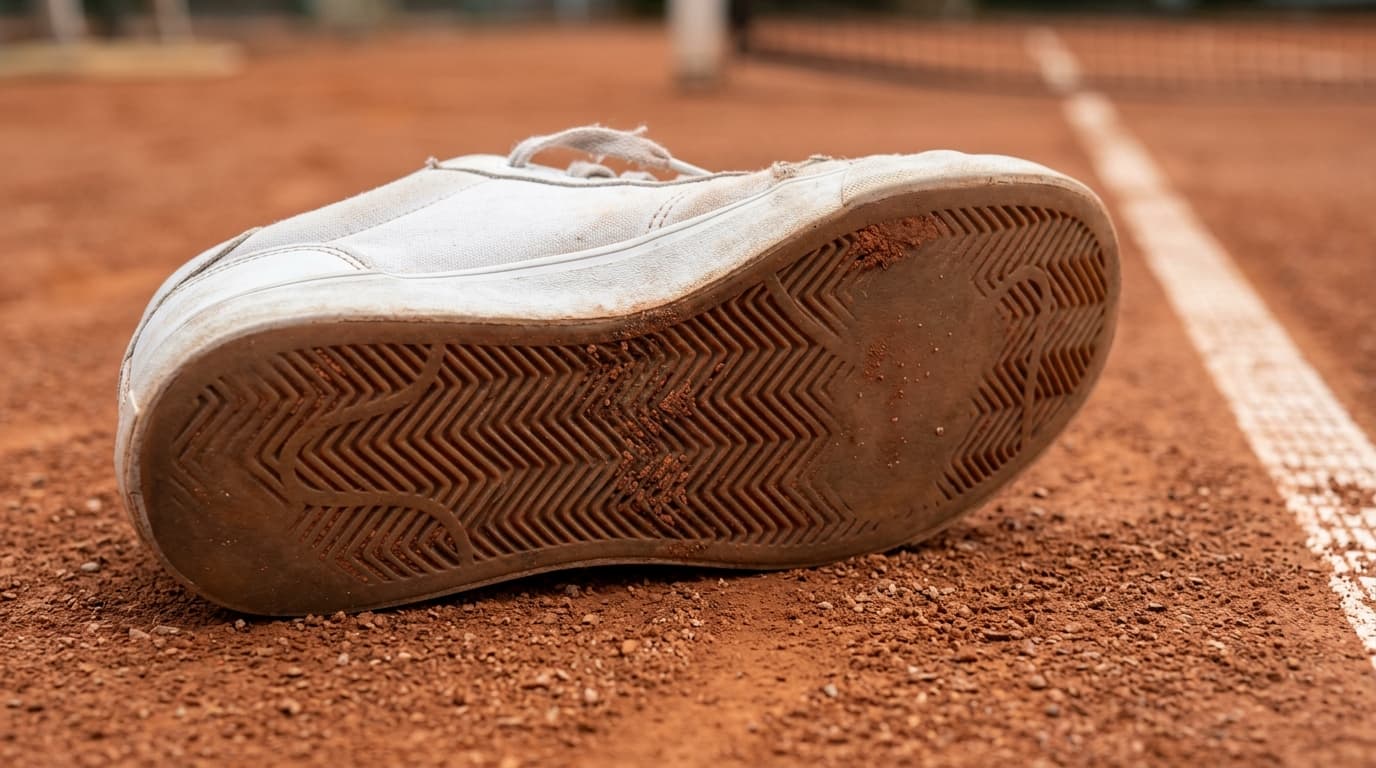
More than eight Belgian courts in ten are clay, reports RTBF. That surface is soft: it wears the rubber far less than hard courts, Tennis Companion points out. At three hours a week from April to September, a player clocks up close to 80 hours: at the end of the season the pair can go back in the bag with a crisp herringbone and foam that is well past its limit. The outsole lies. The creases do not.
Age works the same way. The AAPSM advises replacing a sports shoe that is more than a year old, whether it looks worn or not, because the foam, rubber and upper dry out and degrade even when unused. The pair found at the bottom of the bag after two winters is not a nice surprise.
Who needs to replace sooner than everyone else?
Three profiles. Heavier players wear their shoes out faster, notes Tennis.com. Servers who drag the foot go through the toe long before the foam is used up: the article on tennis shoes for toe draggers compares the protections. And players who slide on hard courts scrape the forefoot and the inner side every time they brake.
For them, the rubber gives out before the cushioning, and the first sign on the list becomes the most important.
What can you do with old tennis shoes in Belgium?
Drop them at Decathlon, whatever the brand. Since January 2026, 33 of the 35 Decathlon Belgium stores have had a collection point for textiles, shoes and small sports equipment. Only Nivelles and Roeselare have none. The partners are Terre, l'Ouvroir and Kringwinkel, which sort between reuse, repair and recycling.
Other channels are scarce. Recupel only takes back electrical appliances, and I found no shoe collection run by the tennis federations. Extended producer responsibility for textiles and shoes has been announced in Belgium from 2028: brands will then have to fund the end of life of what they sell.
Nike has two programmes. Nike Refurbished, launched in Europe in 2023, Belgium included, resells returned or barely worn shoes after reconditioning. That concerns nearly new pairs, not your worn-out shoes. Nike Grind grinds shoes into a granulate used, among other things, to build tennis courts and playgrounds. In 2021, a journalistic investigation reported by The Brussels Times cast doubt on what happened to shoes handed to the programme in Belgium. It is a press investigation, not a ruling by an authority, and I found no documented Nike Grind drop-off point for a Belgian player.
A pair that is merely scruffy, with hours left in its cushioning, can be given away or resold: Decathlon Belgium also offers second-hand resale of equipment.
Does a shoe made with recycled materials wear out faster?
Nothing in the scores suggests it. The two non-Nike models that advertise recycled content are also among the most durable in our database.
Adidas sells the Barricade 13 as containing at least 20% recycled materials. It scores 9.0/10 for durability with its Adiwear 2.0 rubber. Asics states that the Gel-Resolution X upper contains recycled plastic, without publishing a percentage, and that model also scores 9.0/10. At Nike, the Move to Zero programme covers some products with at least 20% recycled content, such as the NikeCourt Legacy Next Nature, but no public percentage was found for the Vapor Cage 4, the GP Challenge or the Vapor 12.
The logic is simple. Recycled content mostly goes into the upper, the lining and the insole. Lifespan is decided in the rubber and the foam. A pair that lasts twice as long saves making a second one, and that gain outweighs 20% of recovered polyester.
What should you replace a worn-out pair with?
A model chosen for its lifespan, not its sticker price. The price that matters is the price per hour of play.
| Model | Durability (our ratings) | Price checked in Belgium | Cost per hour (45 to 60 h) |
|---|---|---|---|
| Nike GP Challenge Pro | 8.2/10 | around €97 | €1.60 to €2.15 |
| Nike Vapor Lite 3 | 7.0/10 | around €70 | €1.15 to €1.55 |
| NikeCourt Lite 4 | 6.8/10 | around €67 | €1.10 to €1.50 |
| Asics Gel-Resolution X | 9.0/10 | around €130 | €2.15 to €2.90 |
| Adidas Barricade 13 | 9.0/10 | around €109 | €1.80 to €2.40 |
The scores come from our ratings, compiled from published tests and not from on-court trials. Prices are averages checked in Belgium between June and September 2026.
For one or two hours a week, the Nike GP Challenge Pro is the most balanced choice. Its hard rubber is dented by only 0.6 mm in RunRepeat's abrasion test, and it stays under €100. The Nike GP Challenge Pro review has the detail. On a tighter budget, the Nike Vapor Lite 3 and the NikeCourt Lite 4 cost less than €1.60 an hour. At that pace, age will stop the pair before the rubber does.
If your outsoles give out before the cushioning, aim for 9.0/10. The Asics Gel-Resolution X is the current model; the Adidas Barricade 13, replaced by the 14, is an end-of-line shoe, while sizes last. At Nike, the GP Challenge 1.5 and the Vapor Pro 3 score 8.6/10: the Nike page presents the range.
The durable tennis shoe ranking lists the eight models that last longest, the best-value ranking those that cost least per hour, and the overall ranking sets them all side by side. Once the new pair is bought, the article on caring for tennis shoes explains how to get it to 60 hours rather than 45.
Sources
- AAPSM, when to replace athletic shoes
- USTA, when is it time to buy a new pair of tennis shoes
- Tennis Warehouse, when to replace tennis shoes
- Tennis Server, shoe wear and toe drag
- Foot.it, shoe wear pattern guide
- Tennis Warehouse, Yonex Eclipsion 5 review
- Tennis.com, when is it time for a new pair of shoes
- Blue Cross Blue Shield of Massachusetts, checking your sports shoes
- Tennis Companion, clay court tennis shoes
- RTBF, clay at the heart of Belgian tennis
- Decathlon Belgium, recycling sports equipment
- Decathlon Belgium, equipment resale
- FashionUnited, Nike Refurbished launches in Europe
- The Brussels Times, investigation into Nike Grind
- Nike, NikeCourt Legacy Next Nature
- Adidas, Barricade 13
- SportsShoes, Asics Gel-Resolution X
- RunRepeat, Nike GP Challenge Pro
Your questions
Frequently asked questions
When should you replace tennis shoes?
After 45 to 60 hours of play, the point at which the midsole is worn out according to the AAPSM and the USTA, or after one year if you play little. At two hours a week, that is a pair every five to seven months. A hole in the outsole is the wrong marker: the cushioning often gives out before the rubber.
How do you know tennis shoes are worn out?
Seven signs: smooth rubber under the forefoot, exposed foam, deep creases in the midsole foam, a shoe that leans when set on a flat surface, a heel counter that collapses when pinched, less grip on hard courts, feet or ankles that hurt more after a match. Any one of the last five is enough to replace the pair.
What can you do with old tennis shoes in Belgium?
Drop them at Decathlon: since January 2026, 33 of its 35 Belgian stores have a collection point for shoes of all brands, with Terre, l'Ouvroir and Kringwinkel handling reuse, repair and recycling. Only Nivelles and Roeselare have none. Recupel only takes back electrical appliances.
Do Nike tennis shoes contain recycled materials?
Some Nike products contain at least 20%, such as the NikeCourt Legacy Next Nature, under the Move to Zero programme. No public percentage was found for the Vapor Cage 4, the GP Challenge or the Vapor 12. Nike Refurbished has resold returned, reconditioned pairs in Belgium since 2023.
Does a tennis shoe made with recycled materials wear out faster?
Nothing in the scores suggests it. The Adidas Barricade 13, sold as containing at least 20% recycled materials, scores 9.0/10 for durability, as does the Asics Gel-Resolution X, whose upper contains recycled plastic. Lifespan depends on the rubber and its thickness, not on where the upper comes from.
Should you replace a pair that is a year old but barely used?
Yes, according to the AAPSM, which advises replacing a sports shoe that is more than a year old, worn or not: the foam, rubber and upper dry out and degrade even in a cupboard. At one hour a week, the age limit and the hours limit fall at almost the same moment, around 52 hours.