Care & repair
Repair a Tennis Shoe Outsole: What Glue Can and Can't Do
Repairing a tennis shoe outsole with a hole: the glue needs 24 to 72 hours to cure and can come off within minutes on hard courts. When to replace?
Contents · 11 sections
- Key takeaways
- Can you repair a tennis shoe outsole with a hole in it?
- How good is Shoe Goo on a worn toe?
- Outsole coming unglued: glue or warranty?
- Can a cobbler resole a tennis shoe?
- When is a repair no longer worth it?
- Which brands offer an outsole warranty if the toe wears through?
- Which tennis shoes spare you the repair?
- Sources
- FAQ
- Related articles
You can repair a tennis shoe outsole, but the result does not last: a Shoe Goo type glue needs 24 to 72 hours to cure, and players report that it can come off within minutes on a hard court. You patch a hole. You do not rebuild an outsole.
The real question lies elsewhere. A pair with a hole almost always has cushioning at the end of its run, and no glue gives hours back to a foam.
Can you repair a tennis shoe outsole with a hole in it?
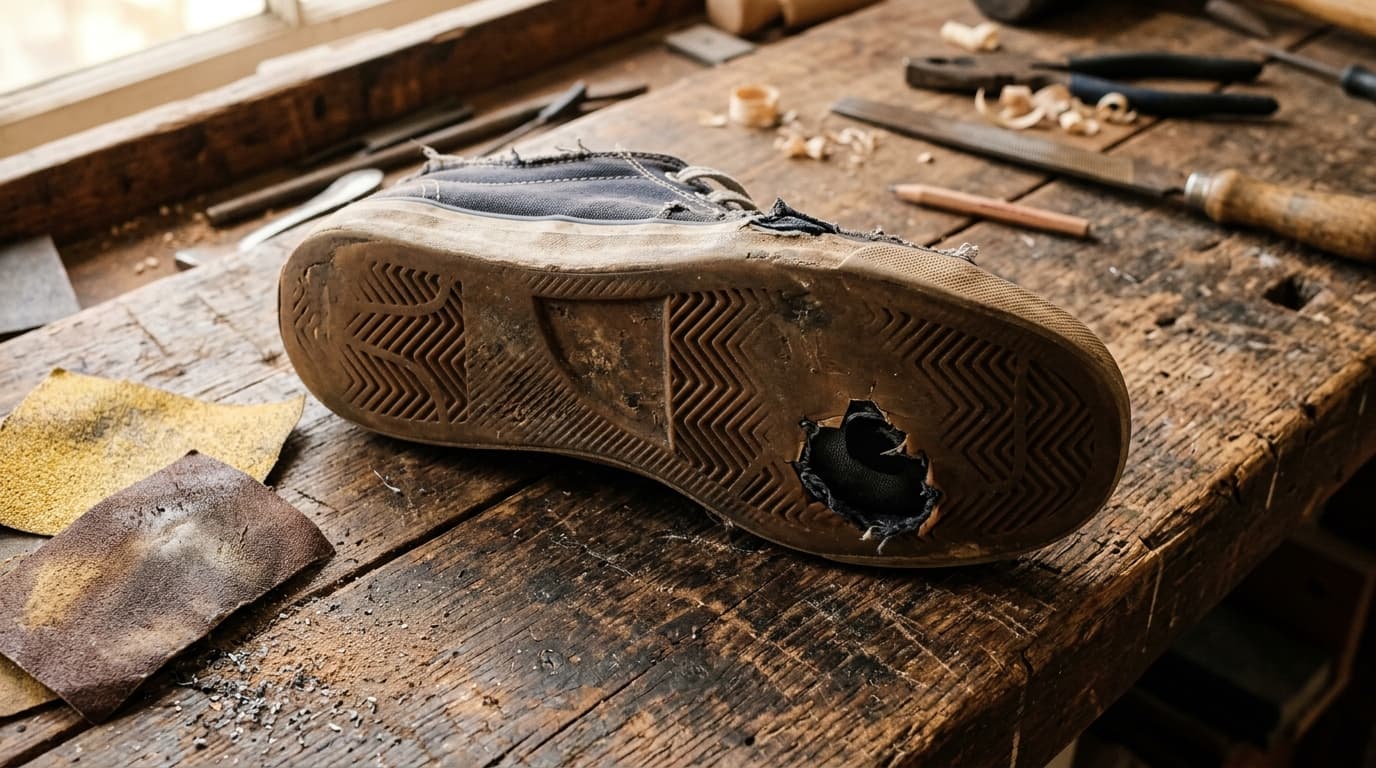
Yes to gain a few sessions, no to start another season. It all depends on how deep the hole goes.
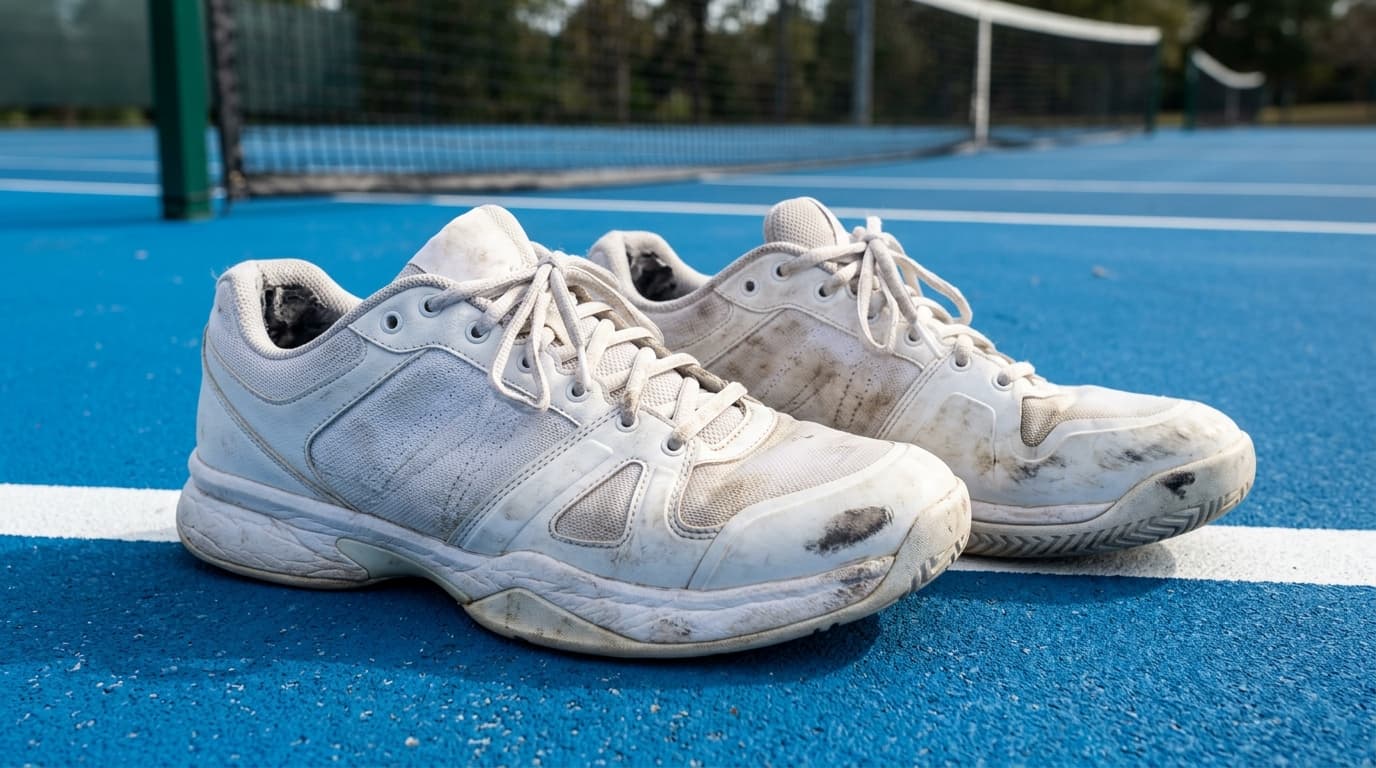
As long as the rubber is only scuffed, smooth under the big toe or at the tip of the foot, there is material left: a protective layer of glue can slow down what comes next. Once the foam shows, the diagnosis changes. Wear guides list visible foam among the signs that call for replacement, along with smooth patches, cuts and differences between the left and right shoe.
That leaves the cushioning, which nobody sees. The AAPSM, the American Academy of Podiatric Sports Medicine, considers a tennis shoe midsole worn out after 45 to 60 hours of play. At three hours a week, that is four to five months. An outsole with a hole rarely has fewer hours than that on the clock, except for a player who drags a foot on serve or slides on hard courts.
That is the case that deserves a repair. The server who wears through a toe in six weeks has a pair whose foam is still good and whose rubber has given out in one spot. For that player, patching makes sense. For everyone else, the hole simply says the pair has had its day.
How good is Shoe Goo on a worn toe?
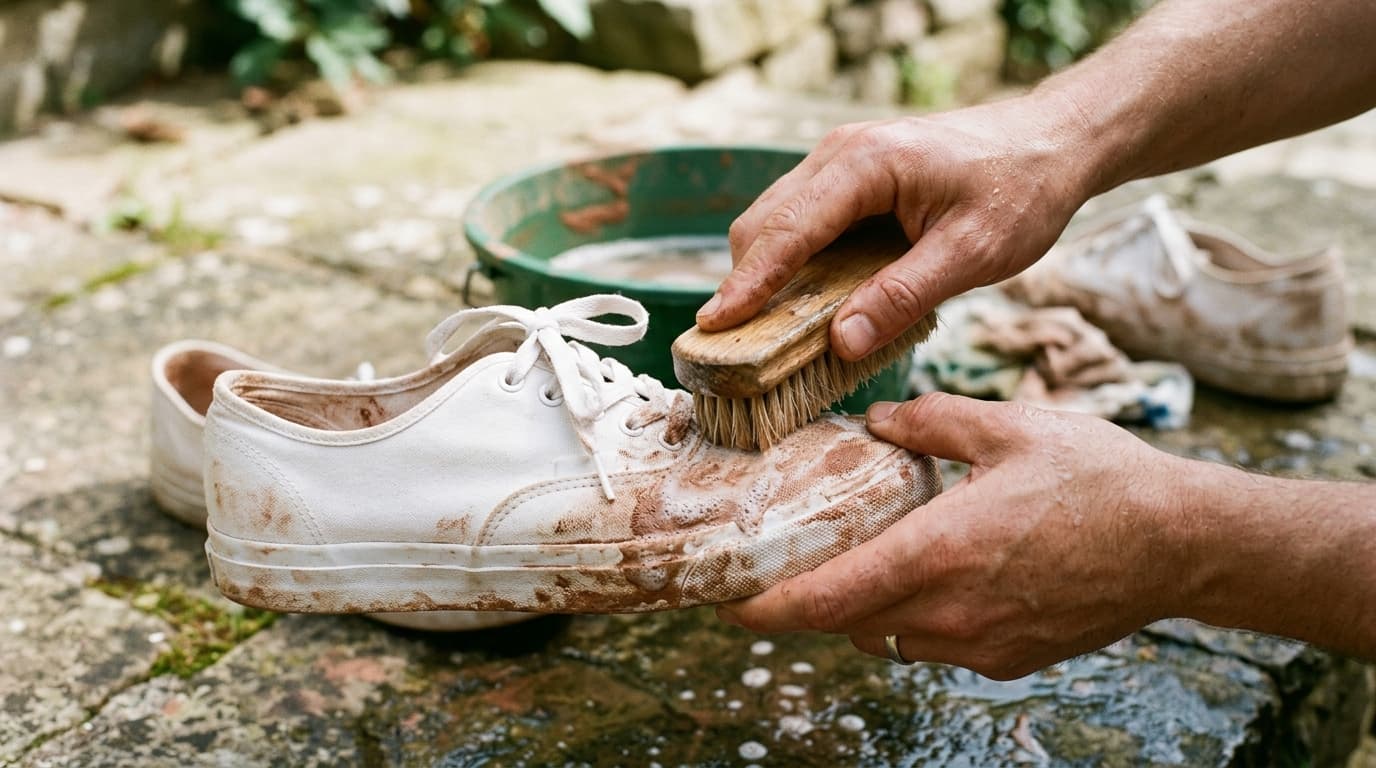
It is a stopgap, and its own buyers say so. Shoe Goo is a thick glue you spread in a layer over the scuffed area; tennis players have long used it against toe drag, the scraping of the back foot on serve.
The method, according to the product page and buyer reviews:
- clean the area, dry and then with water, and let it dry;
- sand the rubber lightly so the glue grips;
- spread an even layer over the worn part;
- let it cure for at least 24 hours, 48 to 72 hours for maximum strength.
The last point is the one people skip. Playing the morning after a repair done the evening before means tearing the layer off on the first serve.
Even well applied, it has a limit. The same reviews report that a layer can come off within minutes on a hard court. Hard courts are a very abrasive surface, Tennis Companion points out, whereas clay wears rubber far less. In Belgium, where more than eight courts in ten are clay according to the RTBF, a patched toe therefore has a better chance of finishing the summer than of getting through a winter indoors.
No source consulted puts a number on the hours gained. So I give no duration: count in sessions, not in months.
Outsole coming unglued: glue or warranty?
Warranty first, if the pair is recent. An outsole peeling away from the upper is not the same problem as scuffed rubber: the first may be a manufacturing defect, the second is wear.
The difference matters in Belgium. The legal guarantee of conformity lasts 2 years and covers defects, not normal wear; Tennis Warehouse Europe refers its customers to those 24 months and to the manufacturer's warranty, in the same terms. Bonding that fails after three outings is something to take up with the seller, proof of purchase in hand. A toe worn through after a season of serving is not.
Gluing it back yourself only makes sense out of warranty. And in that case, look at the age of the pair before reaching for the tube: the AAPSM advises replacing an athletic shoe more than a year old, worn or not, because foam and rubber dry out even when unused. An outsole peeling on a three-year-old pair is often a sign that the materials have aged. Gluing the edge back does not make the rest any younger.
The article on caring for tennis shoes details the six points to look at.
Can a cobbler resole a tennis shoe?
None of the sources consulted documents the resoling of a tennis shoe, and I am not going to invent one.
The reason is easy to guess. A tennis shoe outsole is designed for a surface: deep herringbone for clay, modified herringbone for all-court models, a smooth outsole for carpet. Replace it with generic rubber and you lose that pattern.
When is a repair no longer worth it?
As soon as another sign of wear comes with the hole. The outsole is only the visible part, and it is rarely what protects your knees.
| What you see | What it means | Repair or replace |
|---|---|---|
| Smooth rubber under the big toe, no foam showing | toe drag or braking wear, rubber still present | patching can add a few sessions |
| Toe cap scuffed on the medial side | back foot dragging on serve | patch, then look for a model with toe protection |
| Foam showing under the outsole | rubber worn through | replace |
| Deep creases in the midsole, shoe leaning when placed flat | compressed cushioning | replace, according to the AAPSM |
| Heel counter whose two sides touch when you pinch it | the foot is no longer held | replace |
| The shoe no longer squeaks on hard courts, sorer feet after the match | grip and cushioning fading, according to the USTA | replace |
| Outsole coming unglued on a recent pair | possible defect | seller and legal guarantee |
Two rows out of seven leave room for glue. Both concern the toe.
For a right-hander, the inside of the right shoe goes first, Tennis Server explains: the back foot drags on the court on serve, and the tip and the inner forefoot take the punishment. If your two shoes wear very unevenly, the cause is in your motion, not in the pair. The article on tennis shoes for toe draggers compares toe protection model by model.
The money points the same way. A Nike GP Challenge 1.5 averaging around €125 in Belgium works out at €2.10 to €2.80 per hour of play, based on the 45 to 60 hours of the cushioning. A repair that buys three more hours on foam that is already compressed saves between €6 and €8.50. And it has you play those three hours without cushioning.
Which brands offer an outsole warranty if the toe wears through?
Only one covers the toe cap: Babolat. Its 6-month warranty applies to the Propulse Fury All Court, men's and women's, and comes into play if the outsole is worn through to the insole or if the toe cap is worn through to the inside of the shoe. You need proof of purchase, and the brand grants only one replacement per purchase.
The caveat is well known. The page mentions $20 in shipping costs, which suggests a US service, and its validity in Belgium is not confirmed. Ask the seller in writing before buying a Propulse Fury 3 for that reason.
The other 6-month guarantees are less useful to a player who drags a foot. The one from the US retailer Tennis Warehouse covers only the rubber outsole: the toe guard and the upper are excluded, the outsole must be worn through to the midsole, and the guarantee only applies to a purchase from that store, in the contiguous United States. Mizuno's, published on a US page, also excludes the toe cap, the upper and all clay models.
For Nike, Asics, Adidas and K-Swiss, no brand outsole warranty was found for Europe. The programmes are covered in detail in the article on the 6-month outsole warranty.
Which tennis shoes spare you the repair?
The ones whose rubber has been thickened where it wears. It is less spectacular than a tube of glue, and far more effective.
| Model | Durability (our ratings) | Toe protection | Weight (men's US 10.5) | Average price in Belgium |
|---|---|---|---|---|
| Nike Air Zoom Vapor Cage 4 | 9.4/10 | outsole wrapping up over the toe cap and the medial side | 439 g | not disclosed |
| Nike GP Challenge 1.5 | 8.6/10 | rubber drag guard on the inside of the toe cap | 456 g | around €125 |
| Nike Vapor Pro 3 | 8.6/10 | rubber up to the toe | 425 g | around €117 |
| Babolat Propulse Fury 3 | 9.0/10 | Michelin rubber, toe cap covered by the brand warranty | 408 g | around €102 |
| K-Swiss Ultrashot 4 | 8.4/10 | DragGuard 7.0 in the wear zones | 459 g | around €156 |
The Nike Air Zoom Vapor Cage 4 remains the benchmark. In its review, Tennis Warehouse gives it 4.5/5 for outsole durability and 4.5/5 for toe durability, and names it the most durable model in the Nike range. It is a generation older than the 2025 models: check its availability in Belgium before hunting for it. The Nike Air Zoom Vapor Cage 4 review sums it up.
If you cannot find it, two current Nikes take over. The GP Challenge 1.5 has high-abrasion rubber that is denser under the inner forefoot, plus a drag guard on the toe cap, according to the Tennis Warehouse product page. The Vapor Pro 3 weighs 31 g less and gets the same score, 8.6/10. Both are covered in the Nike GP Challenge 1.5 review and the Nike Vapor Pro 3 review.
The Babolat Propulse Fury 3 is the lightest of the five and the only one whose toe cap is covered by a brand warranty, with the caveat already given. The Babolat page presents its range. The K-Swiss Ultrashot 4 thickens its Aosta 7.0 rubber at the wear points, for 459 g and the highest price in the table; it is described on the K-Swiss page.
No pair is judged without the lifespan of its outsole. The durable tennis shoe ranking lists the eight models that last longest, and the overall ranking sets them against the rest.
When the pair really is finished, it does not have to go in the bin. Since January 2026, Decathlon Belgium has collected shoes of all brands in 33 of its 35 stores, with partners for reuse, repair and recycling. The article on how long tennis shoes last helps you estimate when that moment comes, depending on how often you play.
Sources
- AAPSM, When to replace athletic shoes
- USTA, when is it time to buy a new pair of tennis shoes
- Dick's Sporting Goods, Shoe Goo (product page and customer reviews)
- Tennis Server, shoe wear and toe drag
- Foot.it, shoe wear pattern guide
- Blue Cross Blue Shield of Massachusetts, checking your athletic shoes
- Babolat, six-month outsole warranty
- Tennis Warehouse, 6-month outsole guarantee
- Tennis Warehouse Europe, warranties
- Mizuno USA, outsole warranty
- Tennis Warehouse, Nike Air Zoom Vapor Cage 4 review
- Tennis Warehouse, Nike GP Challenge 1.5
- Tennis Warehouse, K-Swiss Ultrashot 4
- Tennis Companion, clay court tennis shoes
- HEAD, clay court tennis shoes
- RTBF, clay at the heart of Belgian tennis
- Decathlon Belgium, recycling sports equipment
Your questions
Frequently asked questions
Can you repair a tennis shoe outsole with a hole in it?
You can patch it with a Shoe Goo type glue, not make it new again. The product needs 24 hours to cure, or 48 to 72 hours for maximum strength, and players report that a layer can come off within minutes on a hard court. If the hole reaches the foam, the cushioning is at the end of its life anyway.
Does Shoe Goo hold up on a hard tennis court?
Not for long. Players have used it for years against toe drag, but buyer reviews report that a layer can disappear within minutes on hard courts. It holds better on clay, a surface that wears rubber far less. It is a stopgap to finish a season, not a repair.
Which brands offer an outsole warranty on their tennis shoes?
Babolat, Mizuno and New Balance have a programme in their own name, documented on US pages. Babolat covers the Propulse Fury All Court for 6 months, including a worn-through toe cap. The 6-month guarantee often quoted for Nike, Asics, Adidas or K-Swiss is the one from the US retailer Tennis Warehouse, valid for a purchase from that store in the United States.
Does the 2-year legal guarantee cover a worn outsole?
No. In Belgium, the 2-year legal guarantee of conformity covers defects, not normal wear. An outsole coming unglued on an almost new pair may be a defect: go to the seller with your proof of purchase. Rubber worn smooth under the big toe after a season of play is not one.
Which outsole stands up best to a dragging foot?
In our ratings, the Nike Air Zoom Vapor Cage 4 comes first with 9.4/10 for durability: its outsole wraps up over the toe cap and the medial side. Check its availability in Belgium. Among current models, the Babolat Propulse Fury 3 scores 9.0, the Nike GP Challenge 1.5 and Nike Vapor Pro 3 8.6, the K-Swiss Ultrashot 4 8.4.