Durability & wear
How Long Do Tennis Shoes Last? 45 to 60 Hours of Play
A tennis shoe lasts 45 to 60 hours of play and no more than a year. How to work it out for your schedule, signs of wear and the Nike models that last longest.
Contents · 13 sections
- Key takeaways
- How many hours does a tennis shoe really last?
- How many pairs a year do you need for how often you play?
- Why does the outsole wear faster on hard courts than on crushed brick?
- Who wears out their shoes the fastest?
- How do you know it is time to replace your shoes?
- Which tennis shoes last the longest?
- Can you make your tennis shoes last longer?
- What is the most eco-friendly tennis shoe?
- Which shoe should you choose based on how you wear them?
- Sources
- FAQ
- Related articles
A tennis shoe lasts 45 to 60 hours of play before its cushioning is worn out, according to the American Academy of Podiatric Sports Medicine (AAPSM), and no longer than a year even if you rarely play. For a club player on two hours a week, that means a new pair every five to seven months.
The rubber outsole runs on a different clock: on hard courts it can go much sooner; on crushed brick it often outlives the cushioning.
How many hours does a tennis shoe really last?
The reference figure comes from the AAPSM: a midsole is worn out after 45 to 60 hours of tennis, whereas a running shoe can handle 300 to 500 miles. The USTA, the American federation, uses the same range and draws a simple rule from it: at one hour a week, you need at least one pair a year.
That figure is not about the rubber. It is about the foam, the layer that absorbs every step, every stop and every landing after a smash. It compresses first, and it is what protects your knees and ankles.
On the running side, Doctors of Running reports that in machine testing a foam keeps only 75 % of its cushioning after 50 miles. It is not tennis data, but it shows how quickly the loss starts.
The second limit is often forgotten: age. The AAPSM recommends replacing any sports shoe older than a year, whether or not it looks worn, because the outsole, foam and upper dry out and degrade even sitting in a cupboard.
How many pairs a year do you need for how often you play?
The sum fits on one line: hours played per week × weeks played per year ÷ 45 to 60 hours. I have assumed 40 weeks of play a year, which leaves room for holidays, injuries and weeks when the club is closed. If you play all year round without a break, add about 30 %.
| Playing frequency | Hours per year (40 weeks) | Lifespan of one pair | Pairs per year |
|---|---|---|---|
| 1 h a week | 40 h | capped at 12 months (age rule) | 1 |
| 2 h a week | 80 h | 5 to 7 months | 1.3 to 1.8 |
| 3 h a week | 120 h | 3.5 to 5 months | 2 to 2.7 |
| 5 h a week | 200 h | 2 to 3 months | 3.3 to 4.4 |
| 8 h a week | 320 h | 5.5 to 7.5 weeks | 5.3 to 7.1 |
These figures line up with other sources. The USTA talks about replacing shoes "every few months" for a baseliner who plays on hard courts several times a week, and "once a year" for a recreational doubles player on clay. For players doing 6 to 8 hours a week on hard courts, RunRepeat reports feedback that an outsole lasts "one season".
The table also gives you a budget benchmark. A Nike GP Challenge 1.5, seen at around €125 in Belgium (average price observed between June and September 2026), works out at roughly €2.10 to €2.80 per hour if you keep it for 45 to 60 hours. A GP Challenge Pro, seen at around €97, comes down to €1.60 to €2.20 per hour. Discounts shift the amounts, not the logic.
Why does the outsole wear faster on hard courts than on crushed brick?
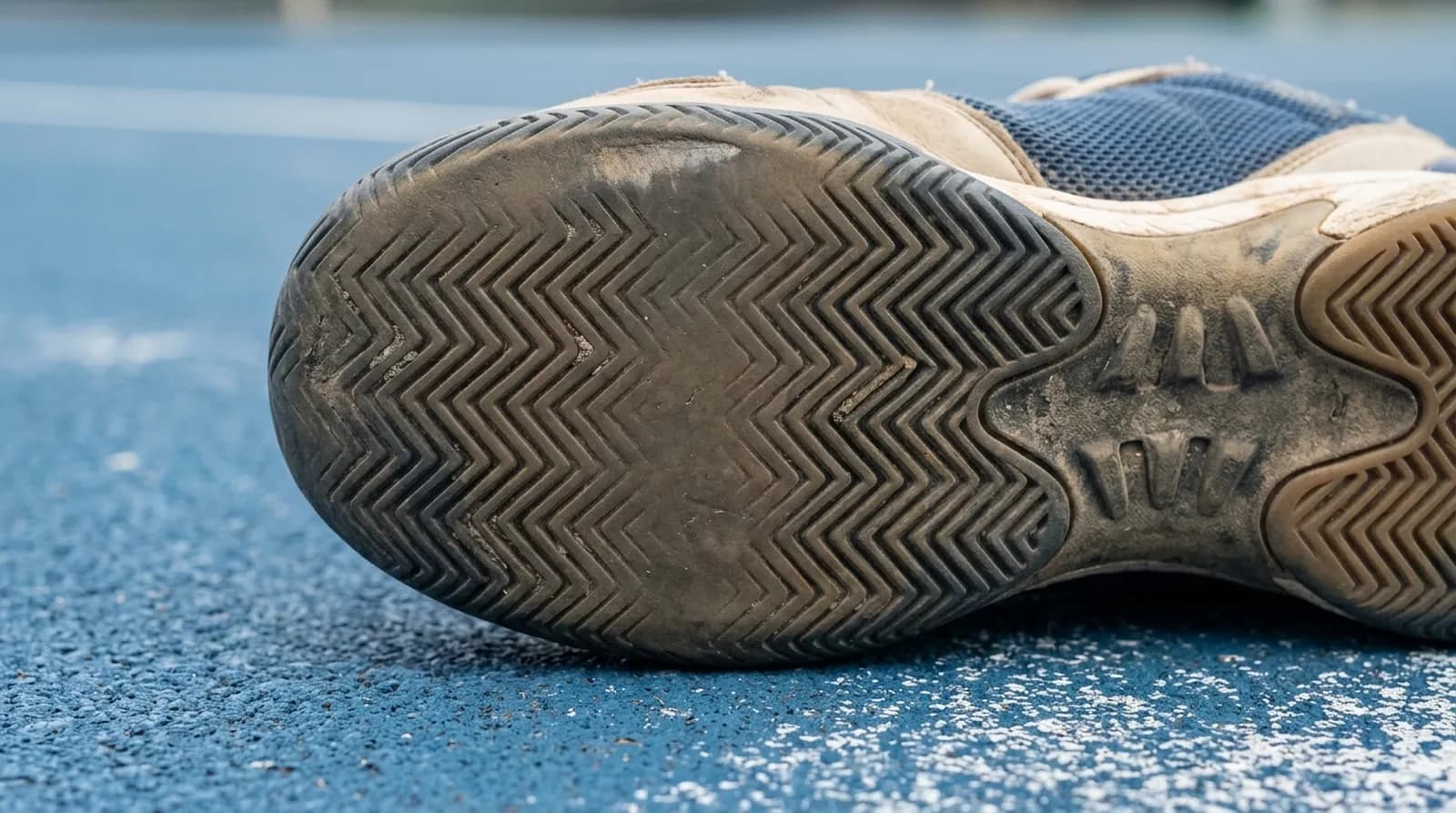
Because hard courts are abrasive. Tennis Companion puts it plainly: an acrylic or concrete court grinds down rubber and needs a tougher outsole, whereas clay, being softer, causes far less wear. Clay-court shoes often have softer rubber, with deep herringbone along the full length to clear the clay.
In Belgium, that changes things. According to RTBF, more than 8 courts in 10 are crushed brick, compared with 16 % in France, and clubs use this surface mainly in summer. Winter is played under domes or indoors, for example on GreenSet or on carpet with rubber granules. On carpet you need a smooth, non-marking sole: too much tread grips the foot and increases the risk of a sprain.
There are two practical consequences.
A player who spends the summer on crushed brick will rarely wear a hole in the rubber. The cushioning, however, wears at the same rate as anywhere else, since the AAPSM's 45 to 60 hours refer to the foam, not the rubber. That is the trap: the shoe looks almost new when it no longer cushions much at all.
Most Belgian players therefore need two pairs, one for outdoors and one for indoors. Each pair builds up fewer hours, and it is often the age rule, one year at most, that decides when to replace it rather than visible wear.
Who wears out their shoes the fastest?
For the same number of hours, not everyone wears shoes at the same rate. The factors that speed up wear:
- Toe drag on the serve: the back foot drags along the court, and the toe and inner forefoot wear first. A right-hander mainly wears the inside of the right shoe (Tennis Server).
- Body weight: heavier players wear out their shoes faster, Tennis.com points out.
- Sliding on hard courts, which scuffs the forefoot and inner side. Tennis Warehouse advises sliders to pick a model with medial protection, such as the Nike Vapor Cage 4.
- Choosing a lightweight shoe. According to Tennis Companion, lightweight models generally last less long than heavier stability models.
- Baseline play, full of braking and lateral pushes, which is harder on the outsole than social doubles.
If three of these five apply to you, divide by 45 rather than 60 in the table's calculation.
How do you know it is time to replace your shoes?
There is no need to wait for a hole in the sole. Here are the checks to run, in order, once a month:
- Listen: on hard courts, a shoe that no longer squeaks has lost grip (USTA).
- Look at the midsole: deep creases in the foam show it has compressed (AAPSM).
- Put the shoe on a table. If it tilts to one side, it needs replacing (AAPSM).
- Squeeze the back: if the two sides of the heel counter touch, it no longer holds your foot.
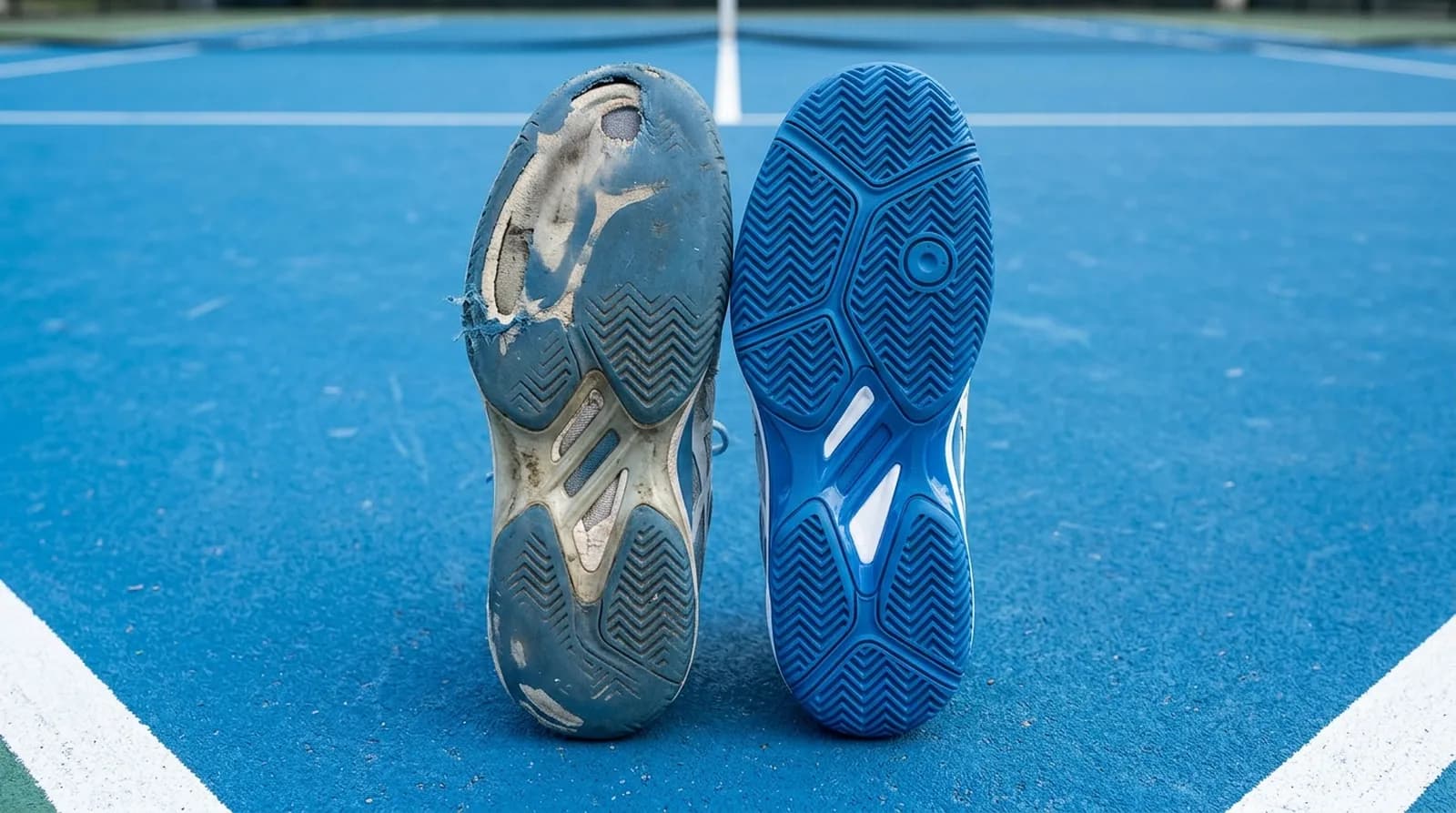
- Turn it over and look for smooth patches, exposed foam, cuts and differences between the left and right shoe.
- Listen to your body: feet or ankles that ache more after a match are a warning sign cited by the USTA.
To give a sense of normal wear, Tennis Warehouse notes that after about 20 hours the front of the Yonex Eclipsion 5's outsole still had plenty of tread left.
Which tennis shoes last the longest?
The ones that put rubber where you wear it. The durability score below is Best Tennis Shoes' editorial rating out of 10, based on published tests (Tennis Warehouse, RunRepeat, Tennis Companion) and technical specifications; prices are averages observed in Belgium between June and September 2026.
| Model | Rubber and reinforcements | Durability score /10 | Average price seen (BE) |
|---|---|---|---|
| Nike Air Zoom Vapor Cage 4 | outsole wraps up the toe cap and inner side | 9.4 | not disclosed |
| Nike GP Challenge 1.5 | denser high-abrasion rubber under the inner forefoot, drag guard | 8.6 | €125 |
| Nike Vapor Pro 3 | Hart rubber up to the toe | 8.6 | €117 |
| Nike GP Challenge Pro | hard rubber (87.5 HC), rubberised drag guard | 8.2 | €97 |
| Nike Vapor 12 | reduced rubber, large drag guard on the toe cap | 7.2 | €159 |
| Asics Gel-Resolution X | full-length AHAR Plus, PGUARD at toe and heel | 9 | €130 |
| Adidas Barricade 13 | full-length Adiwear 2.0 | 9 | €109 |
| Adidas Barricade 14 | Lighttraxion, lighter | 7 | €117 |
| Babolat Propulse Fury 3 | Michelin, thicker lugs | 9 | €102 |
| K-Swiss Ultrashot 4 | Aosta 7.0 + DragGuard 7.0 | 8.4 | €156 |
| Yonex Eclipsion 5 | Endurance Rubber II | 8.2 | €145 |
Within Nike, the pecking order is clear. Tennis Warehouse names the Vapor Cage 4 as the most durable model in the range, with 4.5/5 for outsole durability and 4.5/5 for toe durability; its playtesters in the United States, Europe and Australia singled out its comfort, stability and durability. It is an older generation than the 2025 models, so check that it is still available in your size before setting your heart on it.
Among current models, the GP Challenge 1.5 and the Vapor Pro 3 are the two Nikes to go for if you wear shoes out quickly. The first concentrates denser rubber under the inner forefoot, where toe drag bites, and adds rubber protection on the inside of the toe cap. The second gets a "fantastic" durability verdict from RunRepeat, including in the high-wear zones. The cheaper GP Challenge Pro shows a 0.6 mm dent in RunRepeat's Dremel test, around average, with hard 87.5 HC rubber.
The Vapor 12 plays a different game. To make it lighter, Nike removed much of the rubber, and Tennis Warehouse's playtesters found the outsole smoothing out in the usual places. It keeps a large drag guard on the toe cap, but it is not the pick for a heavy toe-dragger: it is aimed at the attacking player who wants a fast, responsive shoe. The details are in the Nike Vapor 12 review and in the Nike Vapor 12 vs Asics Solution Speed FF 4 head-to-head.
Outside Nike, the Asics Gel-Resolution X wears 0.3 mm less than average in RunRepeat's test, at the cost of being one of the heaviest shoes on the market. At Adidas, the Barricade divides opinion: Tennis Companion feels that durability on the Barricade 14 "is no longer an undisputed strength", while RunRepeat measures a dent of just 0.6 mm against an average of 0.8 mm. The Barricade 13, with its Adiwear 2.0, has a better reputation and can be found as end-of-line stock at around €109.
To go further, the tennis shoe rankings sort these models by player profile, and the comparison tool puts them side by side, criterion by criterion. The brand's whole range is covered on the Nike page.
Can you make your tennis shoes last longer?
A little, yes. There is no magic: no amount of care will give compressed foam back its lost 45 hours. But three habits stop you from cutting a pair's life short.
The first is to rotate two pairs. ASICS explains that foam takes about 48 hours to decompress after hard exercise; playing two sessions back to back in the same pair loads it before it has recovered.
The second is washing. No washing machine, which shortens a shoe's life according to ASICS: a soft brush and water are enough.
The third is drying: take out the insole, stuff the shoe with newspaper and change it after ten minutes or so, with no radiator or hairdryer.
Then there is the question of the warranty. The well-known 6-month outsole warranty is mainly offered by Tennis Warehouse, an American retailer: it can be used once, only covers rubber worn through to the midsole, excludes the toe cap and upper, and applies in the contiguous United States. Tennis Warehouse Europe's warranty page refers you to the manufacturer's warranty instead. In Belgium, the 2-year legal guarantee of conformity applies: it covers manufacturing defects, not normal wear.
What is the most eco-friendly tennis shoe?
The most eco-friendly shoe is the one you keep the longest. A few percent of recycled material counts for less than a durable outsole, good care and a pair you do not have to replace twice as often.
Brands publish few figures on their tennis models. Nike runs its Move to Zero programme, and some products, such as the NikeCourt Legacy Next Nature, contain at least 20% recycled materials; however, no public percentage could be found for the Vapor Cage 4, the GP Challenge or the Vapor 12. Asics says the upper of the Gel-Resolution X contains recycled plastic, without giving a figure. Adidas sells the Barricade 13 as containing at least 20% recycled materials.
At the end of a shoe's life, Belgium offers two options. Since January 2026, 33 of the 35 Decathlon stores have collected shoes of any brand, working with Terre, l'Ouvroir and Kringwinkel for reuse, repair and recycling. Nike Refurbished, launched in Europe in 2023, Belgium included, resells returned or barely worn shoes after refurbishing them. Extended producer responsibility for textiles and footwear is planned in Belgium from 2028.
Which shoe should you choose based on how you wear them?
To find the model that suits your build and your surface, the guide to choosing tennis shoes and the quiz ask the right questions in two minutes. The basics (surface, size, width, cushioning) are covered in the article how to choose tennis shoes.
Sources
- AAPSM, When to replace athletic shoes
- USTA, When is it time to buy a new pair of tennis shoes
- Tennis Warehouse, When to replace tennis shoes
- Doctors of Running, How long do running shoes last
- ASICS, 7 shoe care tips to make your shoes last longer
- RunRepeat, Best hard court tennis shoes
- Tennis Companion, Clay court tennis shoes
- Tennis Companion, Lightweight tennis shoes
- RTBF, Clay at the heart of Belgian tennis (in French)
- Decathlon Belgium, Men's tennis shoes
- Tennis Server, Toe drag and shoe wear
- Tennis.com, When is it time for a new pair of shoes
- Tennis Warehouse, Nike Air Zoom Vapor Cage 4 review
- Tennis Warehouse, Most durable tennis shoes
- Tennis Warehouse, Nike GP Challenge 1.5 product page
- RunRepeat, Nike Vapor Pro 3
- RunRepeat, Nike GP Challenge Pro
- Tennis Warehouse, Nike Vapor 12 review
- RunRepeat, Asics Gel-Resolution X
- Tennis Companion, Adidas Barricade 14 review
- RunRepeat, Adidas Barricade 14
- Tennis Warehouse, Yonex Eclipsion 5 review
- Tennis Warehouse, Durability guaranteed shoes
- Tennis Warehouse Europe, Warranties
- Nike, NikeCourt Legacy Next Nature
- Adidas, Barricade 13
- Decathlon Belgium, Recycling sports equipment (in French)
- FashionUnited, Nike Refurbished launches in Europe
Your questions
Frequently asked questions
How long does a tennis shoe last for a recreational player?
At one hour a week, you will not reach the 45 to 60 hour limit within a year. Age then becomes the deciding factor: the AAPSM advises replacing a sports shoe older than a year, even if it still looks in good shape.
Is a shoe still fine if the outsole has no hole in it?
Not necessarily. The 45 to 60 hours quoted by the AAPSM refer to the midsole, in other words the cushioning. A thick outsole can hide compressed foam, especially if you play on crushed brick.
Do you need two pairs of tennis shoes in Belgium?
Often, yes. Crushed brick dominates in summer, while winter tennis is played indoors or under a dome, on carpet or synthetic surfaces that call for a smooth, non-marking sole. Each pair then clocks up fewer hours, but the one-year limit still applies.
Which Nike tennis shoe lasts the longest?
Tennis Warehouse names the NikeCourt Air Zoom Vapor Cage 4 as the most durable Nike it has tested, with 4.5/5 for outsole and toe durability. It is an older generation, so check availability in Belgium. Among current models, the GP Challenge 1.5 and the Vapor Pro 3 are the hardest-wearing choices.
Does machine washing shorten a shoe's life?
Yes, according to ASICS, which advises against the washing machine and recommends cleaning by hand with a soft brush, then drying away from direct heat.
Does the 6-month outsole warranty apply in Belgium?
As a rule, no. This warranty is mainly offered by the American retailer Tennis Warehouse and is valid in the contiguous United States. In Belgium you have the 2-year legal guarantee, which covers defects but not normal wear.
Do Nike tennis shoes contain recycled materials?
Some products in Nike's Move to Zero programme, such as the NikeCourt Legacy Next Nature, contain at least 20% recycled materials. For the Vapor Cage 4, the GP Challenge and the Vapor 12, no public percentage could be found. For comparison, Adidas states that the Barricade 13 contains at least 20% recycled materials.
Which tennis shoes last longest on hard courts?
The ones that keep plenty of rubber where the shoe rubs. In the Nike range, Tennis Warehouse names the Vapor Cage 4 as the most durable model, with 4.5/5 for outsole and toe durability. Outside Nike, the Asics Gel-Resolution X wears 0.3 mm less than average in RunRepeat's abrasion test.
Which outsole technologies really extend a shoe's life?
Hard rubber and toe reinforcements. Nike fits a rubber drag guard on the toe of the GP Challenge 1.5 and wraps the outsole up over the toe of the Vapor Cage 4. Asics combines AHAR Plus rubber with PGUARD reinforcement on the Gel-Resolution X, Adidas uses Adiwear on the Barricade and Babolat a Michelin compound. According to RunRepeat, softer rubber grips better but wears faster.