Durability & wear
Tennis Shoe Outsole Durability: How Is It Measured?
Tennis shoe outsole durability is measured with a Dremel: 22 seconds at 10,000 rpm, then a dent in mm. The Nike GP Challenge Pro stops at 0.6 mm.
Contents · 12 sections
- Key takeaways
- How does a lab measure the wear of a tennis outsole?
- What are the millimetres of a Dremel test worth?
- Rubber hardness: does a hard rubber last longer?
- What do on-court playtesters measure that the lab cannot see?
- Does an outsole warranty prove that a rubber lasts?
- Why does no test give a lifespan in hours?
- How are our durability scores built?
- How can you measure the wear of your own outsoles?
- Sources
- FAQ
- Related articles
Tennis shoe outsole durability is measured in three ways: a rotary tool in a lab, playtesters on court, and the terms a seller is willing to guarantee. None of the three gives a lifespan in hours.
That is the limit to keep in mind in front of every figure. A 0.6 mm dent, a 4.5/5 score and a 6-month warranty describe the same rubber from three angles, and you need to know what each one is worth before paying €100 or €160 for a pair.
How does a lab measure the wear of a tennis outsole?
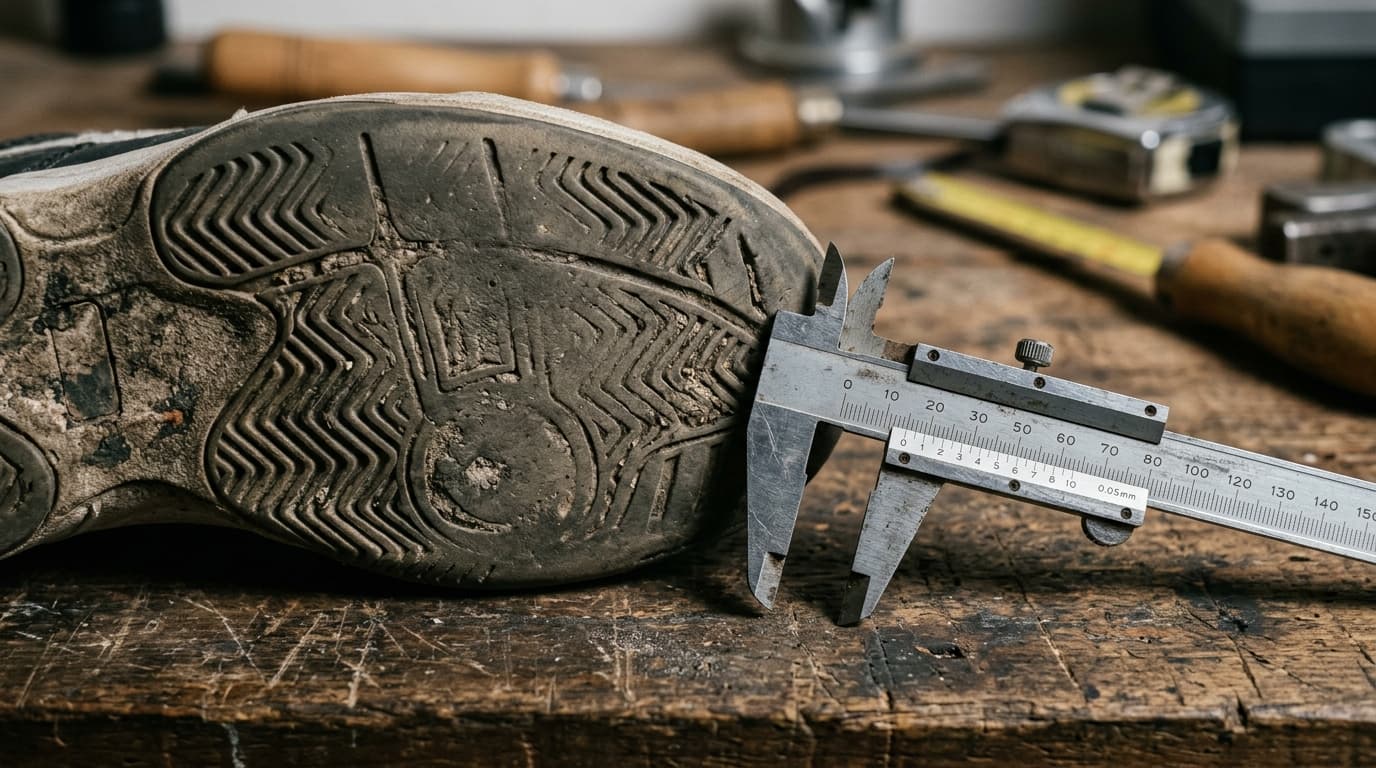
With a rotary tool and a gauge. The most detailed protocol is the one used by RunRepeat: a Dremel spins at 10,000 rpm, fitted with an abrasive tip, and is held against the rubber for 22 seconds under 3.2 N of pressure. The depth of the dent is then measured with a gauge, in millimetres.
The smaller the dent, the better the rubber resists abrasion.
A second instrument completes the first. The durometer reads the hardness of the rubber, expressed in HC. The Nike GP Challenge Pro shows 87.5 HC, a hard rubber, and a 0.6 mm dent.
The strength of the method is its consistency: same tool, same duration, same pressure for every shoe. Its flaw is that it tests a single spot of the outsole, for less than half a minute, without a player's weight or the twist of a change of direction.
What are the millimetres of a Dremel test worth?
They are worth something by comparison, and only against the average shown on the same page. That average moves with the test date: it is 0.6 mm on some RunRepeat pages and 0.8 mm on others.
The same figure can therefore tell two stories.
| Model | Dremel dent | Average quoted on the page | Reading | Durability on our grid |
|---|---|---|---|---|
| Nike GP Challenge Pro | 0.6 mm | 0.6 mm | average | 8.2/10 |
| Asics Gel-Resolution X | not specified | not specified | 0.3 mm less than average | 9.0/10 |
| Adidas Barricade 14 | 0.6 mm | 0.8 mm | better than average | 7.0/10 |
The Nike GP Challenge Pro and the Adidas Barricade 14 both dent by 0.6 mm. The first is ‘average’, the second ‘better than average’, because the two pages do not share the same reference. Comparing two dents without their average is like comparing two prices without knowing the currency.
The gap between their scores on our grid, 8.2 against 7.0, comes from elsewhere: from on-court playtesters, covered further down.
For the GP Challenge Pro, RunRepeat draws a conclusion that matters on a tight budget: its durability matches that of more expensive models while it costs less than average. It was recorded at around €97 in Belgium, and its full review goes through these measurements.
Rubber hardness: does a hard rubber last longer?
In general, yes, with a trade-off on grip. According to RunRepeat's hard court shoe guide, a soft rubber grips more but wears faster, and a hard rubber lasts longer but can feel slippery until it is broken in.
Hardness does not tell the whole story, though. Two other figures count just as much.
Thickness, first. RunRepeat measures 3.0 mm of rubber under the Adidas Barricade 13, clearly less than average. That thin outsole still scores 9.0/10 for durability on our grid, thanks to its full-length Adiwear 2.0 herringbone: a tough rubber makes up for reduced thickness, up to a point.
Placement, next. The Nike Vapor 12 lost a large part of its rubber to save weight, according to Tennis Warehouse, and its score drops to 7.2. The Asics Solution Speed FF 4 makes the same choice, with rubber reinforced only where it wears, and scores 6.2. Its outsole is not a bad one for all that: RunRepeat measures a friction coefficient of 1.11, a very strong grip on hard courts. It is built to grip, not to last.
The article on outsole rubbers compared covers these compounds brand by brand.
What do on-court playtesters measure that the lab cannot see?
Real wear, where it happens. An on-court test lasts weeks and goes through serves, hard stops and slides, three movements a rotary tool does not reproduce.
Tennis Warehouse scores the outsole and the toe cap separately, out of 5. In its review of the Nike Air Zoom Vapor Cage 4, the model gets 4.5/5 for outsole durability and 4.5/5 for toe durability. The testers, spread across the United States, Europe and Australia, name comfort, stability and durability as its strengths. They also explain why: the rubber wraps up over the toe cap and the medial side, the two areas scraped by players who slide on hard courts. The Vapor Cage 4 review points out that it is an older generation, to be tracked down before you count on it.
These tests sometimes give a time marker. In its review of the Yonex Eclipsion 5, Tennis Warehouse notes that after about 20 hours of play, the front of the outsole still had plenty of tread, with light wear under the toes.
They also contradict the lab, and that is their main value. The Adidas Barricade 14 comes out of the Dremel test well, yet the testers at Tennis Companion see its Lighttraxion outsole go smooth under the big toe right up to the toe cap, sooner than expected. Both findings are true at the same time. The first describes the material, the second describes what a player does with it.
Does an outsole warranty prove that a rubber lasts?
It suggests it, without proving it. A seller who replaces a pair worn through in under six months is betting that most outsoles will last longer.
The most quoted warranty is that of the American retailer Tennis Warehouse. It covers the Nike Vapor Cage 4, the Asics Gel-Resolution X and the Adidas Barricade 13 and 14, among others. It can be used once only, for an outsole worn through to the midsole, and excludes the toe cap and the upper.
Two reservations limit that signal. The presence of the Barricade 14 on the list shows that a model debated by playtesters can be covered. And the warranty only applies to a purchase from that retailer in the United States: in Belgium, the 2-year legal guarantee covers defects, not normal wear. The details are in the article on the 6-month outsole warranty.
Why does no test give a lifespan in hours?
Because the answer changes with the player and with the court. Three factors weigh more than the rubber itself.
- The surface: hard courts are very abrasive, clay wears the outsole far less. In Belgium, more than eight courts in ten are clay, according to the RTBF: it is the indoor winter season that puts the rubber to the test.
- The movement: on the serve, the back foot drags along the court. The tip and the medial forefoot go first.
- The build: heavier players wear out their shoes faster, and light models generally last less long than stable ones.
The only figure in hours that serves as a reference concerns the cushioning, not the rubber. The AAPSM considers a midsole worn out after 45 to 60 hours of tennis. On clay, the rubber often outlasts that mark and the foam decides. On hard courts, a player who slides can wear through it sooner.
The calculation by playing frequency is in the article on how long tennis shoes last.
How are our durability scores built?
By compilation, not on a test bench. I do not wear the shoes and I do not grind any outsole: each score out of 10 brings together the published lab measurements, the scores of on-court playtesters, the outsole construction described in the spec sheets and the warranty terms.
When the sources contradict each other, the score reflects it. The Barricade 14 stays at 7.0/10 despite its good Dremel dent, because the wear seen on court weighs in the balance.
The ranking of durable tennis shoes then sorts the models with a published formula: 0.7 times the durability score, plus 0.3 times the overall score. The Nike Air Zoom Vapor Cage 4 comes first, with 9.4 for durability.
| What you read | What it measures | What it does not tell you |
|---|---|---|
| Dremel dent (mm) | the rubber's resistance to abrasion, at one spot | wear under your weight and your footwork |
| Hardness (HC) | how firm the rubber is | its thickness, its placement |
| Playtester score (/5) | real wear after weeks of play | what will happen on your surface |
| Outsole warranty | the seller's bet over six months | whether it applies to a purchase in Belgium |
| Score /10 on our grid | the summary of the four rows above | a lifespan in hours |
How can you measure the wear of your own outsoles?
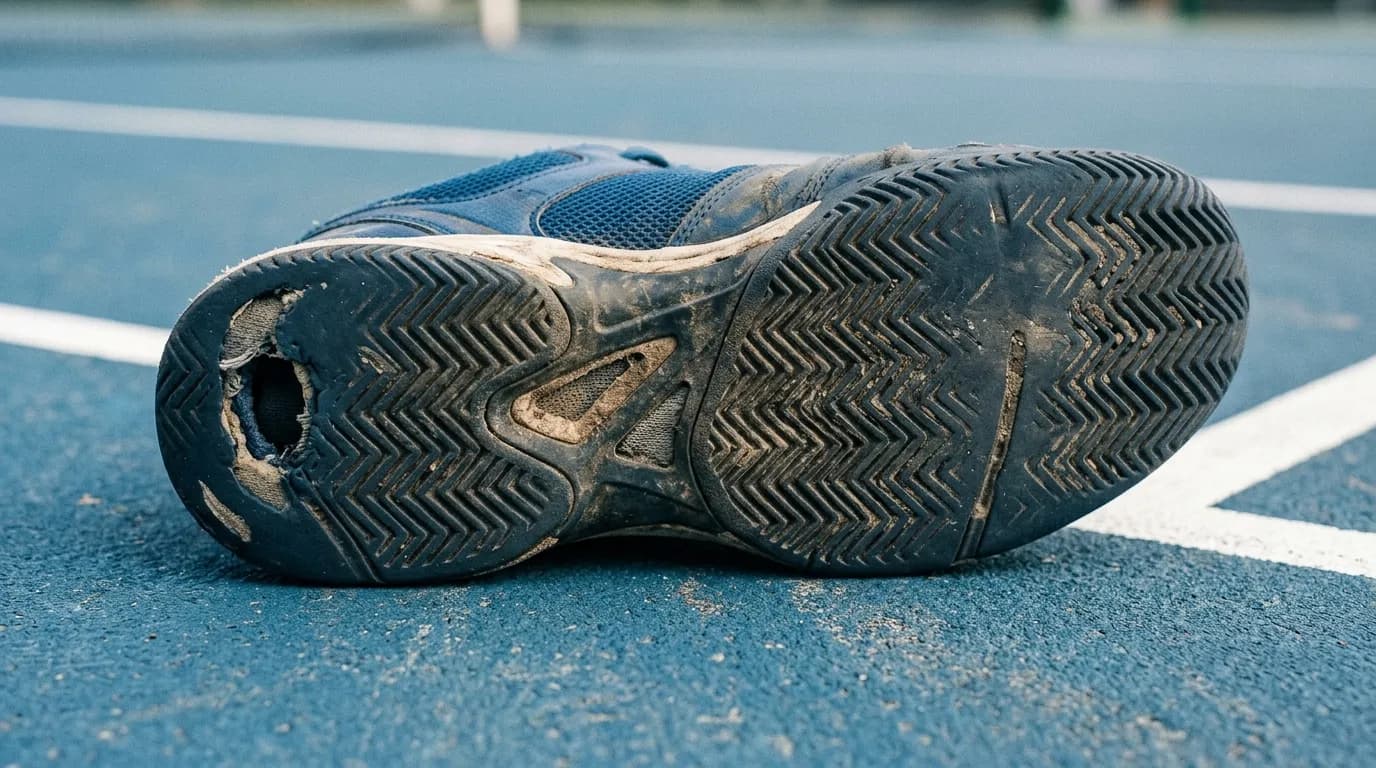
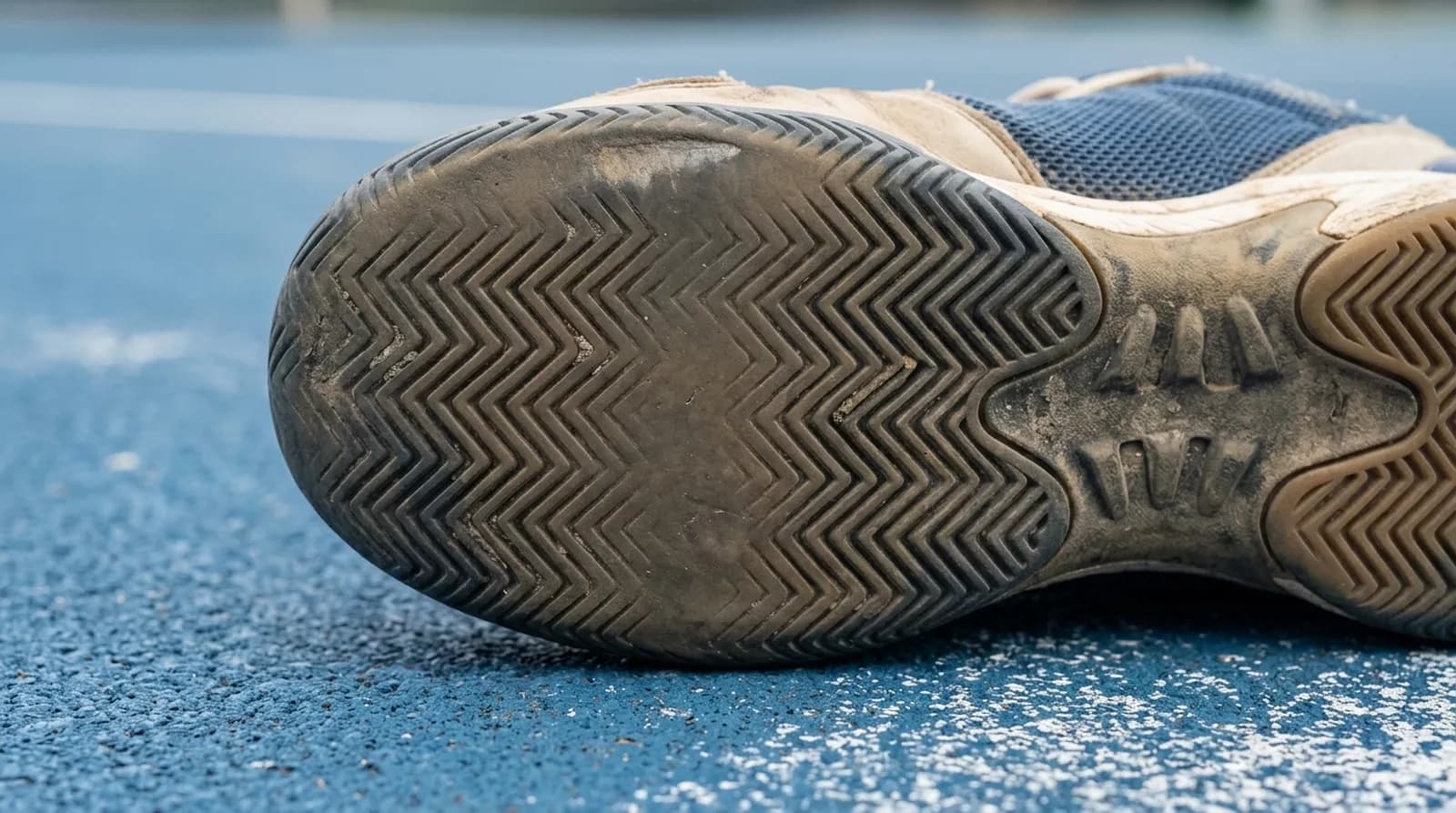
With your eyes, once a month. Turn the pair over and look for four signs:
- smooth areas where the tread has gone, especially under the big toe;
- visible foam, a hole or a cut;
- a clear difference between the left and the right shoe;
- a shoe that leans when placed on a flat surface.
That personal record is the only measurement in hours you will get. It also lets you work out your pair's price per hour of play, the price that matters.
The comparison tool lines up the durability scores of the 37 models, and the overall ranking sets them against the four other criteria.
Sources
- RunRepeat, Nike GP Challenge Pro (Dremel and durometer protocol)
- RunRepeat, best hard court tennis shoes
- RunRepeat, Adidas Barricade 14
- RunRepeat, Adidas Barricade 13
- RunRepeat, Asics Gel-Resolution X
- RunRepeat, Asics Solution Speed FF 4
- Tennis Warehouse, Nike Air Zoom Vapor Cage 4 review
- Tennis Warehouse, Nike Zoom Vapor 12 review
- Tennis Warehouse, Yonex Eclipsion 5 review
- Tennis Warehouse, 6-month outsole warranty
- Tennis Warehouse Europe, warranties
- Tennis Companion, Adidas Barricade 14
- Tennis Companion, clay court tennis shoes
- Tennis Companion, lightweight tennis shoes
- Tennis Server, wear and toe drag
- tennis.com, when is it time for a new pair of shoes
- AAPSM, When to replace athletic shoes
- RTBF, clay at the heart of Belgian tennis
Your questions
Frequently asked questions
How is tennis shoe outsole durability tested?
In the lab, RunRepeat grinds the rubber with a Dremel at 10,000 rpm for 22 seconds under 3.2 N, then measures the depth of the dent. On court, Tennis Warehouse playtesters score the outsole and the toe cap out of 5 after several weeks of play.
Which tennis outsole holds up best according to the tests?
At Nike, the Air Zoom Vapor Cage 4: 4.5/5 for the outsole and for the toe cap at Tennis Warehouse, and 9.4/10 on our grid. The Asics Gel-Resolution X wears 0.3 mm less than average in RunRepeat's Dremel test and scores 9.0/10.
Which tennis shoes last longest on hard courts?
On our grid, the Nike Air Zoom Vapor Cage 4 (9.4/10 for durability), then the Asics Gel-Resolution X, the Adidas Barricade 13 and the Babolat Propulse Fury 3 (9.0). The Nike GP Challenge 1.5 and the Vapor Pro 3 follow at 8.6.
What does 87.5 HC mean for an outsole rubber?
It is its hardness, read on a durometer. At 87.5 HC, the rubber of the Nike GP Challenge Pro is hard. According to RunRepeat, a hard rubber lasts longer than a soft one, but can feel slippery until it is broken in.
Does a good Dremel score guarantee an outsole that lasts?
No. The Adidas Barricade 14 only dents by 0.6 mm, against 0.8 mm on average, while Tennis Companion's testers see its outsole go smooth under the big toe sooner than expected. The Dremel tests one spot of rubber, not the way you play.
How many hours does a tennis outsole last?
No test publishes a lifespan in hours for the rubber. The AAPSM puts midsole wear at between 45 and 60 hours of tennis. On clay, the rubber often outlasts that mark; on hard courts, a player who slides can wear through it sooner.