Durability & wear
Tennis Shoe Outsole Rubber: Which One Lasts Longest?
The tennis shoe outsole that lasts is the one with rubber in the wear zones. Nike Vapor Cage 4 at 9.4/10, AHAR Plus, Adiwear 2.0 and Michelin at 9/10.
Contents · 11 sections
- Key takeaways
- Which rubber lasts longest, brand by brand?
- Why does the amount of rubber matter more than its name?
- How is rubber durability measured?
- Soft or hard rubber: which should you choose?
- Which rubber for which player?
- Does clay wear rubber less?
- How can you tell the rubber is finished?
- Sources
- FAQ
- Related articles
The outsole rubber that lasts longest is the one laid down generously where you wear it: the inner forefoot and the toe. Among the rated models, the Nike Air Zoom Vapor Cage 4 comes first (9.4/10), ahead of Asics AHAR Plus, Adidas Adiwear 2.0 and Babolat's Michelin rubber, all at 9.0/10 on their toughest model.
The name of the compound is never enough.
Which rubber lasts longest, brand by brand?
Every brand has its own rubber, and most offer it in a light version and a hard-wearing one. The table lists the rubber, its toughest model and what published tests say about it. The /10 scores come from our durability grid.
| Brand | Rubber | Reference model | Durability /10 | What tests show |
|---|---|---|---|---|
| Nike | rubber wrapping up over the toe and inner side | Air Zoom Vapor Cage 4 | 9.4 | 4.5/5 outsole and toe at Tennis Warehouse |
| Nike | herringbone high-abrasion rubber, denser at the inner forefoot | GP Challenge 1.5 | 8.6 | rubber drag guard on the toe |
| Nike | full-length Hart rubber | Vapor Pro 3 | 8.6 | "fantastic" durability according to RunRepeat |
| Nike | hard high-abrasion rubber (87.5 HC) | GP Challenge Pro | 8.2 | 0.6 mm in the Dremel test, on the average |
| Asics | AHAR Plus + PGUARD | Gel-Resolution X | 9.0 | 0.3 mm less than average in the Dremel test |
| Adidas | Adiwear 2.0 | Barricade 13 | 9.0 | outsole rated very hard-wearing, but thin (3.0 mm) |
| Adidas | Lighttraxion | Barricade 14 | 7.0 | contradictory tests |
| Babolat | Michelin | Propulse Fury 3 | 9.0 | thicker lugs, brand outsole warranty |
| K-Swiss | Aosta 7.0 + DragGuard 7.0 | Ultrashot 4 | 8.4 | reinforcement in the wear zones |
| Yonex | Endurance Rubber II | Eclipsion 5 | 8.2 | plenty of tread left after about 20 h |
| Head | Hybrasion+ | Revolt Pro 5.0 | 8.2 | formulated for hard courts |
| Wilson | Duralast | Rush Pro 5 | 7.4 | high density, quick holes reported by customers |
| Mizuno | DX Rubber | Wave Exceed Tour 7 | 7.4 | Mizuno's toughest rubber, on a light model |
| New Balance | NDurance | Fresh Foam X CT-Rally v2 | 7.2 | good abrasion resistance according to RunRepeat |
Two rubbers with the same name can give very different scores. Michelin rubber scores 9.0 on the Propulse Fury 3 and 6.4 on the lighter Jet Mach 4. Asics AHAR drops to 6.2 on the Solution Speed FF 4, whose "AI-designed" outsole keeps rubber only where it wears.
Why does the amount of rubber matter more than its name?
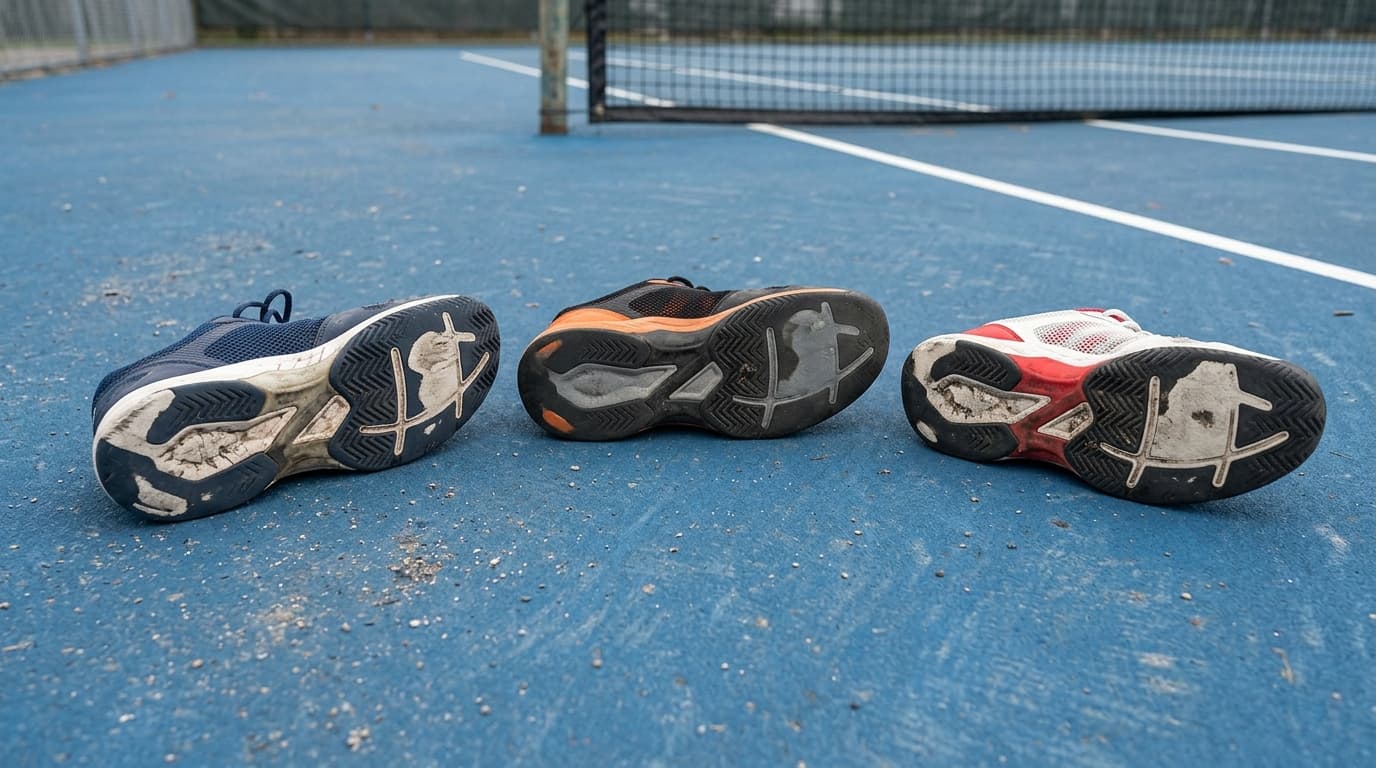
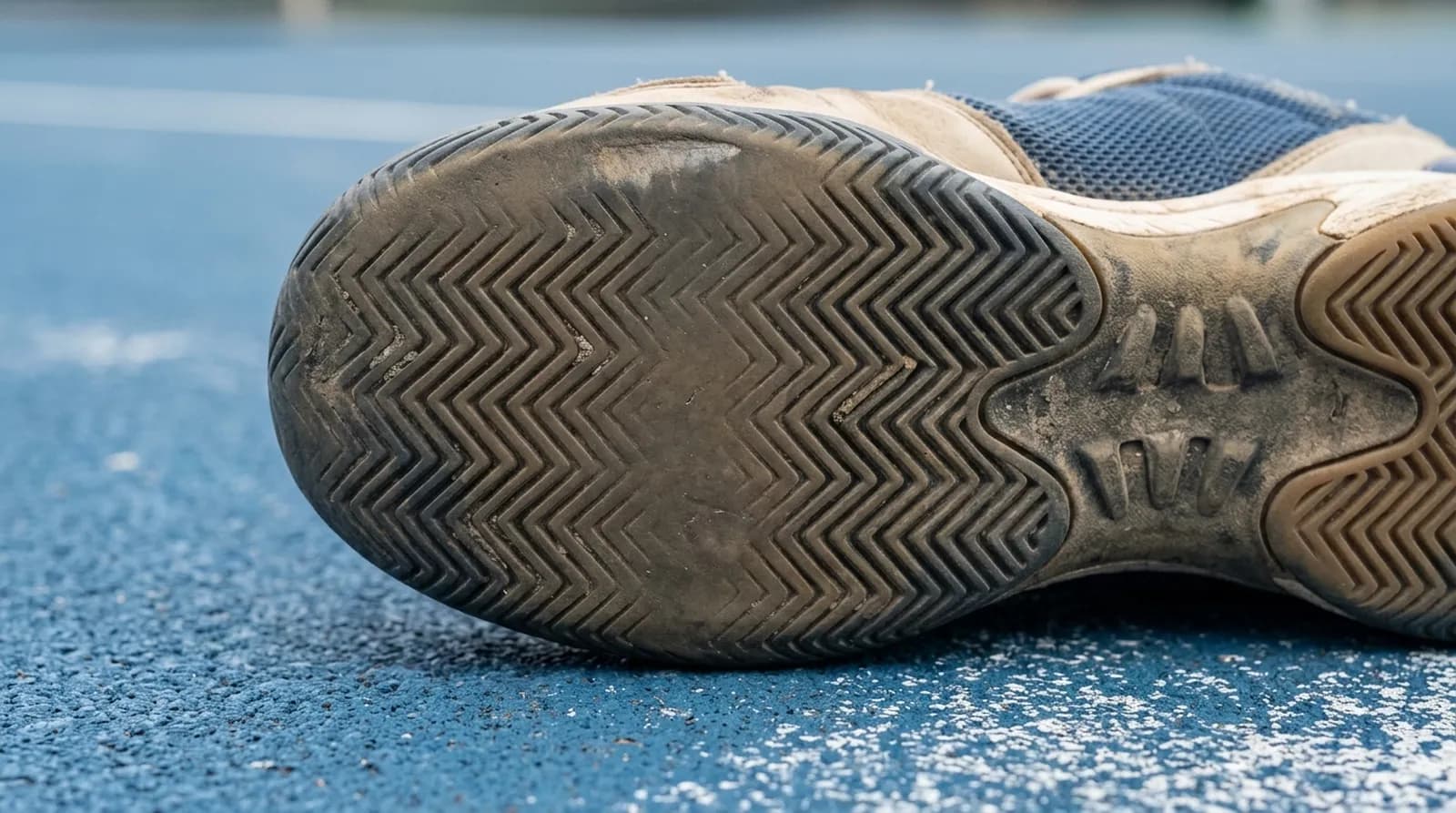
Because wear is localised. On the serve, the back foot drags on the court and the toe wears first; for a right-hander, it is the inside of the right shoe that goes, according to Tennis Server. When braking, it is the inner forefoot.
So the most durable outsoles do not rely on a miracle compound but on geography. The Vapor Cage 4 wraps its rubber up over the toe and inner side. The GP Challenge 1.5 makes it denser under the inner forefoot. The Asics Gel-Resolution X adds PGUARD at the toe and heel, a rubber Asics presents as 50% more durable than its standard AHAR (figure quoted by a retailer). K-Swiss thickens its Aosta 7.0 with DragGuard 7.0 where it rubs.
Conversely, a lightened shoe loses its rubber first. That is the case with the Vapor 12: to save weight, Nike removed much of the rubber, and the score drops to 7.2. The Nike models are covered in detail in the article on the most durable Nike tennis shoes.
How is rubber durability measured?
With a Dremel and a durometer. RunRepeat's protocol applies a Dremel tool at 10,000 rpm, with an abrasive tip, for 22 seconds under 3.2 N of pressure, then measures the depth of the dent with a gauge. Rubber hardness is read on a durometer, in HC.
These figures need careful comparison. RunRepeat's average varies with the date of the test (0.6 mm or 0.8 mm depending on the page), and a 0.6 mm dent can be "average" on one page and "better than average" on another. A measurement only means something next to the average quoted on the same page.
Soft or hard rubber: which should you choose?
Soft rubber grips more but wears faster. Hard rubber lasts longer but can feel slippery until it is broken in, according to RunRepeat. The Nike GP Challenge Pro is the second case: 87.5 HC, a hard rubber that wears at an average rate for a below-average price.
Which rubber for which player?
The right choice depends on how you wear shoes, not on the catalogue.
| Your case | What matters in the rubber | Models to look at (Nike first) |
|---|---|---|
| You wear through the forefoot on hard courts within a few months | thick, dense rubber under the inner forefoot | Nike Vapor Cage 4, GP Challenge 1.5 · Asics Gel-Resolution X · Babolat Propulse Fury 3 |
| You drag your foot on the serve | rubber or reinforcement that wraps up over the toe | Nike Vapor Pro 3, GP Challenge 1.5 · K-Swiss Ultrashot 4 |
| You play mostly on clay in summer | deep herringbone, hardness matters little | clay version of the Nike Vapor Pro 3 or GP Challenge 1.5 |
| You play indoors on carpet in winter | smooth, non-marking outsole, not a hard-court rubber | dedicated indoor model |
| You want durability for under €110 | hard rubber, even without targeted reinforcement | Nike GP Challenge Pro · Adidas Barricade 13 |
Does clay wear rubber less?
Yes, much less. Hard courts are very abrasive, and clay, being softer, wears the outsole little, according to Tennis Companion. In Belgium, more than eight courts in ten are clay (brique pilée, crushed brick), according to RTBF (in French), but clubs spend the winter under a bubble, on GreenSet or on carpet. That is the season that tests the rubber.
How can you tell the rubber is finished?
Not only by holes. The signs to watch, taken from the USTA and wear guides:
- the shoe no longer squeaks on hard courts and grip drops;
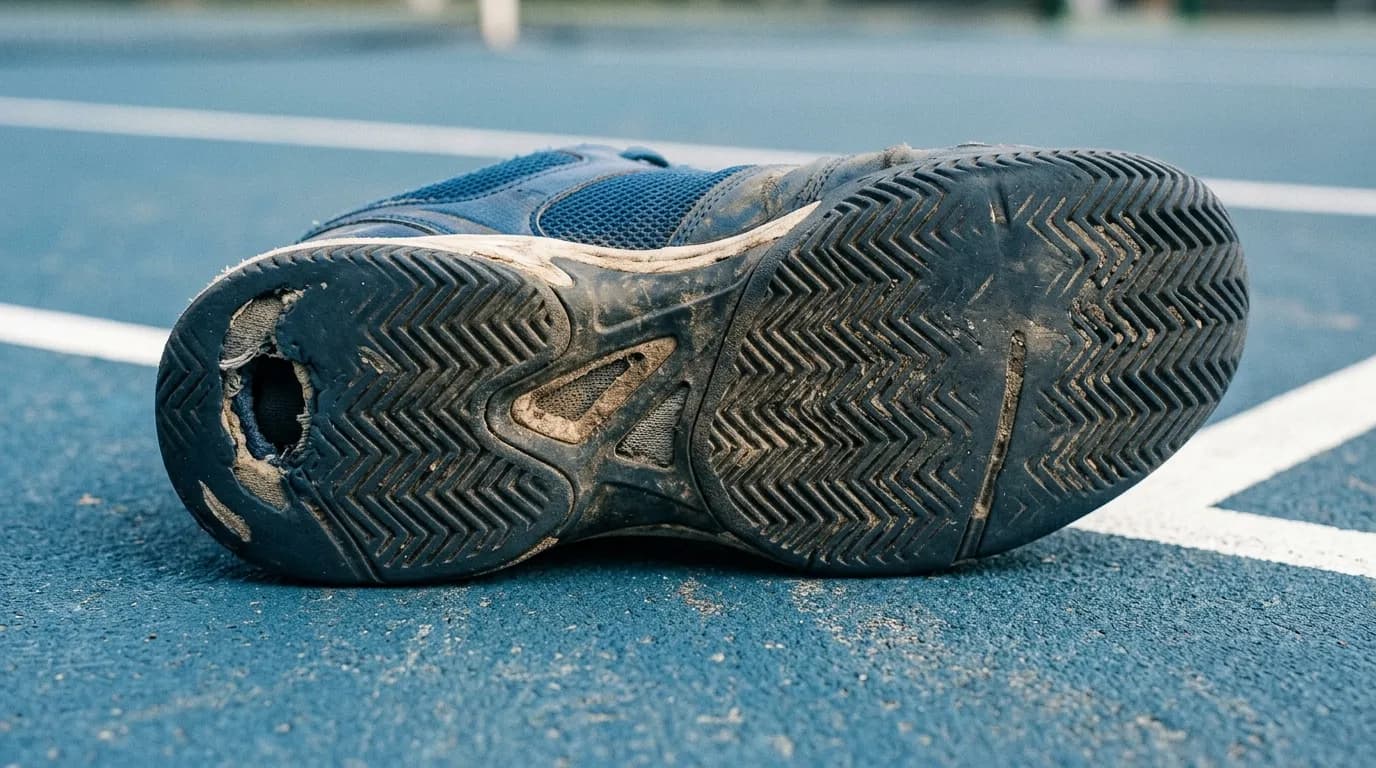
- smooth patches appear, with the tread gone under the big toe;
- the midsole foam starts to show;
- wear differs clearly between the left and right foot;
- your feet and ankles hurt more after a match.
Even intact rubber does not save the cushioning: the AAPSM puts its end of life at 45 to 60 hours of tennis. The calculation by playing pace is in the article on how long tennis shoes last.
The ranking of durable tennis shoes orders these models by score, the comparison tool lines them up criterion by criterion, and the Nike and Asics pages cover each range.
Sources
- RunRepeat, Nike GP Challenge Pro (Dremel and durometer protocol)
- RunRepeat, best hard court tennis shoes (soft or hard rubber)
- Tennis Warehouse, Nike Air Zoom Vapor Cage 4 review
- Tennis Warehouse, Nike GP Challenge 1.5 product page
- Tennis Warehouse, Nike Zoom Vapor 12 review
- Tennis Warehouse, Asics Gel-Resolution X product page
- RunRepeat, Asics Gel-Resolution X
- Tennis Warehouse, Asics Solution Speed FF 4 review
- Tennis Warehouse, Adidas Barricade 13 product page
- Tennis Companion, Adidas Barricade 14
- RunRepeat, Adidas Barricade 14
- Babolat, Michelin partnership
- Tennis Warehouse, Wilson Rush Pro 4 review
- Tennis Warehouse, K-Swiss Ultrashot 4 product page
- Tennis Warehouse, Mizuno Wave Exceed Tour 7 product page
- Tennis Warehouse, Yonex Eclipsion 5 review
- Tennis Warehouse, Head Revolt Pro 5.0 product page
- Tennis Server, wear and toe drag
- Tennis Companion, clay court tennis shoes
- RTBF, clay at the heart of Belgian tennis (in French)
- USTA, when to buy new tennis shoes
- AAPSM, When to replace athletic shoes
Your questions
Frequently asked questions
Which tennis outsole rubber is the most durable?
Among the rated models, the longest-lasting is the outsole of the Nike Air Zoom Vapor Cage 4 (9.4/10), whose rubber wraps up over the toe. Next come Asics AHAR Plus, Adidas Adiwear 2.0 and Babolat's Michelin rubber, at 9.0/10 on their flagship models. The amount of rubber matters as much as the compound.
Does Babolat's Michelin rubber last longer?
It is among the toughest: the Propulse Fury 3 scores 9.0/10 for durability and is the only model covered by a brand outsole warranty. On the lighter Jet Mach 4, the same rubber gives 6.4/10, because there is less of it.
Why is the Adidas Barricade 14 outsole controversial?
Because the tests contradict each other. Tennis Companion sees the new Lighttraxion rubber wear sooner than expected, while RunRepeat measures only 0.6 mm of wear in its Dremel test, against a 0.8 mm average. The Barricade 13, in Adiwear 2.0, remains the safe choice at 9.0/10.
Does hard rubber grip less?
At first, yes. According to RunRepeat, soft rubber grips more but wears faster, and hard rubber can feel slippery until it is broken in. After a few hours of play, the grip gap narrows; the lifespan gap does not.
Which tennis shoe brand lasts longest for the money?
At Nike, the GP Challenge Pro, found at around €97 in Belgium, wears at an average rate in RunRepeat's test. Outside Nike, the Adidas Barricade 13, at around €109, reaches 9.0/10 for durability. Spread over the 45 to 60 hours the cushioning lasts, both cost under €2.50 per hour.
Does the outsole wear more on clay or on hard courts?
On hard courts, clearly. Hard courts are very abrasive, while clay wears rubber far less, according to Tennis Companion. In Belgium, where more than eight courts in ten are clay, rubber suffers mostly in winter, indoors or under a bubble.