Durability & wear
Eco-Friendly Tennis Shoes: The Greenest Pair Lasts Longest
Eco-friendly tennis shoes: brands advertise 20 to 29% recycled content. A pair that lasts 60 hours instead of 45 saves one pair in four each year.
Contents · 13 sections
- Key takeaways
- What is the most eco-friendly tennis shoe?
- The brands' claims, with the numbers
- Do Nike tennis shoes contain recycled materials?
- The calculation that outweighs the percentage
- Does a shoe made with recycled materials wear out faster?
- The objection: cushioning gives out after 45 to 60 hours, whatever the rubber
- What should you do with worn tennis shoes in Belgium?
- Buying less often: which models should you aim for?
- Verdict: last first, recycle second
- Sources
- FAQ
- Related articles
The eco-friendly tennis shoe is not on the shelf yet: only one competition pair in our database publishes a recycled-content percentage, at least 20%, and most publish nothing. The greenest pair is therefore the one you buy least often. At three hours of play a week, an outsole that lasts 60 hours instead of 45 saves one pair in four.
I defend that argument with the brands' own figures, then with the objection that weakens it.
What is the most eco-friendly tennis shoe?
The one that lasts. That is not a dodge: it is what remains when you set the published percentages next to the number of pairs a player wears out in a year.
No pair is judged without the lifespan of its outsole, and that rule also applies to its material footprint.
The brands' claims, with the numbers
Four brands communicate on the subject, with very different levels of precision. I have kept only what is published, and added the durability of the outsole on our editorial grid.
| Brand and model | Published commitment | Figure | Outsole durability |
|---|---|---|---|
| Nike Vapor 12, GP Challenge, Vapor Cage 4 | Move to Zero programme on some products | no public percentage for these models | 7.2 to 9.4/10 |
| Asics Gel-Resolution X | recycled plastic in the upper; recycled sockliner, toe cap, eyelets, tongue and collar lining | no percentage published | 9.0/10 |
| Asics Solution Speed FF 4 | solution-dyed sockliner | around 33% less water and 45% less CO₂ than conventional dyeing | 6.2/10 |
| Adidas Barricade 13 | recycled materials | at least 20% | 9.0/10 |
| On THE ROGER Spin | recycled content, including 95% recycled polyester | around 29% | not in our database |
Three remarks on this table.
First: the two highest figures come from retailer listings or product pages, not from an audit. The one for the Barricade 13 appears on the Adidas page, and the same claim has not been verified for the Barricade 14. The one for THE ROGER Spin comes from a retailer listing. For THE ROGER Pro 3, On's competition model, no public figure was found.
Second: the Asics figure for the Solution Speed FF 4, reported by RunRepeat, concerns the dyeing of a single part, the sockliner. It is real and it is small.
The third is the one that matters. The two models whose recycled content is best documented, the Barricade 13 and the Gel-Resolution X, are also two of the toughest outsoles in our database, at 9.0/10. In their case, the two qualities do not conflict.
In 2021 On also announced CleanCloud, an EVA foam made from captured carbon emissions, with the ambition of extending it to all its EVA midsoles, THE ROGER range included. I found no confirmation that it is used in one of the brand's tennis shoes today. The On page reviews the range.
Do Nike tennis shoes contain recycled materials?
Some Nike shoes do. For the competition tennis models, no percentage is published.
The Move to Zero programme advertises at least 20% recycled materials on some products, such as the NikeCourt Legacy Next Nature, a lifestyle sneaker. For the Vapor 12, the GP Challenge and the Vapor Cage 4, I found no figure. Not disclosed, then, and I will not replace it with an estimate.
Nike acts at two other points in the cycle. The first is Nike Refurbished, launched in Europe in 2023, Belgium included: the brand resells returned or barely worn shoes after reconditioning them, according to FashionUnited. The second is Nike Grind, ground-up used shoes that are used in particular to build tennis courts and playgrounds.
That second programme has a Belgian story worth knowing. In 2021, a journalistic investigation reported by The Brussels Times tracked shoes handed to Nike Grind by GPS. It claims that pairs were shredded in Herenthout instead of being recycled at the Meerhout logistics campus, in the province of Antwerp. That is the finding of an investigation, not an established fact, and it is five years old. It is a reminder of something simple: a take-back programme is worth what its traceability is worth.
Where Nike scores without debate is on lifespan. The Nike page details the outsoles, from the Vapor Cage 4 to the Vapor Pro 3.
The calculation that outweighs the percentage
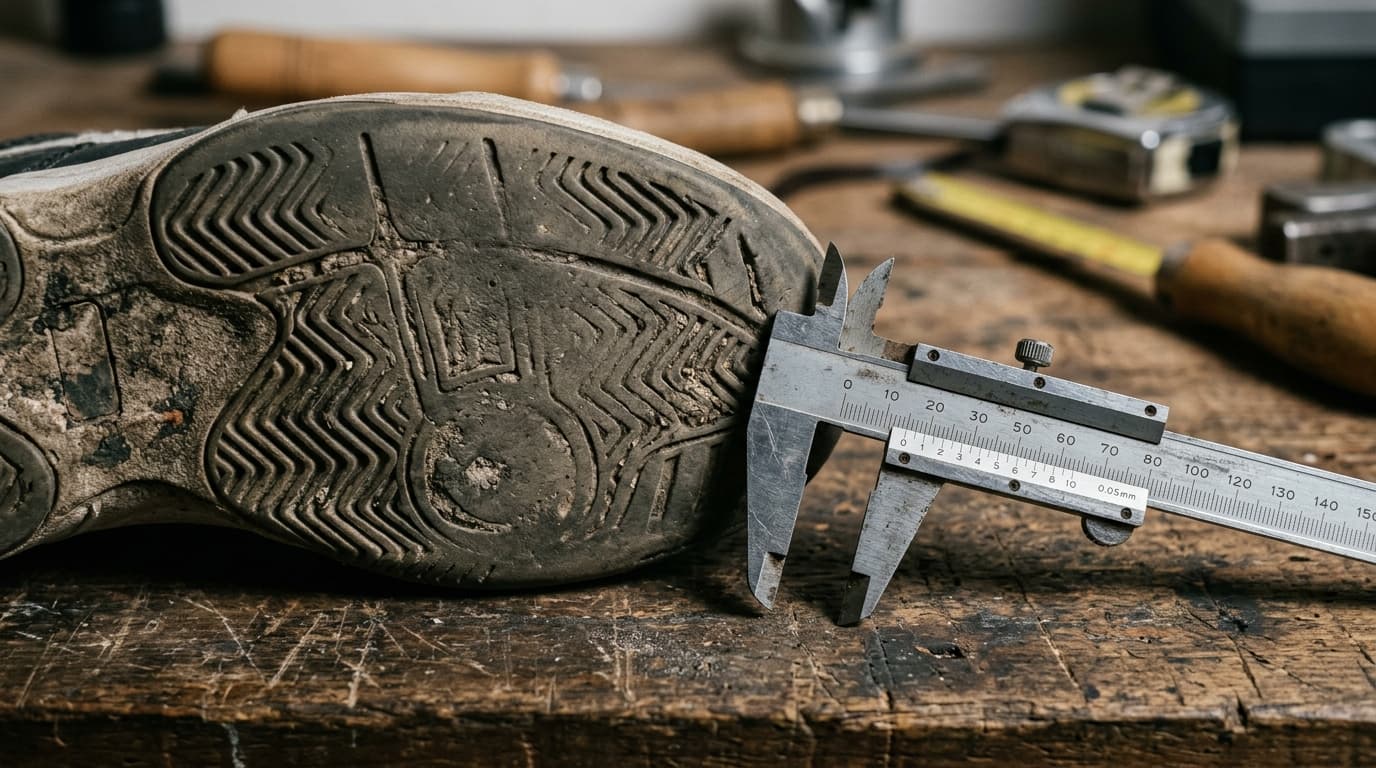
Take a player at three hours a week, about 150 hours a year. The AAPSM, the American Academy of Podiatric Sports Medicine, places midsole wear at 45 to 60 hours of tennis. Depending on whether the pair stops at the bottom or the top of that range, the player does not buy the same number of shoes.
| Your rhythm | Hours per year | Pairs per year if the pair lasts 45 h | Pairs per year if it lasts 60 h |
|---|---|---|---|
| 1 hour a week | about 50 h | 1 | 1 |
| 3 hours a week | about 150 h | 3.3 | 2.5 |
| 5 hours a week, league matches included | about 250 h | 5.6 | 4.2 |
Fifteen more hours per pair means a quarter fewer pairs. So a quarter less rubber, foam, glue, cardboard and transport, whether the material is recycled or not. Over four seasons at three hours a week, that is ten pairs instead of thirteen.
The recycled percentage removes nothing from the total: it changes the origin of part of the material. A pair with 20% recycled content that dies at 45 hours uses more new material per hour of play than a pair with no claim that lasts 60. The calculation is rough, it ignores manufacturing energy, and I found no published life-cycle analysis for a tennis shoe. It gives an order of magnitude, and that order leans towards lifespan.
It is the same reasoning as for your wallet. The article on the cost per hour of play runs it in euros.
Does a shoe made with recycled materials wear out faster?
Nothing in the sources I consulted suggests so, and nothing proves the opposite.
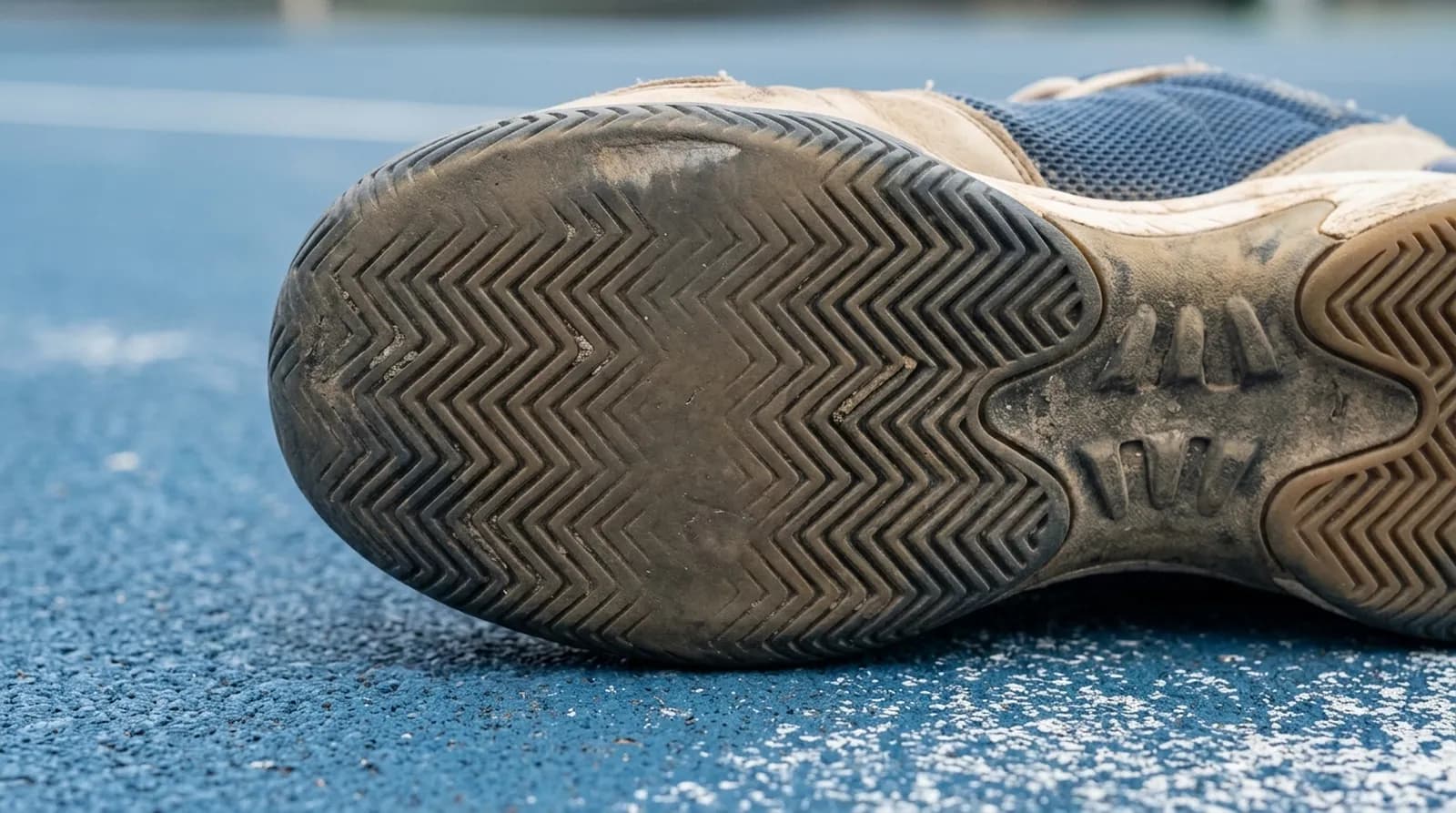
The two examples in our database point the right way: 9.0/10 for durability for the Barricade 13 and for the Gel-Resolution X. But on these two models, the advertised recycled content mostly concerns the upper and the trim parts. The outsole rubber, the part that rubs the court, is Adiwear 2.0 in one case and AHAR Plus in the other. No published measurement compares the wear of a recycled rubber with that of a new one.
So the question stays open.
The objection: cushioning gives out after 45 to 60 hours, whatever the rubber
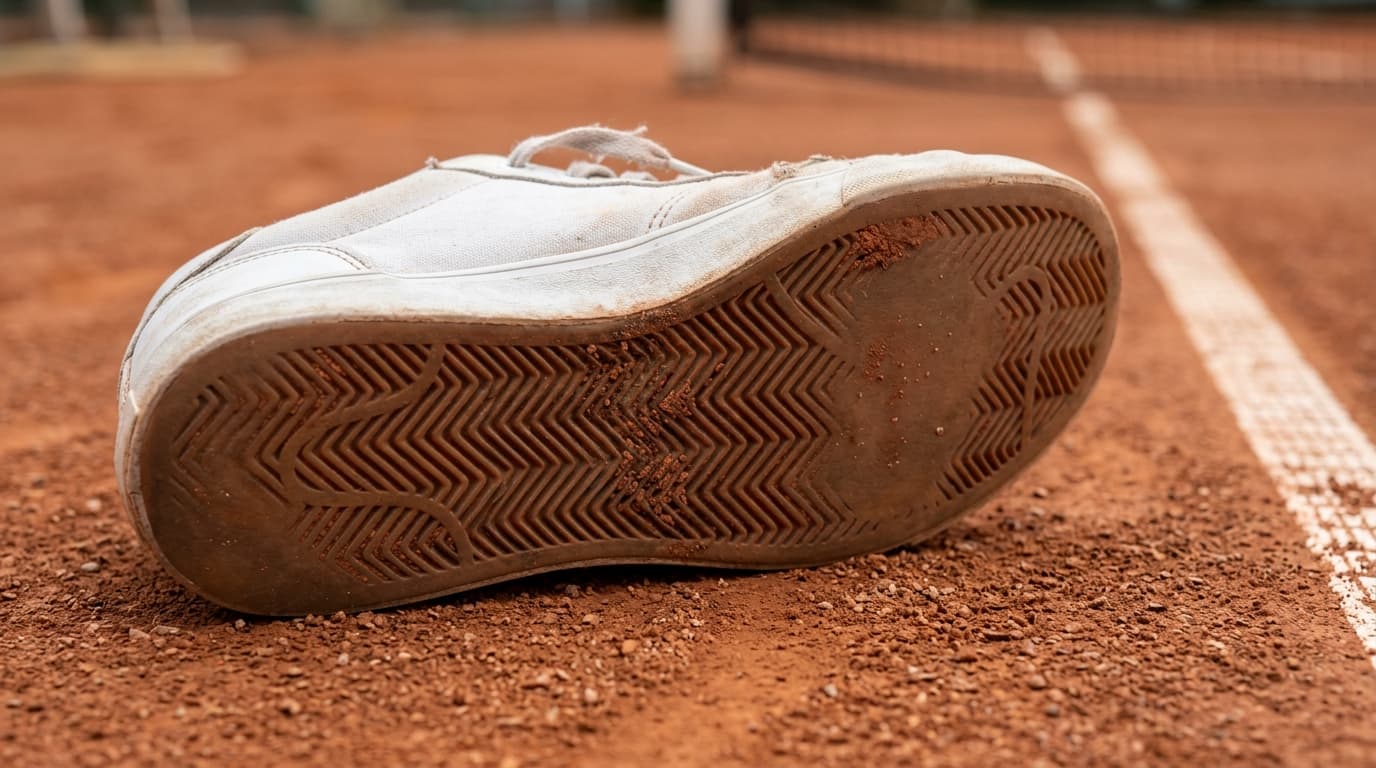
It is a serious one. If the foam is worn at 60 hours in the best case, a rubber able to last 100 is useless: the pair goes in the bin with tread still under the foot. On red clay, that is even the general case. More than eight Belgian courts out of ten are clay according to the RTBF, that surface wears rubber little, and it is the cushioning that sets the end of the pair.
The objection moves the problem, it does not cancel it. It says that, for many Belgian players in summer, lifespan is won somewhere other than in the choice of outsole. It is won in how you treat the pair, and those habits are documented:
- Rotate two pairs. A foam takes about 48 hours to decompress after intense effort, Asics explains in its care advice.
- Ban the washing machine, which shortens lifespan. Washing by hand with a soft brush is enough.
- Dry without heat: sockliner removed, newspaper in the shoe, changed after about ten minutes.
- Keep the pair for the court. The AAPSM points out that materials dry out and degrade even when unused, and advises replacing a sports shoe that is more than a year old.
- Choose the outsole for the surface. A clay outsole on hard courts, or the reverse, wears and grips badly.
In winter, the situation reverses. Indoors on hard courts, the rubber works at every stop, and that is where an outsole rated 9.0/10 gains weeks over one rated 6.4. The guide to caring for tennis shoes goes through each habit, and the article on how long tennis shoes last sets the benchmarks in hours.
What should you do with worn tennis shoes in Belgium?
Drop them off at Decathlon, whatever their brand. It is the only collection scheme I could document at national scale today.
| Your pair | Where to go | Good to know |
|---|---|---|
| Worn out, cushioning finished | Decathlon collection point | 33 of the 35 Belgian stores since January 2026, all brands; only Nivelles and Roeselare have none |
| Still playable, wrong size | Resale at Decathlon, online or in store | Decathlon.be also offers second-hand tennis shoes |
| You are buying a new pair | Nike Refurbished | returned or barely worn pairs, reconditioned by Nike |
| Any pair | Recupel | no: Recupel only takes back electrical appliances |
The partners of Decathlon Belgium are Terre, l'Ouvroir and Kringwinkel, for reuse, repair and recycling. The same page mentions extended producer responsibility for textiles and shoes from 2028 in Belgium; the timetable by Region remains to be confirmed.
On the federations' side, I found no collection dedicated to tennis shoes, neither at the TPPWB nor at Tennis Vlaanderen. A club that put a box at the clubhouse entrance, to be emptied at Decathlon at the end of the season, would already do better than the current situation.
Before throwing a pair away, check that it really is finished. The article on when to replace tennis shoes lists the seven signs that do not lie.
Buying less often: which models should you aim for?
Those with the best-rated outsole, provided you play on a surface where rubber is the limiting factor.
- Nike Air Zoom Vapor Cage 4: 9.4/10 for durability, the best score in our database. It is a generation older than the 2025 models: check its availability in Belgium before counting on it.
- Nike GP Challenge 1.5: 8.6/10, high-abrasion rubber that is denser under the inner forefoot, a current model.
- Nike Vapor Pro 3: 8.6/10, rubber up to the toe, around €117 in Belgium.
- Asics Gel-Resolution X: 9.0/10, with recycled parts advertised in the upper.
- Adidas Barricade 13: 9.0/10 and at least 20% recycled materials, end of line since the Barricade 14 arrived.
The ranking of durable tennis shoes orders them with its sorting formula. One honest reservation: a heavy, stable shoe bought by a light player who only plays on red clay will not gain that player a single hour. The best advice, for them, is to buy nothing as long as the current pair still cushions.
Verdict: last first, recycle second
Sources
- Adidas, Barricade 13 page (recycled materials)
- SportsShoes, Asics Gel-Resolution X (recycled parts)
- RunRepeat, Asics Solution Speed FF 4
- Equinox, On THE ROGER Spin (recycled content)
- FashionUnited, On CleanCloud
- Nike, NikeCourt Legacy Next Nature
- FashionUnited, Nike Refurbished launches in Europe
- The Brussels Times, investigation into Nike Grind
- Decathlon Belgium, recycling sports equipment
- AAPSM, when to replace athletic shoes
- Asics, tips to make your shoes last longer
- RTBF, clay at the heart of Belgian tennis
Your questions
Frequently asked questions
What is the most eco-friendly tennis shoe?
The one you keep the longest. Published recycled-content percentages top out at around 20 to 29%, whereas a pair that lasts 60 hours instead of 45 cuts the number of pairs bought by a quarter. In our database, the Nike Air Zoom Vapor Cage 4 scores 9.4/10 for durability, the Asics Gel-Resolution X and the Adidas Barricade 13 9.0/10.
Do Nike tennis shoes contain recycled materials?
Some Nike products do: the Move to Zero programme advertises at least 20% recycled materials on models such as the NikeCourt Legacy Next Nature. No public percentage was found for the Vapor 12, the GP Challenge or the Vapor Cage 4.
Where can you drop off worn tennis shoes in Belgium?
At a Decathlon store: 33 of the 35 Belgian stores have had a collection point for shoes of all brands since January 2026, with Terre, l'Ouvroir and Kringwinkel as partners. Recupel only takes back electrical appliances, not shoes.
Does a tennis shoe made with recycled materials wear out faster?
Nothing in our database suggests so. The Adidas Barricade 13, advertised with at least 20% recycled materials, scores 9.0/10 for durability, like the Asics Gel-Resolution X, which has several recycled parts. No published measurement compares the wear of a recycled rubber with that of a new one.