Durability & wear
Tennis shoe prices: the real cost per hour of play
A €97 tennis shoe costs €1.60 to €2.15 per hour of play, a €159 one €2.65 to €3.55. The calculation model by model, and what makes it change.
Contents · 12 sections
- Key takeaways
- How do you calculate a tennis shoe's price per hour of play?
- What does an hour of play cost, model by model?
- Is a €70 pair better than a €160 one?
- Why can a cheap pair end up costing more?
- Which Nikes offer the best cost per hour?
- How much should you spend on your first pair of tennis shoes?
- How many pairs a year should you plan for, and what budget?
- When should you buy to lower the price per hour?
- Sources
- FAQ
- Related articles
A tennis shoe's price should be judged per hour of play, not by its price tag. The cushioning lasts 45 to 60 hours whatever the model: a €97 Nike GP Challenge Pro works out at €1.60 to €2.15 per hour, a €159 Nike Vapor 12 at €2.65 to €3.55. For a recreational player, the cheapest pair almost always wins.
Almost, because this calculation assumes the outsole outlives the cushioning.
How do you calculate a tennis shoe's price per hour of play?
You divide the price paid by the number of hours the pair will last. For that number, the reference is the AAPSM, the American Academy of Podiatric Sports Medicine: a tennis shoe's midsole is worn out after 45 to 60 hours of play. The USTA, the US tennis federation, uses the same range.
So the calculation gives a range, not a single figure. A €97 pair divided by 60 hours gives €1.62; divided by 45 hours, €2.16. I round it to €1.60 to €2.15. The top of the range fits a heavy or very mobile player, the bottom a light player who is gentle on his footwork.
Two limits come on top. The AAPSM advises replacing any athletic shoe older than a year, even lightly used, because the foam and rubber dry out. And the calculation only makes sense if the outsole lasts at least as long as the cushioning, which depends on the rubber, your weight and the surface.
What does an hour of play cost, model by model?
The table covers nine shoes, Nike first, with the average price found in Belgium between June and September 2026 and their durability score on our grid (compiled from published tests, not on-court trials).
| Model | Price found in Belgium | Durability /10 | Cost per hour (45 to 60 h) | Cost per hour at 1 h/week (1 year) |
|---|---|---|---|---|
| Nike Vapor Lite 3 | around €70 | 7.0 | €1.15 to €1.55 | €1.35 |
| Nike GP Challenge Pro | around €97 | 8.2 | €1.60 to €2.15 | €1.87 |
| Nike Vapor Pro 3 | around €117 | 8.6 | €1.95 to €2.60 | €2.25 |
| Nike GP Challenge 1.5 | around €125 | 8.6 | €2.10 to €2.80 | €2.40 |
| Nike Vapor 12 | around €159 | 7.2 | €2.65 to €3.55 | €3.06 |
| Asics Gel-Dedicate 9 | around €61 | 5.8 | €1.00 to €1.35 | €1.17 |
| Asics Gel-Resolution X | around €130 | 9.0 | €2.15 to €2.90 | €2.50 |
| Adidas CourtJam Control 3 | around €71 | 7.2 | €1.20 to €1.60 | €1.37 |
| Adidas Barricade 13 | around €109 | 9.0 | €1.80 to €2.40 | €2.10 |
The last column is for the player who plays one hour a week: about 52 hours a year, and a pair replaced after a year, because the cushioning is worn or because of age. The price is then divided by 52.
First finding: when the cushioning wears out at the same rate, the cheapest pair always wins, since they all last 45 to 60 hours. A €61 Gel-Dedicate 9 costs less than half as much per hour as a Gel-Resolution X. The second finding corrects the first: the durability score ranges from 5.8 to 9.0, and it decides whether the pair will reach its 45 hours. No pair is judged without the lifespan of its outsole.
Is a €70 pair better than a €160 one?
For a recreational player, the €70 pair. For a player who wears out his rubber before his cushioning, a durable mid-range pair, rarely the €160 one.
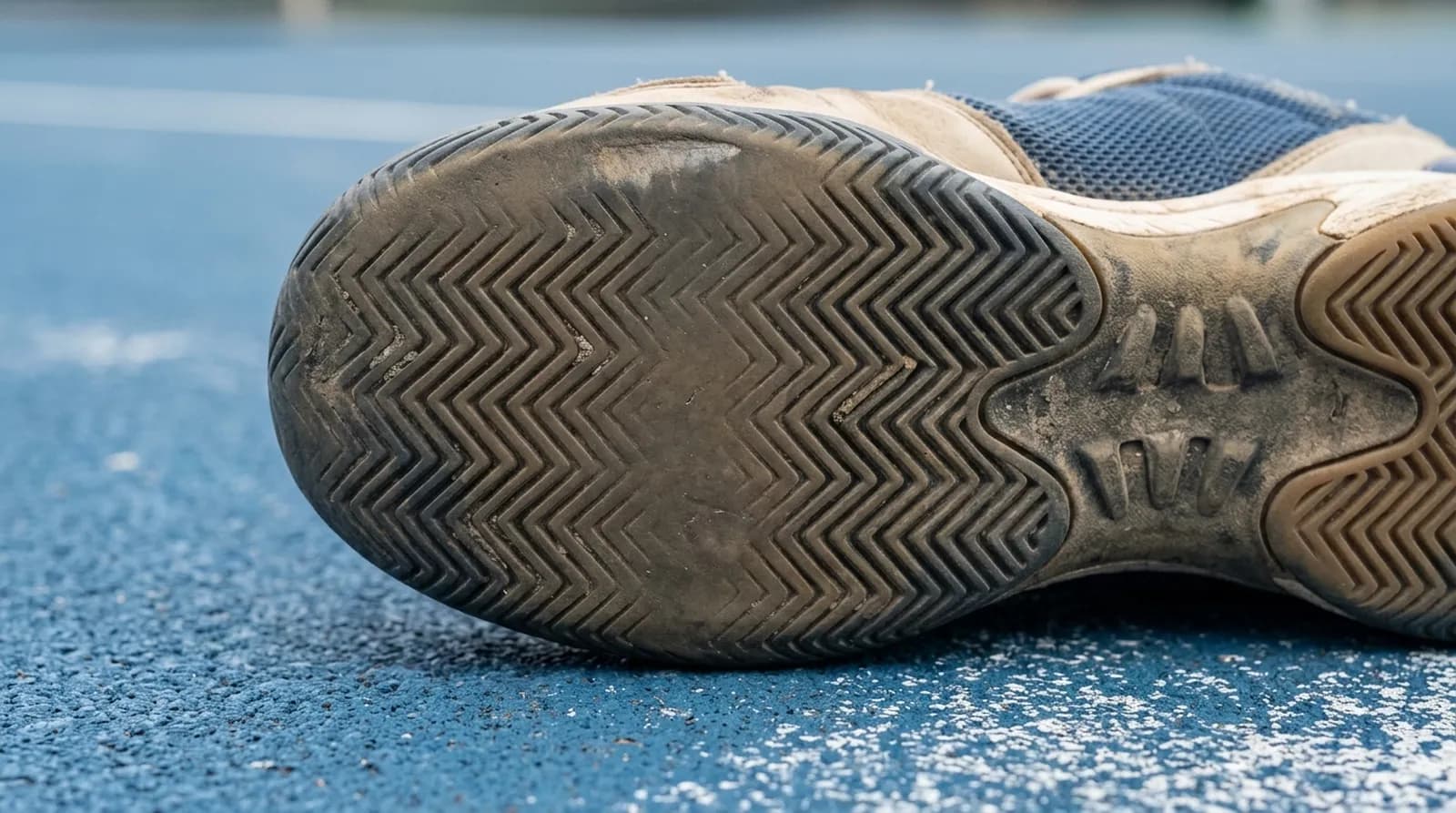
The €160 pair, here the Vapor 12, does not buy lifespan. To make it lighter, Nike removed much of the rubber, and Tennis Warehouse sees the outsole smooth out in the usual spots: 7.2/10 for durability, like the Adidas CourtJam Control 3 sold at €71. What the Vapor 12 brings is lightness (414 g in men's US 10.5) and grip (9.4/10). It is a playing choice, not a wear calculation, and the Vapor 12 review explains this trade-off.
The €70 pair, for its part, is not for everyone. The Vapor Lite 3 scores 7.0/10 for durability, and RunRepeat's test highlights an upper and outsole that are durable for the price, with a toe in the same reinforced rubber. For one or two hours a week on clay, it will reach its 45 hours without difficulty.
In between, the €95 to €135 bracket gathers the shoes that last longest: Barricade 13, Gel-Resolution X, GP Challenge 1.5, Vapor Pro 3, GP Challenge Pro. That is where a regular player finds the best calculation.
Why can a cheap pair end up costing more?
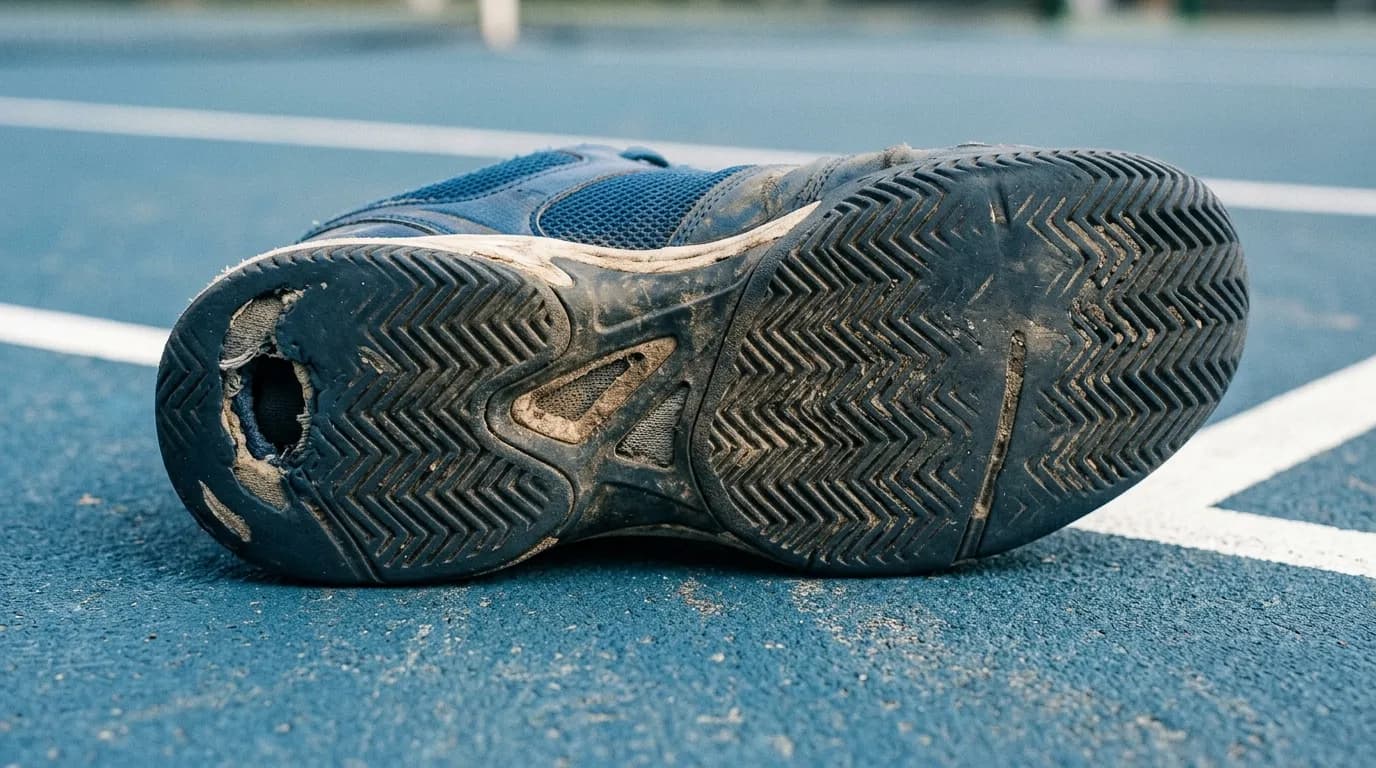
Because its outsole can give out before the cushioning, and the per-hour calculation collapses. The typical case is the heavy, powerful player or the toe dragger who plays on hard courts.
The USTA puts it another way: a baseliner who plays on hard courts several times a week wears shoes out much faster than a recreational doubles player on clay. Heavier players also wear out their shoes faster, according to Tennis.com. For them, entry-level rubber, like the basic AHAR of the Gel-Dedicate 9 (5.8/10), can smooth out or wear through before the foam is compressed.
No published test converts a durability score into hours, and I do not do it either. But the reasoning is simple: if a €61 pair only lasts half of its 45 hours, it ends up at the hourly price of a €120 pair, with two trips to the shop. For this profile, a GP Challenge Pro or a Barricade 13 is a better calculation than a Gel-Dedicate 9.
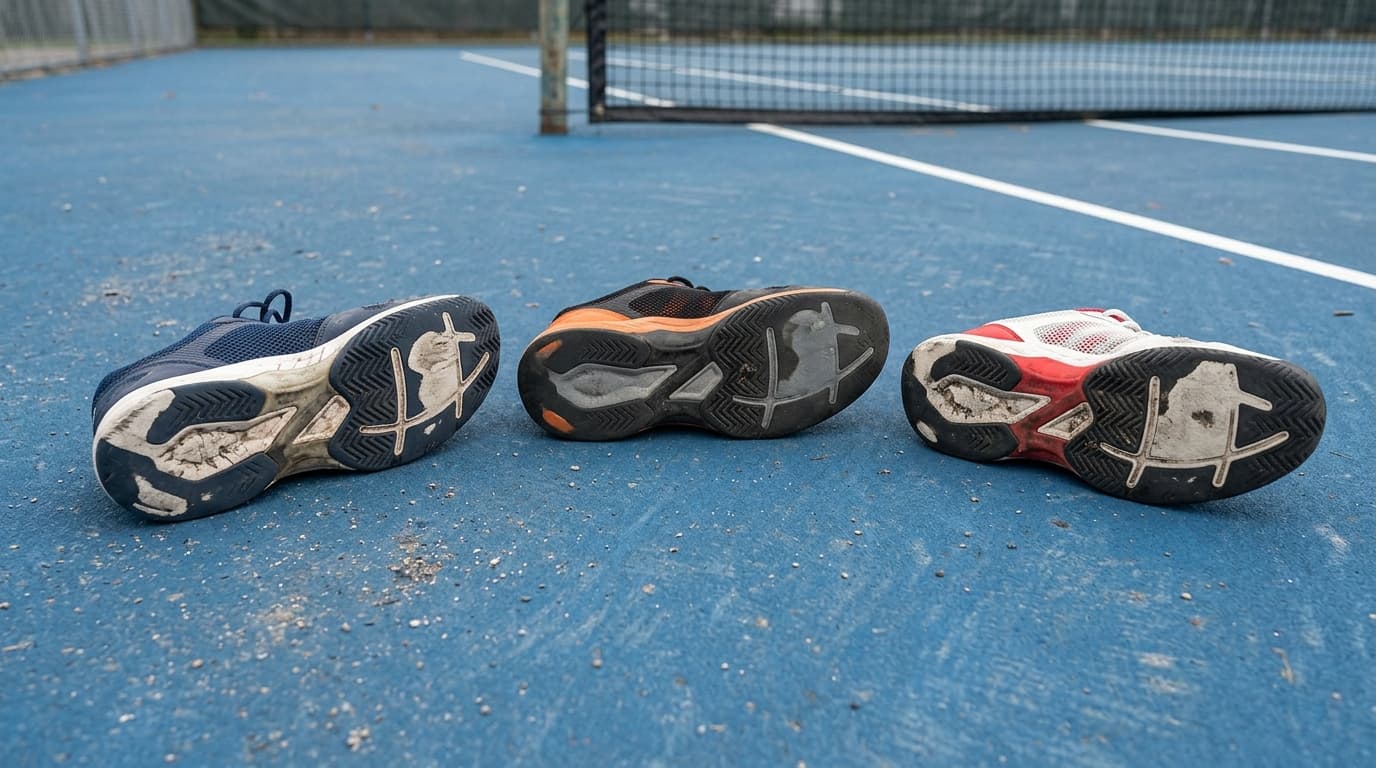
Toe drag is the most frequent case. For a right-hander, the toe of the right shoe can wear through before the cushioning is done; the article on tennis shoes for toe draggers compares toe guards.
Which Nikes offer the best cost per hour?
The GP Challenge Pro for a regular player, the Vapor Lite 3 for a recreational player.
The GP Challenge Pro is the best compromise in the range. According to RunRepeat's measurements, its hard rubber (87.5 HC) only wears 0.6 mm deep in the Dremel test, in line with the average, and its durability matches pricier models while it costs less than average. With 8.2/10 for durability and 8.8/10 for comfort, it works out at €1.60 to €2.15 per hour. Its weak point is the upper: the reviews collected report a mesh that gets damaged easily. It is all in the GP Challenge Pro review.
The Vapor Lite 3 goes down to €1.15 to €1.55 per hour. It is the Nike to aim for as a first pair or for one to two hours a week.
Above it, the Vapor Pro 3 (around €117) and the GP Challenge 1.5 (around €125) both score 8.6/10 for durability. They cost €0.35 to €0.65 more per hour than the GP Challenge Pro, but their rubber holds up better under a heavy player or when sliding on hard courts.
How much should you spend on your first pair of tennis shoes?
Between €60 and €100. In Belgium, entry level sits between €60 and €75 (Asics Gel-Dedicate 9, Adidas GameCourt 3 and CourtJam Control 3, Nike Court Lite 4 and Vapor Lite 3), mid-range between €95 and €135, and high end between €145 and €200.
To start out, Decathlon recommends a comfortable, flexible shoe; durability and cushioning become priorities as your level rises. A €70 first pair will be worn out by age or cushioning before you know whether your game wears the toe, the forefoot or the heel. The second pair is chosen by looking at the first.
The ranking of tennis shoes for beginners and the quiz help you decide according to your profile.
How many pairs a year should you plan for, and what budget?
At least one pair a year at one hour a week, according to the USTA. At two hours a week, count on two pairs; at three hours, two to three.
Belgian players have one more expense. More than eight courts out of ten are red clay in Belgium according to RTBF, but clubs spend the winter under a dome or indoors, on GreenSet or carpet. Many players end up with two pairs, one per season.
That is not necessarily more expensive. Two pairs share the hours, and each wears out more slowly; the summer pair wears little on clay, a surface far less abrasive than hard courts. For a player on two hours a week, two €70 pairs alternated over the year cost the same per hour as a single €70 pair replaced twice. Only the AAPSM's one-year age limit trims this calculation.
When should you buy to lower the price per hour?
When a model changes version, then during the sales. When a new generation comes out, the old one drops: the Barricade 13 is found at around €109 against €117 for the Barricade 14, although it scores 9.0/10 for durability against 7.0 for its successor, whose lighter Lighttraxion outsole wears out earlier according to Tennis Companion.
In Belgium, the 2026 winter sales ran from 3 to 31 January, and the summer sales start on 1 July. Promotions can appear all year round anyway since a Council of State ruling set aside the Belgian rule on sales periods, according to Test-Achats.
One thing is not up for negotiation: the often-quoted 6-month outsole warranty belongs to the US retailer Tennis Warehouse, not a warranty that applies in Belgium. Details are in the article on the 6-month outsole warranty.
To estimate your hours according to how often you play, see the article on how long tennis shoes last. The best value ranking orders the models by a published formula, the comparison tool lines them up criterion by criterion, and the Nike page presents the whole range.
Sources
- AAPSM, When to replace athletic shoes
- USTA, when to buy a new pair of tennis shoes
- Tennis.com, when is it time for a new pair of shoes
- RunRepeat, Nike GP Challenge Pro
- RunRepeat, Nike Vapor Lite 3
- RunRepeat, Nike Vapor Pro 3
- Tennis Warehouse, Nike Zoom Vapor 12 review
- Tennis Warehouse, Nike GP Challenge 1.5 product page
- Tennis Warehouse, Asics Gel-Dedicate 9 product page
- Tennis Warehouse, Asics Gel-Resolution X product page
- Tennis Warehouse, Adidas CourtJam Control 3 product page
- Tennis Warehouse, Adidas Barricade 13 review
- Tennis Companion, Adidas Barricade 14
- Decathlon Belgium, men's tennis shoes
- RTBF, clay at the heart of Belgian tennis
- Tennis Companion, clay court tennis shoes
- Paris Match Belgium, 2026 sales dates
- Test-Achats, sales all year round in Belgium
- Tennis Warehouse, 6-month outsole warranty
Your questions
Frequently asked questions
Which tennis shoe offers the best value for money?
At Nike, the GP Challenge Pro: around €97 in Belgium, 8.2/10 for durability and 8.8/10 for comfort, or €1.60 to €2.15 per hour of play. RunRepeat rates its durability on par with pricier models. Under €75, the Vapor Lite 3 (around €70) is the brand's lowest cost per hour.
Is a €70 tennis shoe better than a €160 one?
At one or two hours a week on clay, the €70 pair is: the cushioning wears out in 45 to 60 hours whatever the price, and the €160 pair costs more than twice as much per hour. The expensive pair only pays off if its outsole holds where an entry-level pair would give out before the cushioning.
Which tennis shoe brand lasts longest for the money?
At Nike, the GP Challenge Pro offers 8.2/10 for durability for around €97. At Asics, the Gel-Resolution X reaches 9.0/10 for around €130. At Adidas, the end-of-line Barricade 13 scores 9.0/10 for around €109. No brand wins across its whole range: it is a model-by-model calculation.
How many pairs of tennis shoes do you need per year?
At least one a year at one hour of play per week, according to the USTA, which uses 45 to 60 hours before the cushioning is worn out. At three hours a week, count on two to three pairs. The AAPSM also advises replacing any athletic shoe older than a year, even if lightly used.