Reviews NikeCourt Air Zoom GP Challenge Pro
The Nike GP Challenge Pro is the stable Nike for the intermediate player: 8.2/10 for durability with hard rubber that only wears 0.6 mm deep in RunRepeat's test, 8.8/10 for comfort, found at around €97 in Belgium.
Verdict
The GP Challenge Pro scores 8.8/10 because it offers the essentials of the GP Challenge family for under €100. Its hard high-abrasion rubber (87.5 HC) only wears 0.6 mm deep in RunRepeat's Dremel test, and RunRepeat rates its durability on par with pricier models; a rubberised drag guard protects the toe. Its wide base and Air Zoom cushioning on a rounded sole give it 8.6/10 for stability and 8.8/10 for comfort. Two flaws: a mesh upper that gets damaged easily according to the reviews collected, and above-average weight (the men's weight is not published). At around €97 in Belgium, it works out at €1.60 to €2.15 per hour of play, the best calculation in Nike's range above 8/10 for durability. For a player who wears out outsoles quickly on hard courts, the GP Challenge 1.5 lasts longer for about €28 more.
Best for : Intermediate player who wants a stable Nike without paying for the top of the range
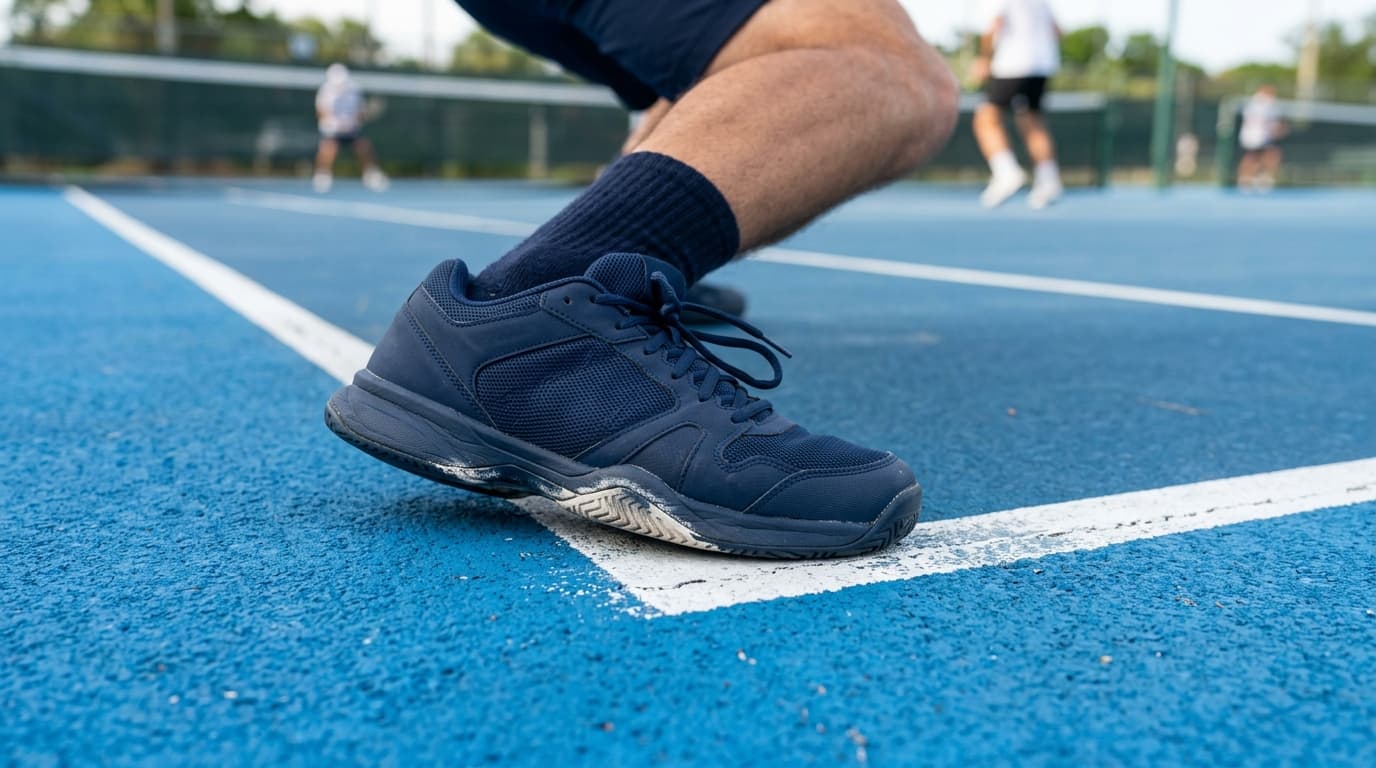
The GP Challenge Pro has herringbone high-abrasion rubber and a rubberised drag guard on the toe. In RunRepeat's Dremel test, its hard rubber (87.5 HC) only wears 0.6 mm deep, in line with the average, and RunRepeat rates its durability on par with pricier models. It scores 8.2/10 for durability on our grid, behind the GP Challenge 1.5 and the Vapor Pro 3 (8.6). The weak point is the mesh upper. No outsole warranty was identified; in Belgium, the 2-year legal guarantee covers defects, not wear. The cushioning lasts 45 to 60 hours of play according to the AAPSM.
Pros
- Hard rubber (87.5 HC): 0.6 mm of wear in RunRepeat's Dremel test, average durability for a lower price
- 8.2/10 for durability, rubberised drag guard on the toe against toe drag
- Wide base: 8.6/10 for stability, very stable laterally according to RunRepeat
- Air Zoom on a rounded sole: good shock absorption, 8.8/10 for comfort
- Around €97 in Belgium, €1.60 to €2.15 per hour of play, hard-court and clay versions
Cons
- Mesh upper that gets damaged easily, according to the reviews collected
- Heavier than average; men's weight not published (7.8/10 for lightness)
- No outsole warranty identified
How long does the Nike GP Challenge Pro's outsole last?
As long as pricier models' outsoles, for a below-average price. That is RunRepeat's finding: in the Dremel test, a grinder spinning at 10,000 rpm applied to the outsole for 22 seconds, the GP Challenge Pro's rubber only wears 0.6 mm deep, in line with the average of the shoes measured. Its rubber is hard, at 87.5 HC on the durometer.
Nike fitted it with herringbone high-abrasion rubber and a rubberised drag guard on the toe, against the back foot scraping on the serve. On our grid, it scores 8.2/10 for durability. That is less than the GP Challenge 1.5 and the Vapor Pro 3 (8.6), but clearly more than the Vapor 12 (7.2), sold for around €60 more.
Hard rubber has a known downside: it lasts longer, but can feel slippery until it is broken in. Allow a few sessions before you get the advertised grip (8.8/10).
The cushioning follows its own calendar. The AAPSM puts the end of life of a tennis shoe's midsole at 45 to 60 hours of play. At two hours a week, that is five to seven months, and the GP Challenge Pro's rubber will often still have tread by then, especially on clay.
No pair is judged without the lifespan of its outsole. This one has a good lifespan for its price; its weak point lies elsewhere, in the upper.
Is the mesh upper its weak point?
Yes, that is the recurring complaint. The reviews collected on the GP Challenge Pro report a mesh upper that gets damaged easily, while the outsole and drag guard hold up well. On a tennis shoe, the upper suffers most at the front, when braking and pushing off sideways, and on the inner side for a player who slides.
This flaw matters all the more because no warranty covers it. Even the often-quoted 6-month outsole warranty from the US retailer Tennis Warehouse excludes the upper and the toe cap; it also only applies to a purchase from that retailer, in the United States. In Belgium, the 2-year legal guarantee covers manufacturing defects, not normal wear.
A few habits limit the damage. No washing machine, which shortens a shoe's life according to ASICS: wash by hand with a soft brush. After a match in the rain or on damp clay, take out the insole and stuff the shoe with newspaper, without putting it against a radiator.
For a player who mainly wears out the upper, because he slides a lot or scrapes the inner side, the GP Challenge 1.5 is a safer bet: Nike reworked its upper and toe reinforcements for durability. For a player who wears out the outsole first, the GP Challenge Pro remains a very good calculation.
GP Challenge Pro or GP Challenge 1.5: which should you choose?
The GP Challenge Pro under €100, the GP Challenge 1.5 if you wear out outsoles quickly or want maximum cushioning.
Both share the same idea: a stable baseline shoe, with herringbone high-abrasion rubber and a drag guard. The GP Challenge 1.5 goes further everywhere. Its rubber is denser under the inner forefoot, the area that wears first when pushing off, according to Tennis Warehouse's product page. It puts Air Zoom in the heel and forefoot on a TPU plate. The result: 8.6/10 for durability, 9.4 for comfort and 9.0 for stability, against 8.2, 8.8 and 8.6 for the GP Challenge Pro.
The difference costs about €28: €125 for the 1.5 against €97 for the Pro, in average prices found in Belgium between June and September 2026. Per hour of play, based on 45 to 60 hours, the GP Challenge Pro works out at €1.60 to €2.15, the 1.5 at €2.10 to €2.80.
So the choice depends on how you wear shoes out. If your current pair dies from the cushioning, with tread still left under the foot, the GP Challenge Pro is enough. If it dies from the outsole or the toe, especially on hard courts, the extra €28 for the 1.5 buys rubber where you wear it. The 1.5 also weighs 456 g in men's US 10.5, among the heaviest shoes on the market; the Pro's men's weight is not published.
The comparison tool lines up both models criterion by criterion.
Is the GP Challenge Pro comfortable and stable?
Yes, that is its strength. RunRepeat describes it as very stable laterally, with good shock absorption and a smooth heel-to-toe transition. On our grid, it scores 8.8/10 for comfort and 8.6/10 for stability.
This stability comes from the base. Nike widened the GP Challenge Pro's outsole to plant the foot more broadly on the ground, which helps with changes of direction and landings at the baseline. The Air Zoom cushioning sits on a rounded, rocker-type sole, which explains the smooth transition noted by RunRepeat.
The downside is weight. Sources rate it heavier than average, and its lightness only scores 7.8/10. The men's weight is not published in the sources consulted, which record 12.05 oz, about 342 g, in women's US 8.5. A light player who comes to the net and wants a lively shoe will be more at ease in a Vapor Pro 3, whose outsole holds up better (8.6/10) for about €20 more.
So who is it for? The intermediate player who wants a stable Nike without paying for the top of the range: a club player who hits from the baseline, plays two to four hours a week and wants a shoe that does not twist under him. A beginner can also choose it, although Decathlon first recommends a comfortable, flexible shoe for starting out; under €75, the Vapor Lite 3 is the other Nike option.
For established knee or back pain, a podiatrist or physiotherapist is the right person to see, not a shoe.
Does the GP Challenge Pro suit Belgian red clay and indoor courts?
Yes for red clay, in its clay version, and yes for GreenSet in its hard-court version. Belgian retailers sell both: Tennis-Point.be lists the GP Challenge Pro as a clay shoe, Zalando as a clay-court version, and nike.com/be as a hard-court version.
Red clay is where it will last longest. In Belgium, more than eight courts out of ten are red clay according to RTBF, and clay wears outsoles much less than hard courts. Its hard rubber will lose little tread over a summer season; it is the cushioning, after 45 to 60 hours, that will set the replacement date.
In winter, clubs play under a dome or indoors. On GreenSet, a hard surface, take the hard-court version: that is where the rubber works hardest, and where its Dremel test result counts. On carpet, however, neither version is suitable. You need a fully smooth, non-marking outsole, according to Decathlon Belgium, otherwise the foot locks and the risk of a sprain rises.
Many Belgian players therefore end up with two pairs, one per season. The article clay or hard court: where do outsoles wear explains this logic, and the ranking of clay court tennis shoes places the GP Challenge Pro among the summer models.
How much does the GP Challenge Pro cost in Belgium, and what is it worth per hour of play?
Around €97, in average prices found in Belgium between June and September 2026. In the United States, it sells for $125; its official European price is not published. You can find it at Tennis-Point.be, Passasports, Zalando and on nike.com/be.
The price that matters is the price per hour of play. Based on 45 to 60 hours before the cushioning wears out, according to the AAPSM, a €97 GP Challenge Pro works out at €1.60 to €2.15 per hour. That is the best calculation in Nike's range for a shoe rated above 8/10 for durability: the Vapor Pro 3 (around €117) costs €1.95 to €2.60 per hour, the GP Challenge 1.5 (around €125) €2.10 to €2.80. Only the Vapor Lite 3, at around €70, goes lower, with 7.0/10 for durability.
Against other brands, two benchmarks. The Asics Gel-Challenger 15, found at around €109, has AHAR Plus rubber with modified herringbone and scores 8.0/10 for durability, for €1.80 to €2.40 per hour. The Adidas Barricade 13, end-of-line at around €109, reaches 9.0/10 thanks to its full-length Adiwear 2.0, with a less durable upper according to RunRepeat. The GP Challenge Pro remains the cheapest of the three.
No outsole warranty was identified for this model. Warranty details are in the article on the 6-month outsole warranty, the full calculation in the one on the cost per hour of play, and the whole range on the Nike page.
Specs
| Weight | not disclosed |
|---|---|
| Drop | not disclosed |
| Outsole | Herringbone high-abrasion rubber, hard (87.5 HC), rubberised drag guard on the toe |
| Outsole warranty | None |
| Cushioning | Air Zoom, rounded (rocker) sole |
| Upper | Mesh (fragile according to the reviews collected) |
| Courts | All courts, Clay |
| Fit | Wide base for stability. |
| Typical price | ≈ 97 € |
Frequently asked questions
Is the Nike GP Challenge Pro worth it in 2026?
It is the cheapest stable Nike that keeps its outsole: 8.8/10 in our editorial scores, 8.2/10 for durability and 8.8/10 for comfort, for around €97 in Belgium. RunRepeat rates its durability on par with pricier models. Its weak point is the mesh upper, which gets damaged easily.
How much does the GP Challenge Pro cost in Belgium?
Around €97, in average prices found between June and September 2026 at Tennis-Point.be, Passasports, Zalando and on nike.com/be. It sells for $125 in the United States; the official European price is not published. Per hour of play, it works out at €1.60 to €2.15.
Does the GP Challenge Pro have an outsole warranty?
No, no outsole warranty was identified for this model. In Belgium, the 2-year legal guarantee covers manufacturing defects, not normal wear. The often-quoted 6-month warranty belongs to the US retailer Tennis Warehouse, for other models, and it excludes the upper.
How much does the Nike GP Challenge Pro weigh?
The men's weight is not published in the sources consulted, which record 12.05 oz, about 342 g, in women's US 8.5. Sources rate it heavier than average, and its lightness scores 7.8/10 on our grid, the price of its wide base and stability.
GP Challenge Pro or Asics Gel-Challenger 15?
The GP Challenge Pro, if budget matters: around €97 against €109, with slightly better durability (8.2/10 against 8.0) and more comfort (8.8 against 8.2). The Gel-Challenger 15 keeps Asics' AHAR Plus rubber and weighs 414 g in men's US 10.5, a known weight.
Is the GP Challenge Pro suitable for a beginner?
Yes, especially for a beginner who is progressing fast and wants a stable shoe. For a very first pair at one hour a week, the Vapor Lite 3 (around €70) costs less per hour. The GP Challenge Pro is aimed more at the intermediate player who plays two to four hours a week.
Sources
- RunRepeat, Nike GP Challenge Pro
- Tennis Warehouse, Nike GP Challenge Pro product page
- Tennis Warehouse, Nike GP Challenge 1.5 product page
- RunRepeat, best hard court tennis shoes
- Tennis Warehouse, Asics Gel-Challenger 15 product page
- Tennis Warehouse, Adidas Barricade 13 review
- AAPSM, when to replace athletic shoes
- ASICS, shoe care tips
- RTBF, clay at the heart of Belgian tennis
- Decathlon Belgium, men's tennis shoes
- Tennis Warehouse, 6-month outsole warranty
- Tennis Warehouse Europe, warranties
Editorial scores built from maker specs, published lab tests and player feedback.