Courts & play
Clay or hard court tennis shoes: where do outsoles wear?
On hard courts the outsole wears far faster than on clay, where cushioning gives out before the rubber (45 to 60 h). Which version for summer and winter.
Contents · 11 sections
- Key takeaways
- Clay or hard court: which surface wears the outsole most?
- What gives out first depending on the surface?
- Why does a Belgian player mostly wear out outsoles in winter?
- Which tennis shoes last longest on hard courts?
- What changes between a clay outsole and an all-court outsole?
- Which outsole for indoor courts and carpet?
- Does sliding on hard courts cause more wear?
- Sources
- FAQ
- Related articles
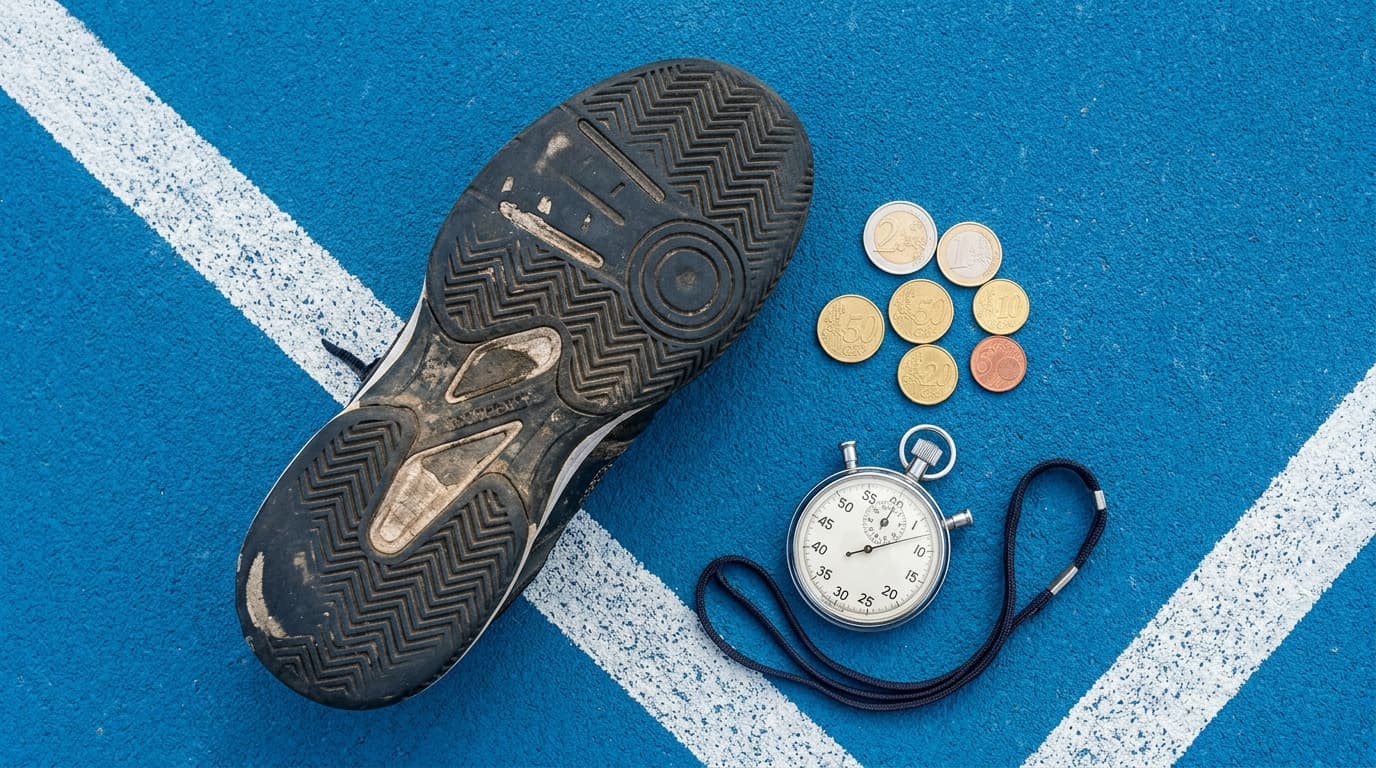
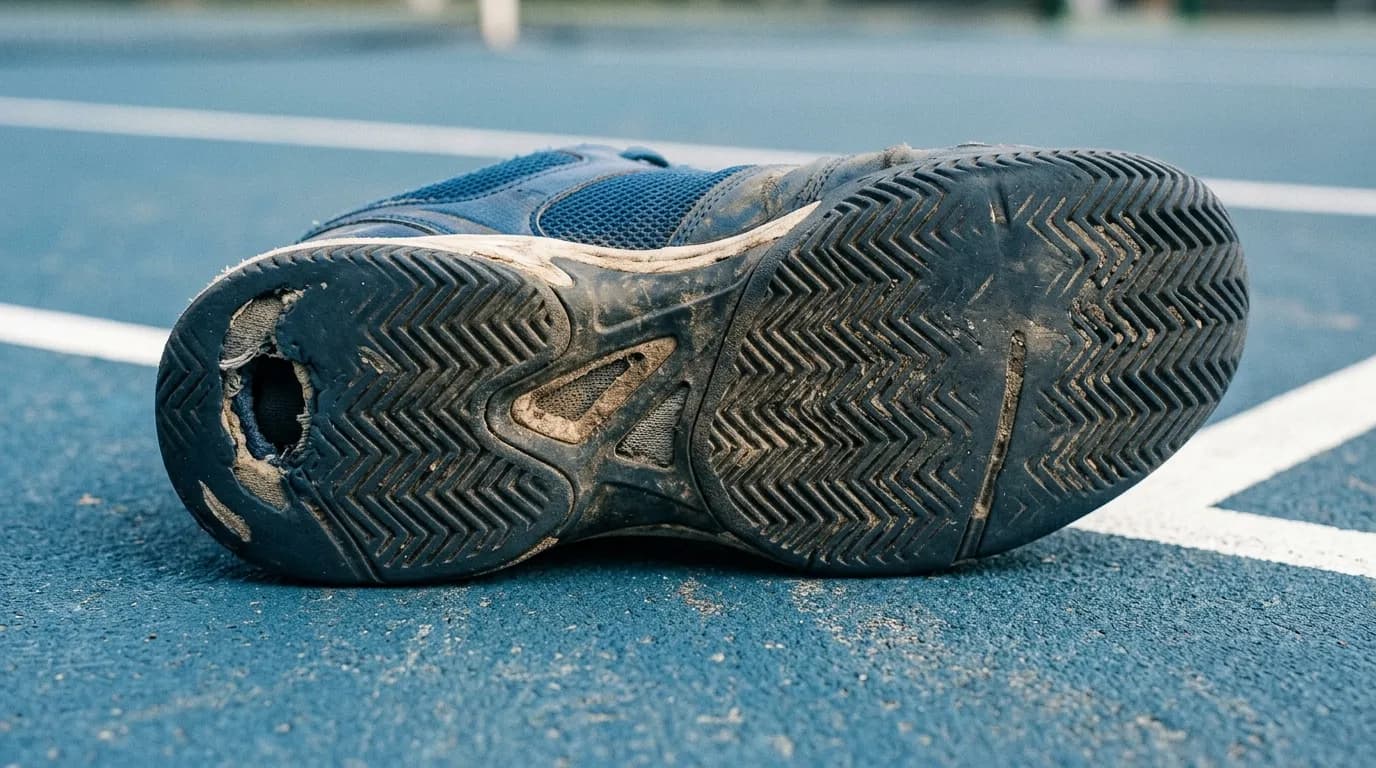
Your outsoles wear much more on hard courts than on clay. Hard courts are very abrasive, while red clay, softer, wears the rubber little: on that court, it is the cushioning, worn out after 45 to 60 hours, that decides when to change pairs. On hard courts, it is often the outsole.
For a Belgian competitor, who plays outdoors in summer and indoors in winter, the real question is therefore: which pair for which season?
Clay or hard court: which surface wears the outsole most?
Hard courts, clearly. According to Tennis Companion, hard courts are a very abrasive surface that demands a tougher outsole, while clay, softer, wears the outsole much less. The USTA points the same way: a baseliner who plays on hard courts several times a week wears out shoes much faster than a recreational doubles player on clay.
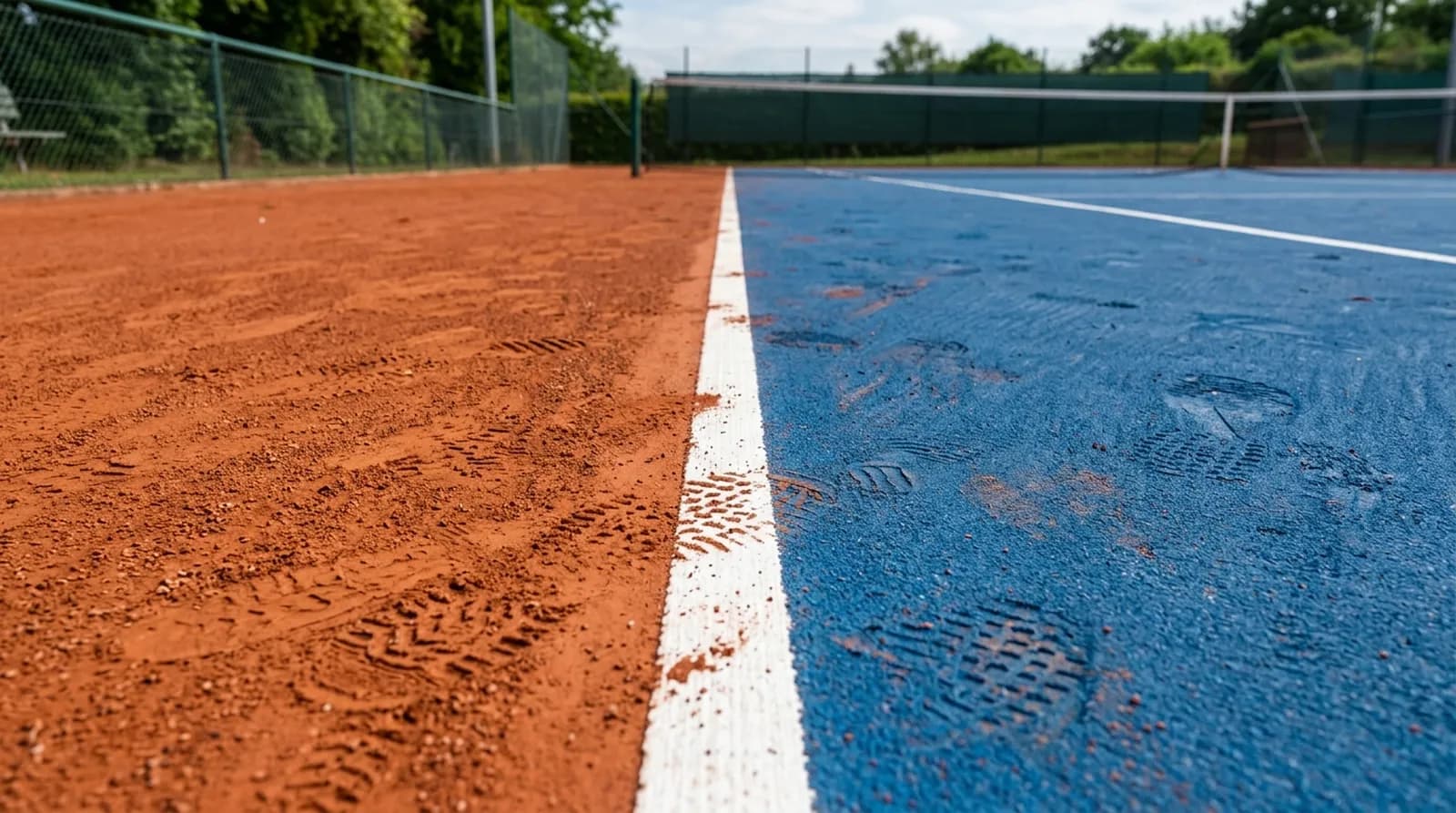
On hard courts, the rubber rubs against an acrylic or concrete surface with every step. On red clay, the layer of dust and granules lets the foot slide, and the outsole rubs against a material that gives way. In Belgium, a typical clay court sits on gravel, 6 cm of lava and 2 cm of crushed brick, with granules and dust on top for sliding, according to the specialist Scheerlinck quoted by the DH.
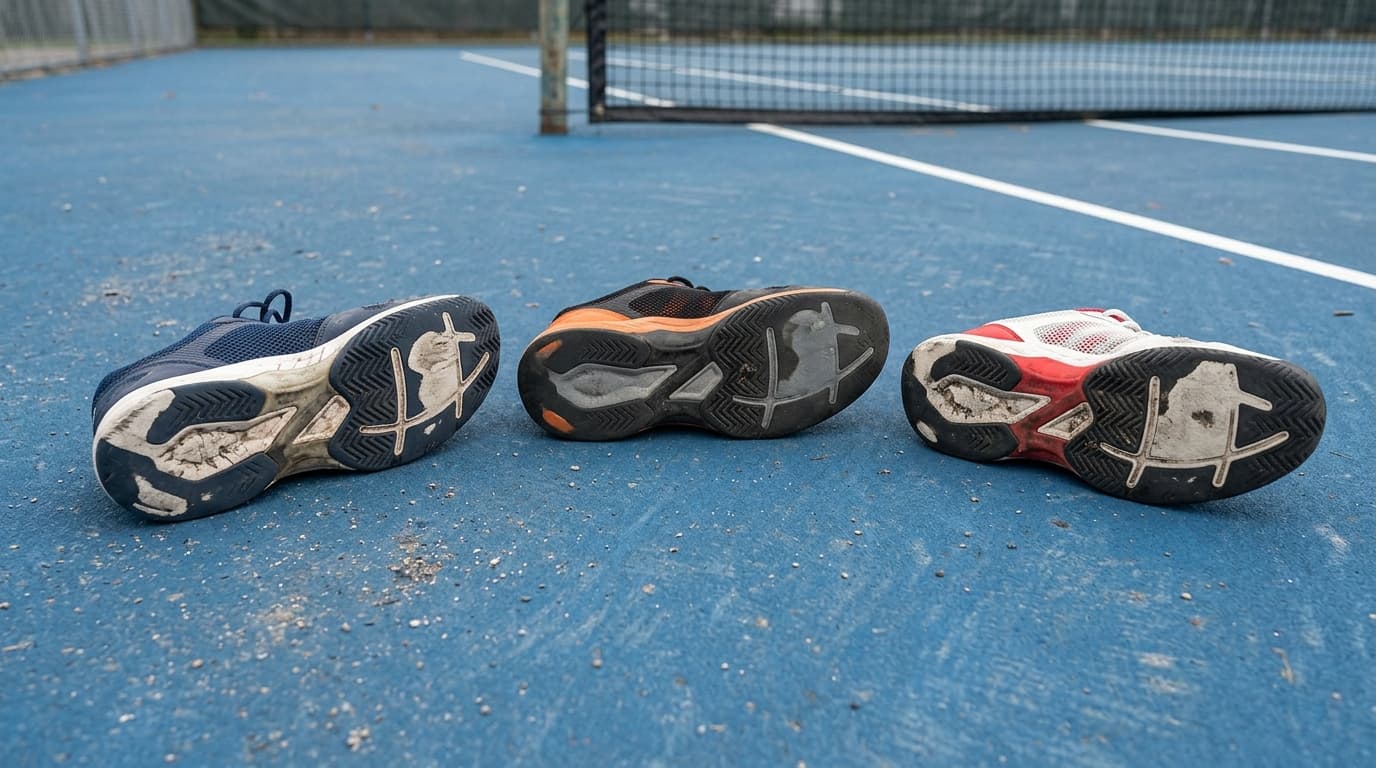
The areas affected change too. On hard courts, slides and braking scrape the forefoot and the inner side, and toe drag on the serve wears the toe. On clay, sliding is built into the surface itself, and wear is spread out.
What gives out first depending on the surface?
On hard courts, often the rubber. On red clay, almost always the cushioning.
| Surface | Rubber wear | What gives out first | Suitable outsole |
|---|---|---|---|
| Red clay | low | the cushioning, after 45 to 60 hours | deep herringbone along the whole length (clay version) |
| Hard court (GreenSet, acrylic, concrete) | high | the forefoot rubber and the toe, sometimes before the cushioning | modified herringbone, durable rubber (all-court version) |
| Indoor carpet | variable | the cushioning | fully smooth, non-marking outsole |
| Sand-filled artificial grass | variable | the cushioning | small nubs (omni outsole) |
How long the cushioning lasts does not depend on the surface. The AAPSM, the American Academy of Podiatric Sports Medicine, puts the end of life of a tennis shoe's midsole at 45 to 60 hours of play, whatever the court. On clay, your pair will often still have tread when it is time to replace it; the signs to watch are then deep creases in the foam, a shoe that leans when set down flat, or feet that hurt more after a match.
On hard courts, both counters run at once. For a heavy player, a slider or a toe dragger, the rubber can lose the race. RunRepeat reports feedback that an outsole lasts "a season" at 6 to 8 hours a week on hard courts, an imprecise wording that still gives the order of magnitude. No pair is judged without the lifespan of its outsole, and on hard courts, that lifespan is read first in the durability score.
Why does a Belgian player mostly wear out outsoles in winter?
Because summer is played on red clay and winter on hard courts or carpet. In Belgium, more than eight courts out of ten are red clay, against 16% in France, according to RTBF. Because of the climate, clubs keep clay mostly for the summer.
In winter, clubs play under a dome or indoors, for example on GreenSet, a hard surface, or on carpet with rubber granules. That is where the rubber works hardest. An interclub player who plays summer matches on clay and trains all winter on GreenSet will mostly wear out the winter pair.
The practical consequence is simple: many Belgian players end up with two pairs, one per season. It is not a luxury, it is what two surfaces with different grip and different wear require.
Which tennis shoes last longest on hard courts?
Those whose rubber is rated 8.5/10 or more for durability. At Nike, the Vapor Pro 3 and the GP Challenge 1.5 (8.6/10 each); outside Nike, the Asics Gel-Resolution X (9.0/10). The table covers five models, Nike first, with their versions, their durability score on our grid (compiled from published tests, not on-court trials) and the average price found in Belgium between June and September 2026.
| Model | Versions | Durability /10 | Weight | Price found in Belgium |
|---|---|---|---|---|
| Nike Vapor Pro 3 | all court, clay | 8.6 | 425 g (US 10.5) | around €117 |
| Nike GP Challenge 1.5 | all court, clay, Premium clay | 8.6 | 456 g (US 10.5) | around €125 |
| Nike Vapor 12 | hard court, clay | 7.2 | 414 g (US 10.5) | around €159 |
| Asics Gel-Resolution X | all court, Clay | 9.0 | 425 g (US 9) | around €130 (Clay: around €160 list price) |
| Adidas Barricade 14 | all court, clay, grass | 7.0 | 400 g (US 10.5) | around €117 |
The Vapor Pro 3 is the most logical Nike for winter: its Hart rubber covers the outsole up to the toe, and RunRepeat rates its durability as "fantastic" even in the wear zones. The GP Challenge 1.5 holds up just as well, with denser rubber under the inner forefoot and a drag guard, for 31 g more and much more cushioning.
The Vapor 12 is the opposite. Nike removed much of its rubber to make it lighter, and Tennis Warehouse sees the outsole smooth out in the usual spots. On clay, this flaw matters little, and its lightness and grip (9.4/10) make it an excellent summer shoe. On hard courts, it will wear quickly. The Vapor 12 review explains this trade-off.
Outside Nike, the Adidas Barricade 14 divides opinion: Tennis Companion finds that durability is no longer an undisputed strength with its new Lighttraxion outsole, while RunRepeat measures a 0.6 mm dent in the Dremel test, against a 0.8 mm average on the same page. For a winter pair, the Gel-Resolution X, with full-length AHAR Plus, is Asics' benchmark.
What changes between a clay outsole and an all-court outsole?
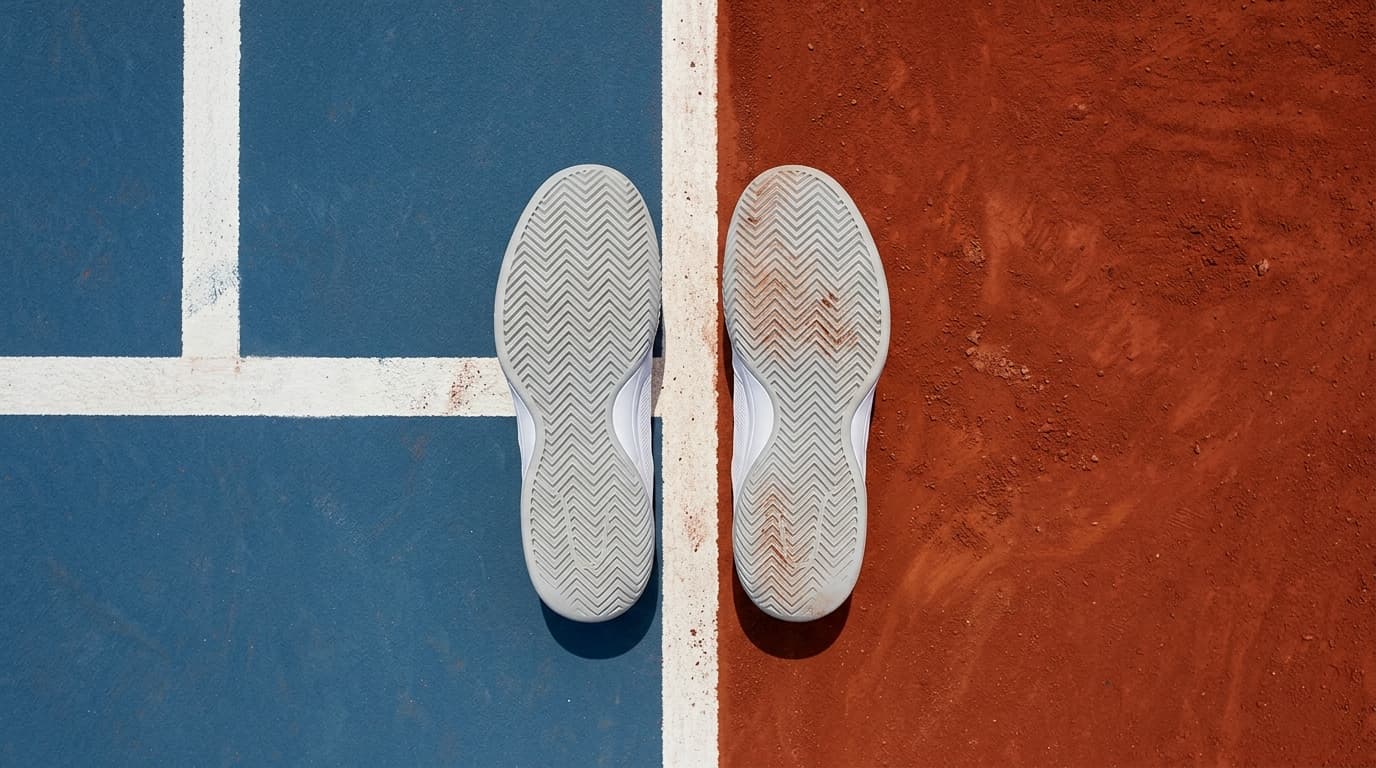
The pattern, first. According to HEAD, clay shoes have deep herringbone across the whole outsole, which clears the clay, while all-court models have modified herringbone, rounder and shallower: versatile, but less effective on clay.
The rubber, next, and here sources do not agree. Tennis Companion writes that clay shoes often have softer rubber, since the surface causes little wear. Tennis-Point.be, on the other hand, describes its clay shoes ("gravelschoenen") with harder herringbone rubber, to grip without the clay sticking. Keep the common point in mind: on red clay, the pattern matters, not the thickness of the rubber.
Nike makes its three flagship models in both versions. Belgian retailers sell the GP Challenge 1.5 in a clay version (Tennis-Point.be lists it as a "gravelschoen", TennisDirect.be as Premium Clay), and the Vapor 12 and Vapor Pro 3 also come in a clay version. At Asics, the Gel-Resolution X Clay has a list price of around €160, and was seen at €99.99 at Decathlon in Austria.
Which outsole for indoor courts and carpet?
A smooth outsole on carpet, an all-court version on GreenSet. On carpet, you need a fully smooth, tread-free, non-marking outsole, according to Decathlon Belgium. Too much tread gives too much grip: the foot locks and the risk of a sprain rises. TennisDirect.be even has a section dedicated to "tapijt" (carpet) shoes.
On GreenSet, on the other hand, an all-court version is the right choice, and it is the one that should carry your best rubber. If your winter club plays on carpet, your winter pair is not an all-court version but an indoor model.
Does sliding on hard courts cause more wear?
Yes. Sliding on hard courts heavily wears the forefoot and the inner side, according to the Nike Vapor Cage 4 review published by Tennis Warehouse. Sliders are better off choosing a model protected on the inside: the Vapor Cage 4, whose rubber wraps up onto the toe cap and the side, is the example at Nike, but it predates the 2025 models, so check availability in Belgium.
Sliding has an upside, though. According to a 1995 ATP study quoted by Sportzorg, the physio was called 0.42 times per match on hard courts, against 0.20 times on clay. Surfaces where players slide naturally cause fewer injuries, and wear the rubber less.
The ranking of clay court tennis shoes lists the summer models, the ranking of durable tennis shoes the ones that hold up on hard courts, and the buying guide points you in the right direction for your profile. The comparison of compounds is in the article on outsole rubbers, and estimating your hours in the one on how long tennis shoes last.
Sources
- Tennis Companion, clay court tennis shoes
- USTA, when to buy a new pair of tennis shoes
- AAPSM, When to replace athletic shoes
- HEAD, everything you need to know about clay court tennis shoes
- Tennis-Point.be, clay court shoes
- RTBF, clay at the heart of Belgian tennis
- DH, the secrets of Belgian clay
- L'Avenir, a club under a dome in Walloon Brabant
- ITF, surface types
- Sportzorg, tennis shoes and court types
- Decathlon Belgium, men's tennis shoes
- TennisDirect.be, carpet shoes
- RunRepeat, best hard court tennis shoes
- RunRepeat, Nike Vapor Pro 3
- Tennis Warehouse, Nike GP Challenge 1.5 product page
- Tennis Warehouse, Nike Zoom Vapor 12 review
- Tennis Warehouse, Nike Air Zoom Vapor Cage 4 review
- Tennis Warehouse, Asics Gel-Resolution X product page
- Boozt, Asics Gel-Resolution X Clay
- Decathlon Austria, Asics Gel-Resolution X Clay
- Tennis Companion, Adidas Barricade 14
- RunRepeat, Adidas Barricade 14
Your questions
Frequently asked questions
Can you play on hard courts with clay court shoes?
That is not what they are made for. A clay outsole has deep herringbone along its whole length, designed to clear the clay. On hard courts, the most abrasive surface, you need an all-court outsole with modified herringbone, and a rubber rated at least 8/10 for durability if you play often.
Does an all-court shoe work on clay?
Yes, as a fallback. Its modified herringbone, rounder and shallower, makes it versatile but less effective on clay than a dedicated model, according to HEAD. For a season of interclub matches on red clay, the clay version grips better.
Which pair for summer and winter interclub matches?
In summer, a clay version: at Nike, the Vapor Pro 3 or the GP Challenge 1.5, which also come in a clay version. In winter, on GreenSet, their all-court version, which scores 8.6/10 for durability. On carpet, you need a smooth, non-marking outsole.
Do clay court shoes have softer rubber?
Sources disagree. Tennis Companion writes that clay shoes often have softer rubber, since the surface causes little wear. Tennis-Point.be, on the other hand, describes its clay shoes ("gravelschoenen") with harder herringbone rubber, to grip without the clay sticking. What they share is the deep herringbone pattern.