Buying guides
Which Tennis Shoes to Choose for Interclub League Play?
For interclubs: Nike Vapor 12 (9.2/10) if you play fast, Vapor Pro 3 (8.6/10 for durability, around €117) if you slide. 45 to 60 hours per pair.

Contents · 13 sections
- Key takeaways
- Nine competition models, Nike first
- Speed or stability: which should come first in interclubs?
- Why does clay change the calculation?
- Which Nike for which competitor?
- And outside Nike?
- Does one pair last a whole interclub season?
- Serving wears the toe, whatever the surface
- How do you make the pair last until the final match?
- Which shoe for which interclub player?
- Sources
- FAQ
- Related articles
Which tennis shoes should you choose for interclubs? The Nike Vapor 12 if you play fast and move forward: 9.2/10 on our grid, 9.4/10 for grip. The Nike Vapor Pro 3 if you slide or keep the same pair all year: 8.6/10 for durability, around €117 in Belgium.
Between the two lies a choice every competitor makes without always putting it into words. Fewer grams, or more rubber.
Nine competition models, Nike first
All of them come in a clay version. The scores come from our editorial grid, compiled from the tests published by RunRepeat, Tennis Warehouse and Tennisnerd. I have not worn any of these pairs.
| Model | Overall score | Durability | Stability | Lightness | Weight (men's) |
|---|---|---|---|---|---|
| Nike Vapor 12 | 9.2/10 | 7.2 | 8.8 | 9.3 | 414 g (US 10.5) |
| Nike GP Challenge 1.5 | 9.1/10 | 8.6 | 9.0 | 7.6 | 456 g (US 10.5) |
| Nike Vapor Pro 3 | 9.0/10 | 8.6 | 8.8 | 8.6 | 425 g (US 10.5) |
| Asics Solution Speed FF 4 | 8.6/10 | 6.2 | 8.2 | 9.3 | 371 g (US 10.5) |
| Asics Court FF 3 | 8.2/10 | 7.4 | 8.6 | 7.4 | 439 g (US 10.5) |
| Adidas Barricade 14 | 8.7/10 | 7.0 | 9.3 | 6.8 | 400 g (US 10.5) |
| Adidas Adizero Ubersonic 5 | 8.3/10 | 5.5 | 7.8 | 9.2 | 388 g (US 10.5) |
| Wilson Rush Pro 5 | 8.3/10 | 7.4 | 8.6 | 7.8 | 408 g (US 10.5) |
| Babolat Jet Mach 4 | 8.3/10 | 6.4 | 8.0 | 9.0 | 369 g (size not specified) |
A quick read is enough: no shoe rated 9 or more for lightness goes above 7.2 for durability. The three least hard-wearing outsoles in the table (Ubersonic 5, Solution Speed FF 4, Jet Mach 4) belong to three speed shoes, and the Vapor 12 does barely better.
Speed or stability: which should come first in interclubs?
Stability if you are heavy or play from the baseline, speed if you are light and come to the net. Tennis Companion sets out the rule in its guide: lightweight shoes generally last less long, stable and heavier models last longer, and a stable base suits heavy or powerful players better.
The gaps can be measured. In the same size, there are 85 g between the Asics Solution Speed FF 4 (371 g) and the Nike GP Challenge 1.5 (456 g). On a day when a singles and a doubles follow one another, that is the case for light shoes. The case for heavy shoes comes later, at the end of the season, when you turn the pair over to see how much rubber is left.
The Nike Vapor 12 is the clearest compromise in the table. It weighs 414 g in a US 10.5, or 43 g more than the Asics, but it keeps 8.8/10 for stability and 9.4/10 for grip, the best grip score in our database. Its price is paid in rubber: to make it lighter, Nike removed a large part of the rubber, according to the Tennis Warehouse review. Hence 7.2/10 for durability.
Why does clay change the calculation?
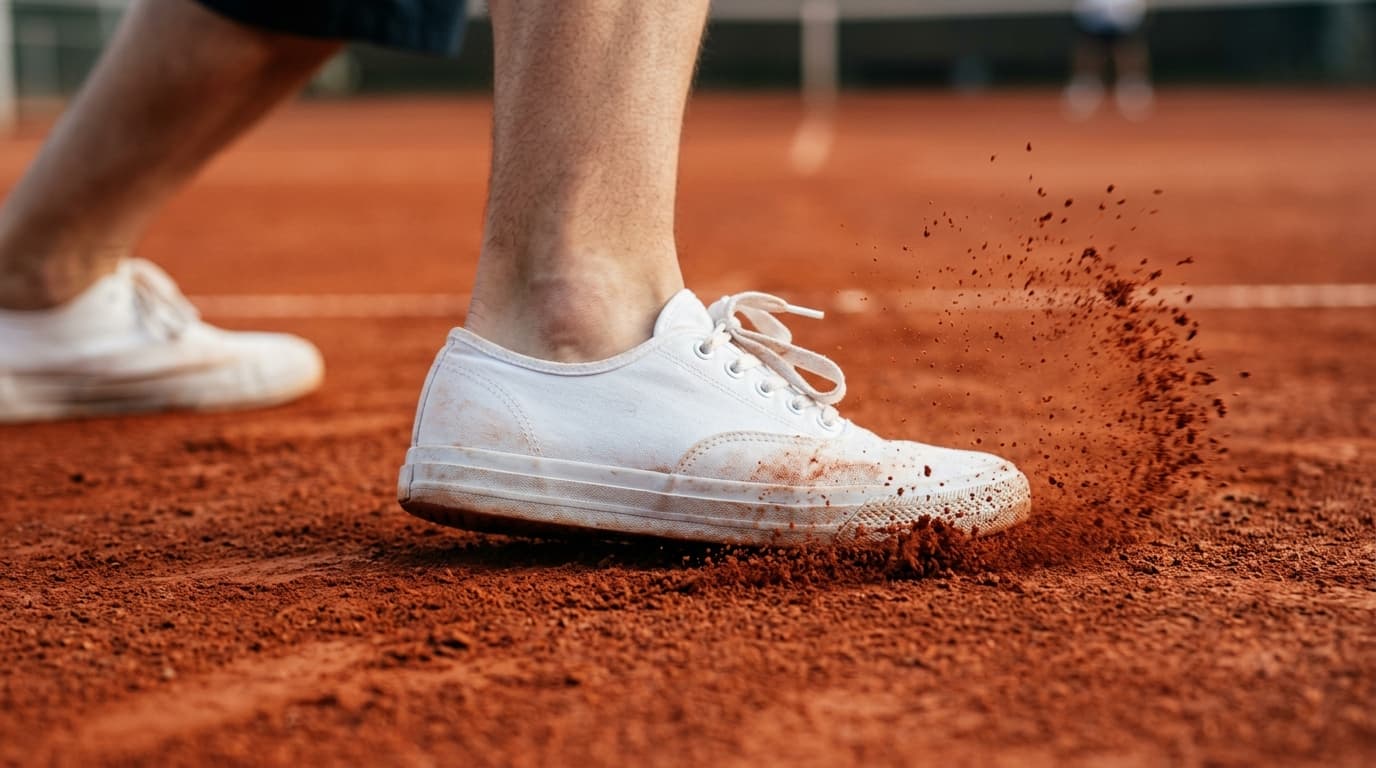
Because clay wears rubber far less than hard courts. And in Belgium, more than eight courts in ten are clay, according to RTBF, against 16% in France.
A durability score is therefore not read here as it is in a country of hard courts, the most abrasive surface. A Belgian competitor plays summer matches on a soft surface, where the weakness of a speed shoe weighs much less. A Vapor 12 or a Solution Speed FF 4 that you would advise against for a slider on hard courts becomes a defensible choice in summer, provided you take the clay version. Its outsole has deep herringbone tread along its whole length, which grips and clears the clay, HEAD explains in its guide.
On clay, then, it is the foam that sets the end of the pair, not the rubber. The AAPSM, the American Academy of Podiatric Sports Medicine, places midsole wear at between 45 and 60 hours of tennis. No rubber, even one rated 9/10, pushes that limit back.
Winter reverses everything. Under a dome or indoors on GreenSet, rubber becomes the first criterion again, and the Vapor Pro 3 or the GP Challenge 1.5 regain the advantage. On carpet, you need a completely smooth, non-marking outsole: none of the nine clay versions is suitable. The article on wear on clay and on hard courts details this gap.
Which Nike for which competitor?
Three Nikes, three ways of playing.
The Vapor 12 is the attacking player's shoe. It keeps the foot close to the ground, with an Air Zoom unit in the heel and a split herringbone outsole. It scores 9.2/10 overall, first in our competition ranking. Two reservations: its fit is narrow in width, with no wide version identified, and its lightened rubber copes badly with a player who slides on hard courts. The Nike Vapor 12 review gives the details, and the head-to-head Vapor 12 versus Solution Speed FF 4 compares it with its direct rival.
The Vapor Pro 3 is the one that lasts the season. Its Hart rubber covers the whole outsole, right up to the toe, and RunRepeat calls its durability "fantastic", wear zones included. It weighs 425 g in a US 10.5, only 11 g more than the Vapor 12, for 8.6/10 for durability against 7.2. Its Air Zoom unit is limited to the forefoot: it gives less push. At around €117, it is also €42 less. See the Nike Vapor Pro 3 review.
The GP Challenge 1.5 is aimed at the baseline hitter. It is the most cushioned (9.4/10 for comfort), the most stable of the three (9.0/10), and a rubber reinforcement protects the big-toe side. It weighs 456 g, which makes it one of the heaviest shoes on the market. The Nike GP Challenge 1.5 review describes it in detail.
If I had to keep only one for a player who does not want two pairs, it would be the Vapor Pro 3. It wins no criterion, and it loses none.
And outside Nike?
Six models, which I sort by use rather than by score.
- Asics Solution Speed FF 4: the lightest in the table in a known size, 371 g in a US 10.5, and 9.0/10 for grip. Its lightened AHAR outsole stops at 6.2/10 for durability. Around €132. See the Asics Solution Speed FF 4 review.
- Asics Court FF 3: Novak Djokovic's shoe, with a sock-like upper and a PGUARD toe protector. Stable (8.6/10), heavy (439 g), and the most expensive on the list at around €179. See the Asics Court FF 3 review.
- Adidas Barricade 14: the best stability score in the table, 9.3/10, and a wide version at some retailers. Its new Lighttraxion rubber is rated 7.0/10 for durability. See the Adidas Barricade 14 review.
- Adidas Adizero Ubersonic 5: 9.2/10 for lightness, but 5.5/10 for durability, the lowest score in the table, and cushioning that RunRepeat judges minimal. It runs small. See the Adidas Adizero Ubersonic 5 review.
- Wilson Rush Pro 5: the all-rounder, 8.6/10 for grip and for stability, and one of the three on the list that also come in a grass version, with the Barricade 14 and the Jet Mach 4. See the Wilson Rush Pro 5 review.
- Babolat Jet Mach 4: 369 g according to RunRepeat, a Matryx upper in woven fibres, a wide version, and Michelin rubber in double thickness at the toe and under the inner forefoot. Durability: 6.4/10. See the Babolat Jet Mach 4 review.
Does one pair last a whole interclub season?
Rarely, if you train on top of the matches.
The calculation is simple and does not depend on the model. Take a competitor who plays 4 hours a week, training and matches included. The AAPSM's 45 to 60 hours are reached in 11 to 15 weeks. A clay season from April to September runs to around 26 weeks, or 104 hours: nearly two sets of cushioning.
The table below applies this calculation to the average prices recorded in Belgium between June and September 2026. The last column is the shoe budget for those 104 hours, if the outsole lasts as long as the cushioning.
| Model | Average price | Cost per hour of play | Budget for 104 h |
|---|---|---|---|
| Nike Vapor 12 | €159 | €2.65 to €3.55 | €275 to €370 |
| Nike GP Challenge 1.5 | €125 | €2.10 to €2.80 | €215 to €290 |
| Nike Vapor Pro 3 | €117 | €1.95 to €2.60 | €205 to €270 |
| Asics Solution Speed FF 4 | €132 | €2.20 to €2.95 | €230 to €305 |
| Asics Court FF 3 | €179 | €3.00 to €4.00 | €310 to €415 |
| Adidas Barricade 14 | €117 | €1.95 to €2.60 | €205 to €270 |
| Adidas Adizero Ubersonic 5 | €116 | €1.95 to €2.60 | €200 to €270 |
| Wilson Rush Pro 5 | €107 | €1.80 to €2.40 | €185 to €245 |
| Babolat Jet Mach 4 | €104 | €1.75 to €2.30 | €180 to €240 |
The price that matters is the price per hour of play. Between a Vapor 12 and a Vapor Pro 3, the gap over a summer season runs from €70 to €100. That is the price of speed, and each player decides whether it is worth it. The full method is in the article on cost per hour of play.
These ranges are a ceiling on lifespan. No published test converts a durability score into hours. On hard courts, an outsole rated 5.5 or 6.2 can give out before the foam, and an hour of play then costs more than the table says.
Serving wears the toe, whatever the surface
Toe drag does not depend on the court. On serve, the back foot drags, and the toe and the inner forefoot wear first; a right-hander mostly wears the inside of the right shoe, notes Tennis Server.
For a big server, toe protection therefore counts as much as weight. In this table, it is found on the GP Challenge 1.5 (reinforcement on the big-toe side), the Vapor Pro 3 (rubber right up to the toe), the Court FF 3 (PGUARD) and the Jet Mach 4 (double thickness at the toe). The article on toe drag ranks the protections.
How do you make the pair last until the final match?
- Rotate two pairs. ASICS points out that foam takes around 48 hours to decompress after an intense effort. A competitor who plays on Saturday and trains on Monday does not leave a single pair that time.
- Keep one pair per season. Clay version in summer, all-court version in winter. The first wears little, the second takes the hard court.
- Look at the creases in the foam, not only the rubber. On clay, the outsole can look new when the cushioning is already packed down.
- Respect the age limit. The AAPSM advises replacing an athletic shoe that is more than a year old, even if the tread is intact.
Which shoe for which interclub player?
- You play fast, moving forward, mostly on clay: Nike Vapor 12, 9.2/10, in the clay version.
- You slide, or you keep the same pair summer and winter: Nike Vapor Pro 3, 8.6/10 for durability, around €117.
- You hit from the baseline and you are heavy: Nike GP Challenge 1.5, 9.0/10 for stability, 9.4/10 for comfort.
- You want the lightest shoe possible: Asics Solution Speed FF 4 (371 g) or Babolat Jet Mach 4 (369 g), accepting 6.2 and 6.4/10 for durability.
- Your ankle needs support: Adidas Barricade 14, 9.3/10 for stability.
- You also play on grass: Wilson Rush Pro 5, Adidas Barricade 14 or Babolat Jet Mach 4.
✓ Pros
- 9.2/10 overall, first in our competition ranking
- 9.4/10 for grip, the best score in our database
- 414 g in a US 10.5 for 8.8/10 for stability
- Clay and hard court versions
✗ Cons
- Lightened rubber: 7.2/10 for durability
- Narrow fit in width, no wide version identified
- Around €159 in Belgium, or €2.65 to €3.55 per hour of play
- No outsole guarantee identified
The competition tennis shoes ranking orders these models by score, and the overall ranking sets them against the rest of the market. For the choice of summer outsole, read Which tennis shoes should you choose for clay?. The comparison tool lines up the nine models criterion by criterion.
Sources
- Tennis Companion, lightweight tennis shoes
- AAPSM, when to replace athletic shoes
- RTBF, clay at the heart of Belgian tennis
- Tennis Warehouse, Nike Zoom Vapor 12 review
- RunRepeat, Nike Vapor 12
- RunRepeat, Nike Vapor Pro 3
- Tennis Warehouse, Nike GP Challenge 1.5 listing
- Tennis Warehouse, Asics Solution Speed FF 4 review
- RunRepeat, Asics Court FF 3
- RunRepeat, Adidas Barricade 14
- RunRepeat, Adidas Adizero Ubersonic 5
- Tennis Warehouse, Wilson Rush Pro 5 listing
- RunRepeat, Babolat Jet Mach 4
- Tennisnerd, Babolat Jet Mach 4
- Tennis Server, wear zones in tennis
- ASICS, tips to make your shoes last longer
- HEAD, clay court tennis shoes guide
Your questions
Frequently asked questions
Which tennis shoes should you choose for interclubs?
The Nike Vapor 12 if you play fast and move forward: 9.2/10 overall, 9.4/10 for grip, 414 g in a US 10.5. The Nike Vapor Pro 3 if you slide or wear through your outsoles: 8.6/10 for durability for around €117. The Nike GP Challenge 1.5 if you hit from the baseline and want cushioning (9.4/10 for comfort).
Speed or stability: which should come first in competition?
Stability if you are heavy or play from the baseline, speed if you are light and come to the net. The gap can be weighed: 371 g for the Asics Solution Speed FF 4, 456 g for the Nike GP Challenge 1.5, in the same size. The Nike Vapor 12 sits between the two, with 8.8/10 for stability and 9.3/10 for lightness.
Does one pair last a whole interclub season?
Rarely for a player who trains. The AAPSM places cushioning wear at between 45 and 60 hours of tennis. At 4 hours a week, that is 11 to 15 weeks, for a summer season of around 26 weeks. On clay, the rubber generally lasts longer than the foam.
Is the Nike Vapor 12 any good in 2026 for a competitor?
It is the best rated in our database, 9.2/10: 9.4 for grip, 9.3 for lightness, 8.8 for stability and for comfort. Nike removed a large part of the rubber to make it lighter, hence 7.2/10 for durability. It costs around €159 in Belgium, or €2.65 to €3.55 per hour of play.