Durability & wear
Tennis shoes for toe draggers: which ones protect the toe?
For toe draggers, the Nike Vapor Cage 4 protects the toe best (9.4/10). Among current models, the GP Challenge 1.5 and Vapor Pro 3 hold up at 8.6/10.
Contents · 13 sections
- Key takeaways
- What is toe drag, and where does it wear the shoe?
- Which tennis shoes last longest when you drag your toe?
- Why does the Vapor Cage 4 resist toe friction best?
- GP Challenge 1.5, Vapor Pro 3 or GP Challenge Pro: which current Nike for an interclub player?
- Is the Vapor 12's large drag guard enough?
- Drag guard, PGUARD, Adituff, DragGuard 7.0: which toe protections exist?
- How many hours does a shoe last when the toe wears first?
- Clay or indoor: where does the toe wear most?
- Should you repair a worn toe with Shoe Goo?
- Sources
- FAQ
- Related articles
If you drag your back foot on the serve, choose a shoe whose rubber or a dedicated guard wraps up over the toe. The Nike Air Zoom Vapor Cage 4 resists that friction best (9.4/10 for durability), but it is an older generation, so check it is available in Belgium. Among current models, the GP Challenge 1.5 and the Vapor Pro 3 hold up at 8.6/10.
The rest comes down to weight and price.
What is toe drag, and where does it wear the shoe?
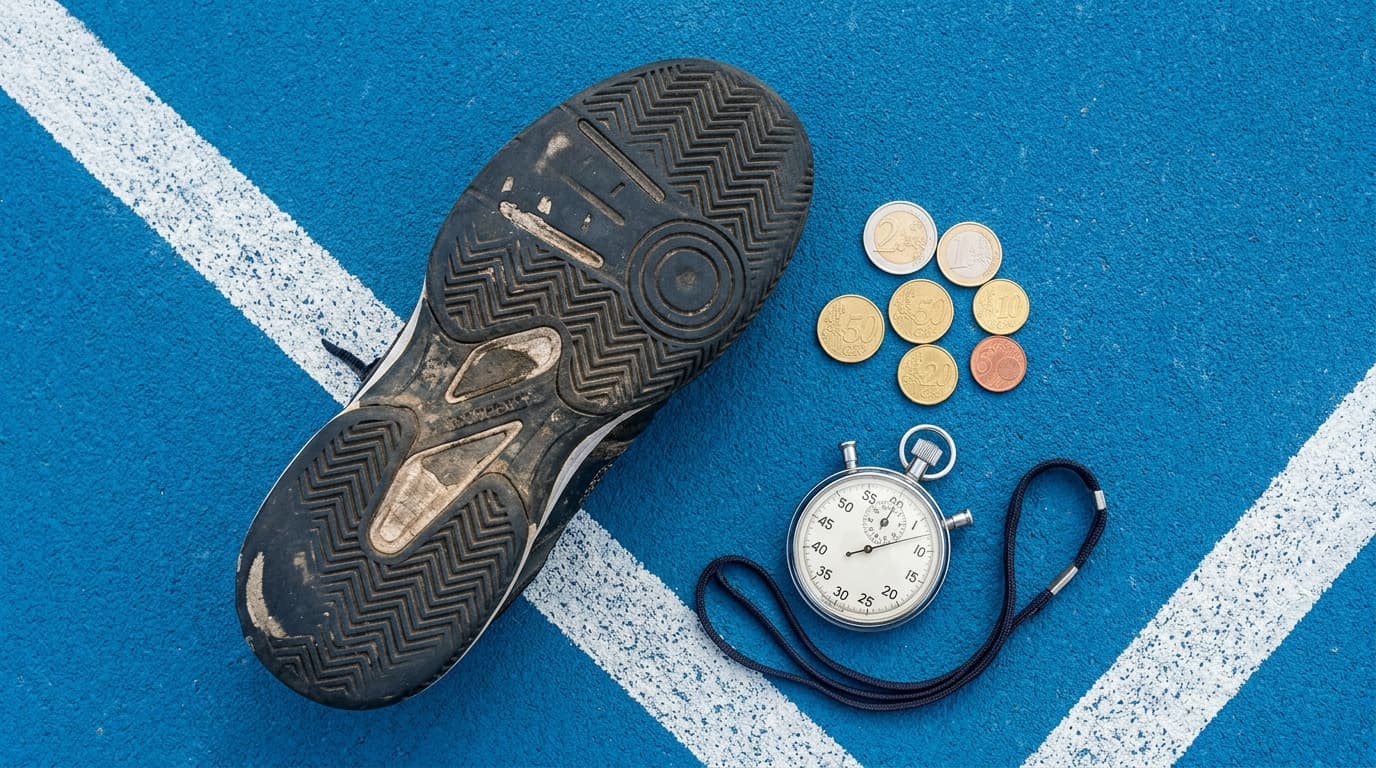
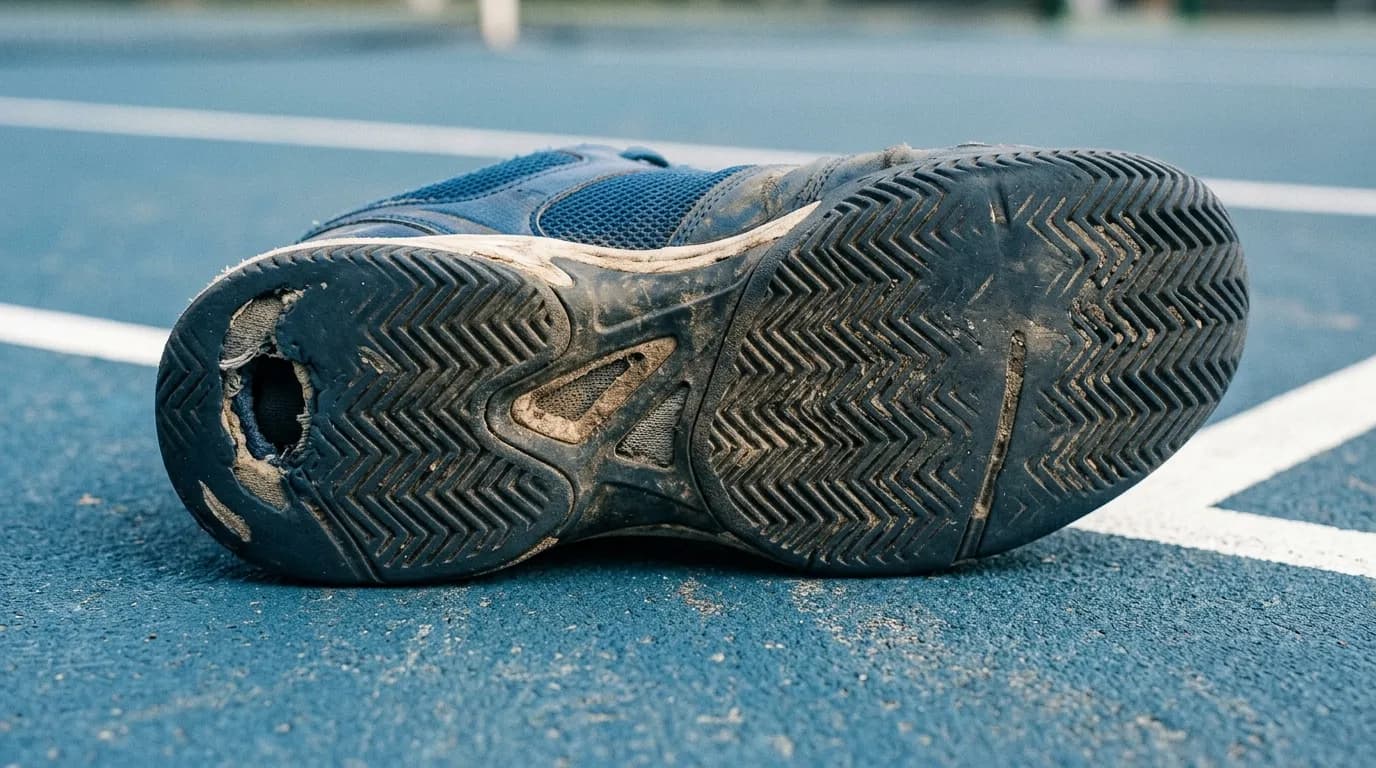
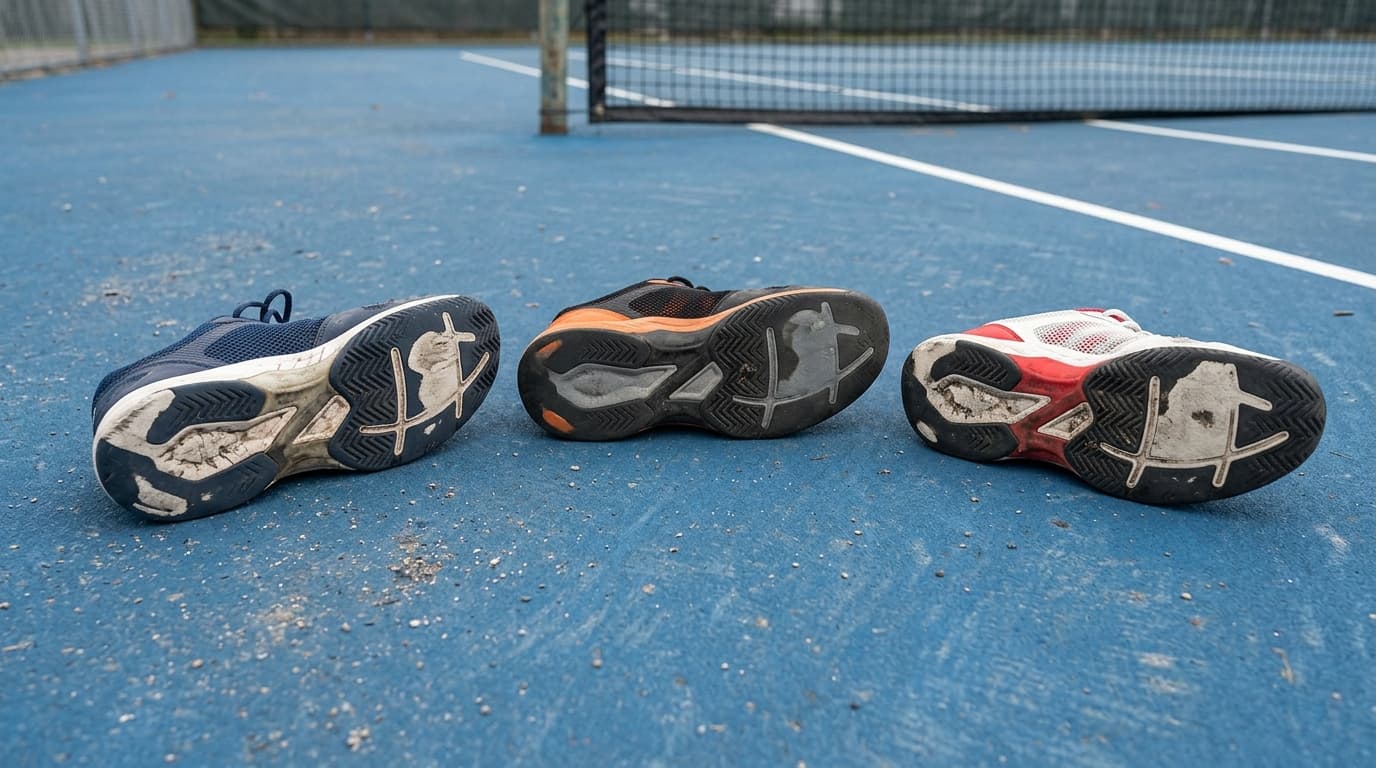
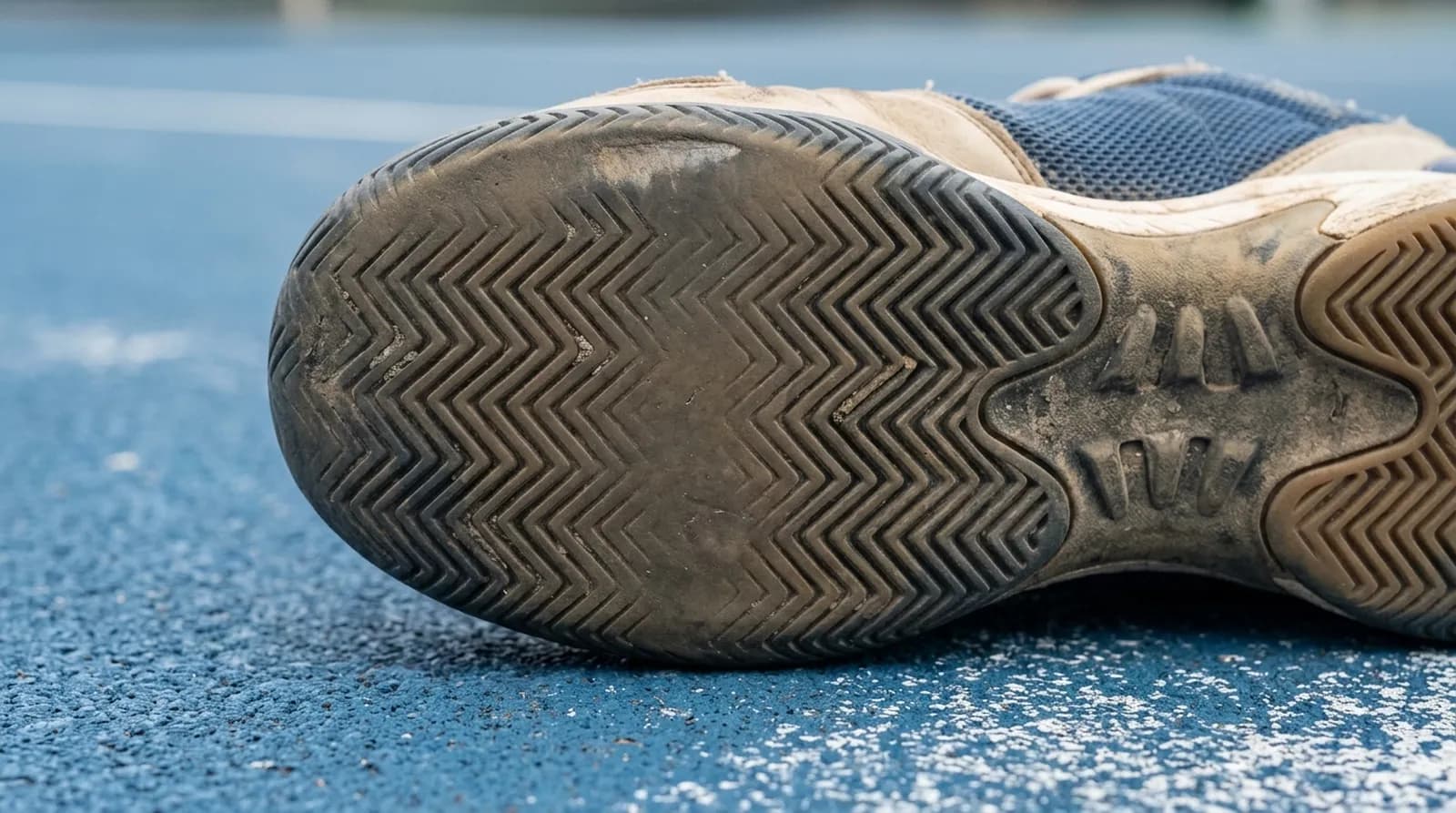
Toe drag is the back foot dragging along the court during the serve. The tip of the shoe and the inner forefoot, on the big-toe side, rub at every serve, then again when braking. According to Tennis Server, a right-hander therefore wears mostly the inside of the right shoe.
The marks come quickly. In the Adidas Barricade 14 test published by Tennis Companion, the outsole wore smooth under the big toe all the way to the toe cap. For a competitor who plays several times a week, it is often the toe that goes through first, while the heel and midfoot still have tread.
Manufacturers respond in two ways. Either they lay more rubber on the toe, so the outsole "wraps up" onto the upper. Or they glue on a dedicated guard, called drag guard at Nike, PGUARD at Asics, Adituff at Adidas and DragGuard 7.0 at K-Swiss.
Which tennis shoes last longest when you drag your toe?
Those that combine hard-wearing rubber with a protected toe. The table lists nine models, Nike first, with their durability score on our grid (compiled from published tests, not on-court trials), their weight in men's US 10.5 and the average price found in Belgium between June and September 2026.
| Model | Toe protection | Durability /10 | Weight | Price found in Belgium | Cost per hour (45 to 60 h) |
|---|---|---|---|---|---|
| Nike Air Zoom Vapor Cage 4 | rubber wrapping up over the toe and inner side | 9.4 | 439 g | not published (end-of-line stock) | depends on the price found |
| Nike GP Challenge 1.5 | rubber drag guard on the inside of the toe | 8.6 | 456 g | around €125 | €2.10 to €2.80 |
| Nike Vapor Pro 3 | Hart rubber up to the toe | 8.6 | 425 g | around €117 | €1.95 to €2.60 |
| Nike GP Challenge Pro | rubberised drag guard, hard rubber (87.5 HC) | 8.2 | not published | around €97 | €1.60 to €2.15 |
| Nike Vapor 12 | large drag guard, cast PU at the toe, lightened rubber | 7.2 | 414 g | around €159 | €2.65 to €3.55 |
| Asics Gel-Resolution X | PGUARD at toe and heel, full-length AHAR Plus | 9.0 | 425 g (US 9) | around €130 | €2.15 to €2.90 |
| Asics Court FF 3 | PGUARD toe guard, three-piece AHAR Plus | 7.4 | 439 g | around €179 | €3.00 to €4.00 |
| Adidas CourtJam Control 3 | Adituff on the toe, Adiwear rubber | 7.2 | 428 g | around €71 | €1.20 to €1.60 |
| K-Swiss Ultrashot 4 | DragGuard 7.0 on Aosta 7.0 rubber | 8.4 | 459 g | around €156 | €2.60 to €3.45 |
Cost per hour divides the price by the lifespan of the cushioning: 45 to 60 hours of tennis according to the AAPSM, the American Academy of Podiatric Sports Medicine. No pair is judged without the lifespan of its outsole, and for a player who drags the toe, that lifespan depends first on the toe.
Two points stand out from the table. Protection costs grams: the GP Challenge 1.5 and the Ultrashot 4 exceed 450 g, and the Vapor Pro 3 is the lightest shoe scoring 8.5 or more, size for size (425 g in US 10.5). And price guarantees nothing: the Asics Court FF 3, the most expensive, only scores 7.4.
Why does the Vapor Cage 4 resist toe friction best?
Because its outsole does not stop under the foot. On the Vapor Cage 4, the rubber wraps up over the toe and the inner side, the two areas a player scrapes when dragging the foot or sliding on hard courts. The Tennis Warehouse review gives it 4.5/5 for outsole durability and 4.5/5 for toe durability, and the retailer names it the most durable Nike.
The line has form. On the Zoom Cage 2, a much older generation, Tennis Warehouse Europe noted that even the heaviest toe draggers had not worn through the toe.
Its other drawback is weight: 439 g in men's US 10.5. For a competitor who finds a pair, it remains the brand's best toe protection. The durable Nikes are covered in detail in the article on the most durable Nike tennis shoes.
GP Challenge 1.5, Vapor Pro 3 or GP Challenge Pro: which current Nike for an interclub player?
It depends on what you want on top of a tough toe: cushioning, lightness or price.
The GP Challenge 1.5 is the best armed against toe drag. Its Tennis Warehouse product page describes a high-abrasion herringbone rubber, denser under the inner forefoot, and a rubber drag guard on the inside of the toe, exactly where a right-hander's back foot rubs. Nike also reworked the "toe skins" for durability. With Air Zoom in the heel and forefoot over a TPU plate, it scores 9.4/10 for comfort. It is also the heaviest of the Nikes compared, at 456 g.
The Vapor Pro 3 protects the toe differently. Its Hart rubber covers the outsole right up to the toe, and RunRepeat notes excellent resistance to friction there, with durability described as "fantastic" even in the wear zones. It weighs 31 g less than the GP Challenge 1.5 and costs about €8 less. Its forefoot Air Zoom unit is smaller (8.4/10 for comfort).
The GP Challenge Pro is the under-€100 option. Its hard rubber, at 87.5 HC, loses only 0.6 mm in RunRepeat's Dremel test, which is average, and a rubberised drag guard covers the toe. Its weakness is higher up: reviews report a mesh upper that tears easily.
A competitor who hits from the baseline and wants cushioning will take the GP Challenge 1.5. One who covers a lot of court and wants a livelier shoe will take the Vapor Pro 3. The ranking of tennis shoes for competition places these two Nikes among the other brands.
Is the Vapor 12's large drag guard enough?
For the toe, partly. For the rest of the outsole, no.
To lighten the Vapor 12, Nike removed a large part of the rubber, and Tennis Warehouse sees the outsole wear smooth in the usual places. It keeps a large drag guard on the toe and cast PU over the toe and inner edge, which delays a hole at the tip without slowing wear under the forefoot. The result: 7.2/10 for durability on our grid, against 8.6 for the Vapor Pro 3, for around €159. It remains the best Nike for a light player who wants to feel the court (9.4/10 for grip, 414 g), and the Vapor 12 review explains that trade-off.
Drag guard, PGUARD, Adituff, DragGuard 7.0: which toe protections exist?
Every brand has its own guard, and the spec sheets describe them as follows, Nike first:
- Drag guard (Nike): a rubber piece on the inside of the toe, on the GP Challenge 1.5, the GP Challenge Pro and, in large format, the Vapor 12. On the Vapor Cage 4, it is the outsole rubber itself that wraps up over the toe.
- PGUARD (Asics): a reinforcement at the toe and heel of the Gel-Resolution X, and a toe guard on the Court FF 3. Asics presents this rubber as 50% more durable than its standard AHAR, a figure repeated by a retailer and not confirmed by any published test.
- Adituff (Adidas): an abrasion-resistant material placed on the toe and inner upper against friction on the serve, at the net and in lateral movement, described as early as 2013 by Complex. It features on the CourtJam Control 3.
- DragGuard 7.0 (K-Swiss): a layer that thickens the Aosta 7.0 rubber in the areas that wear most, on the Ultrashot 4. The Hypercourt Supreme 2 adds a Durawrap X upper against foot friction.
A guard does not make up for a thin outsole. The Court FF 3 has its PGUARD, but its three-piece outsole, designed for flexibility, holds it to 7.4/10 for around €179. The Gel-Resolution X, in full-length AHAR Plus with PGUARD, reaches 9.0: it is Asics' benchmark for players who wear out the toe, and the Asics page covers the rest of the range.
The Adidas CourtJam Control 3 is the budget calculation. Its Adituff protects the toe for €1.20 to €1.60 per hour of play, without matching the endurance of a Barricade according to Tennis Warehouse. The Ultrashot 4, for its part, targets the aggressive slider who wears out the toe, with 8.4/10, but weighs 459 g.
How many hours does a shoe last when the toe wears first?
45 to 60 hours for the cushioning, whatever happens to the toe. This AAPSM threshold applies to every model in the table: a Vapor Cage 4 with an intact toe still needs replacing once its midsole is compressed.
Toe drag adds a second counter. For a player who drags the foot a lot, the toe can wear through before the cushioning is done, and the pair goes with foam hours still left in it. That is what good toe protection buys back: it brings the wear of the toe closer to that of the rest of the shoe, and lowers the cost per hour of play.
To estimate your hours based on how often you play, see the article on how long tennis shoes last. The comparison of compounds, from Hart rubber to Aosta 7.0, is in the article on outsole rubbers.
Clay or indoor: where does the toe wear most?
On hard courts, by far. Hard courts are very abrasive, while clay, being softer, wears the outsole far less, according to Tennis Companion. In Belgium, more than eight courts in ten are clay ("brique pilée") according to the RTBF, but clubs spend the winter under a bubble or indoors, on GreenSet or carpet.
For an interclub player, the summer pair therefore suffers little from toe drag. It is the winter pair that needs a serious guard when it is used on GreenSet or another hard surface: a Vapor Pro 3 or a GP Challenge 1.5 in the all-court version. On carpet, the priority changes, because you need a smooth, non-marking outsole and a dedicated indoor model.
Should you repair a worn toe with Shoe Goo?
It is a stopgap, not a fix. Players have long used this kind of adhesive sealant against toe drag: clean the toe, sand it lightly, then let it dry for 24 hours, or 48 to 72 hours for maximum strength. Customer reviews nonetheless report that a layer can come off within minutes on a hard court.
Do not count on a warranty either. At the American retailer Tennis Warehouse, the toe is excluded from the 6-month outsole warranty; only Babolat says it covers a toe worn through, on its Propulse Fury All Court, with validity in Europe still to be checked. The details are in the article on the 6-month outsole warranty.
The ranking of durable tennis shoes orders these models by durability score, the overall ranking places them among all tennis shoes, and the comparison tool lines them up criterion by criterion. The brand's full range is on the Nike page.
Sources
- Tennis Server, wear and toe drag
- Tennis Warehouse, Nike Air Zoom Vapor Cage 4 review
- Tennis Warehouse, most durable tennis shoes
- Tennis Warehouse Europe, Nike Zoom Cage 2 review
- Tennis Warehouse, Nike GP Challenge 1.5 product page
- RunRepeat, Nike Vapor Pro 3
- RunRepeat, Nike GP Challenge Pro
- Tennis Warehouse, Nike Zoom Vapor 12 review
- Tennis Warehouse, Asics Gel-Resolution X product page
- RunRepeat, Asics Court FF 3
- Complex, Adidas Adituff
- Tennis Warehouse, Adidas CourtJam Control 3 product page
- Tennis Warehouse, K-Swiss Ultrashot 4 product page
- Tennis Warehouse, K-Swiss Hypercourt Supreme 2 product page
- Tennis Companion, Adidas Barricade 14
- Tennis Companion, clay court tennis shoes
- RTBF, clay at the heart of Belgian tennis
- AAPSM, When to replace athletic shoes
- Tennis Warehouse, outsole warranty terms (Gel-Resolution X page)
- Babolat, six-month outsole warranty
- Dick's Sporting Goods, Shoe Goo (customer reviews)
Your questions
Frequently asked questions
Does an outsole warranty cover a hole in the toe?
As a rule, no. The 6-month warranty of the American retailer Tennis Warehouse covers only the rubber outsole: the toe guard and the upper are excluded. Babolat is the exception on its Propulse Fury All Court, where a toe worn through to the inside of the shoe can be covered, with proof of purchase. Whether this programme applies in Belgium remains to be checked.
Does a toe guard really change how long a tennis shoe lasts?
Yes, if it sits on a thick outsole. The Nike Vapor Cage 4, whose rubber wraps up over the toe, scores 4.5/5 for toe durability at Tennis Warehouse. The Vapor 12 keeps a large drag guard but lost rubber elsewhere, and drops to 7.2/10. The guard protects the toe, not the cushioning, which lasts 45 to 60 hours.
Which tennis shoe for interclub matches if you drag your foot on the serve?
The Nike GP Challenge 1.5 (around €125) if you want cushioning, the Vapor Pro 3 (around €117) if you want a lighter shoe: both score 8.6/10 for durability and protect the toe. The Vapor Cage 4 does better (9.4/10), but it is an older generation whose availability in Belgium needs checking.
Is the Nike Vapor Cage 4 still available in Belgium?
Availability is limited. It predates Nike's 2025 models, sells mostly as end-of-line stock, and its official European price is not published. Check stock in your size with a Belgian retailer; otherwise, the GP Challenge 1.5 and the Vapor Pro 3 are the current options closest in durability.