Reviews NikeCourt Zoom GP Challenge 1.5
The Nike GP Challenge 1.5 is Nike's shoe for the aggressive baseliner: 9.4/10 for comfort, 8.6/10 for durability thanks to denser rubber under the inner forefoot, 456 g, found at around €125 in Belgium.
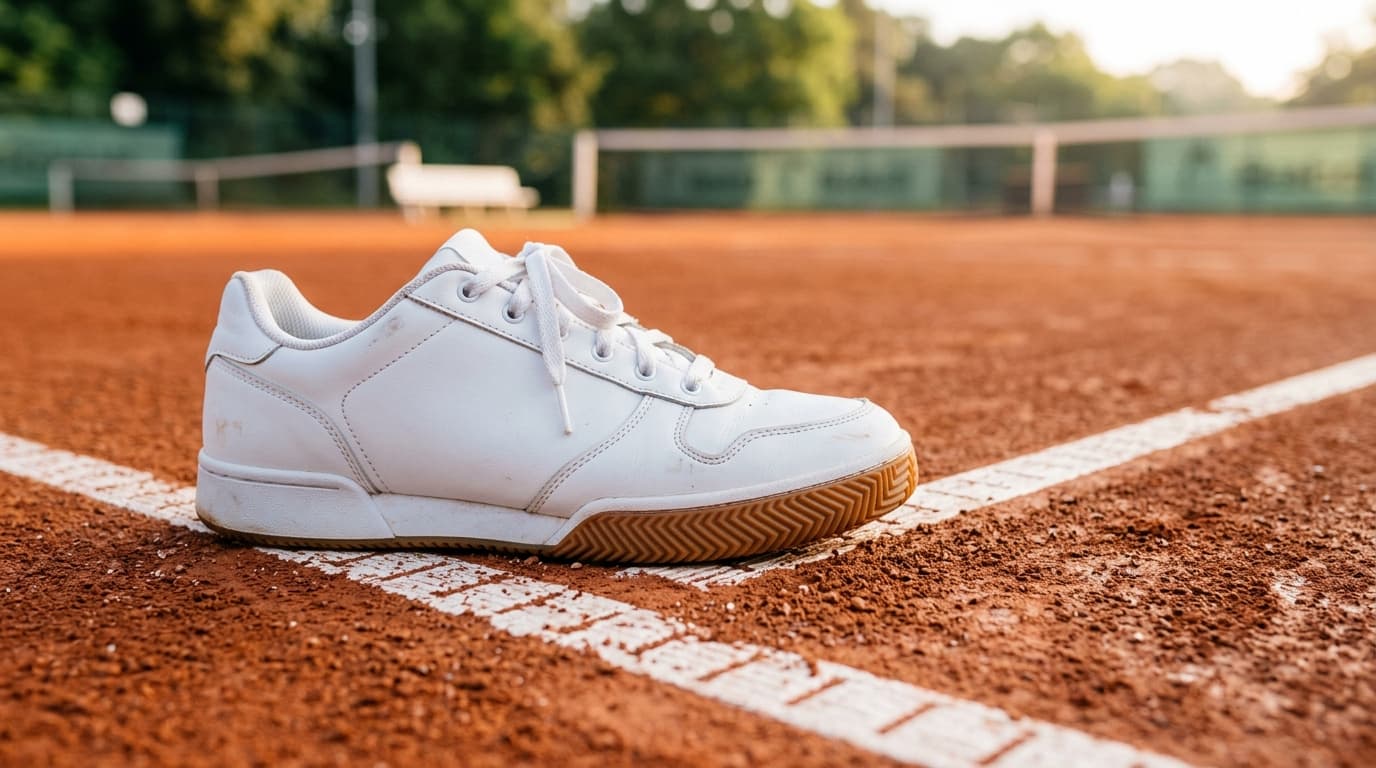
Verdict
The GP Challenge 1.5 scores 9.1/10 because it brings together what a baseline hitter asks of a shoe: cushioning (Air Zoom in the heel and forefoot, 9.4 for comfort, the best score in the Nike range), stability (9.0, with a TPU plate) and an outsole that lasts (8.6). Nike made its high-abrasion rubber denser under the inner forefoot, the area that wears first when you push off, and added a rubber drag guard inside the toe against toe drag. The price of that comfort is weight: 456 g in men's US 10.5, among the heaviest shoes on the market. At around €125 in Belgium, it works out at €2.10 to €2.80 per hour of play. For a heavy or powerful player, or one who looks after their knees, this is the Nike to aim for; for a player who runs a lot, the Vapor Pro 3 lasts as long for 31 g less.
Best for : Aggressive baseliner (Frances Tiafoe's model)

The GP Challenge 1.5 has herringbone high-abrasion rubber, denser under the inner forefoot, and a rubber drag guard on the inside of the toe, according to Tennis Warehouse's product page. It scores 8.6/10 for durability on our grid, like the Vapor Pro 3, behind the Vapor Cage 4 (9.4). No outsole warranty was identified; in Belgium, the 2-year legal guarantee covers defects, not wear. The cushioning ages faster than the rubber: 45 to 60 hours of play according to the AAPSM. On clay, the outsole will wear much more slowly than on hard courts.
Pros
- 9.4/10 for comfort: Air Zoom in the heel and forefoot, the most cushioned Nike
- High-abrasion rubber, denser under the inner forefoot, 8.6/10 for durability
- Rubber drag guard inside the toe, against toe drag
- TPU plate and locked-in fit: 9.0/10 for stability
- Hard-court and clay versions sold in Belgium
Cons
- 456 g in men's US 10.5, one of the heaviest shoes on the market
- Pricier than the Vapor Pro 3 (around €125 against €117) for the same durability score
- No outsole warranty identified
How long does the Nike GP Challenge 1.5 outsole last?
A long time for a shoe this comfortable, because Nike put the rubber where it goes. According to Tennis Warehouse's product page, the GP Challenge 1.5 has herringbone high-abrasion rubber, denser under the inner forefoot, and a rubber drag guard on the inside of the toe. The upper was also revised to hold up better.
On our grid, it scores 8.6/10 for durability. That is the same score as the Vapor Pro 3, more than the GP Challenge Pro (8.2) and clearly more than the Vapor 12 (7.2). Only the Vapor Cage 4 does better at Nike (9.4), but it is an older generation, mostly sold as end-of-line stock.
The reinforced area is no accident. When braking and pushing off from the baseline, it is the inner forefoot that rubs; on the serve, the back foot drags on the court, and for a right-hander the inside of the right shoe wears first. The drag guard delays the moment the toe wears through, which is often when the pair goes in the bin.
The cushioning keeps its own calendar. The AAPSM puts the end of a midsole's life at 45 to 60 hours of tennis. At three hours a week, that is four to five months, and the GP Challenge 1.5 will often still have tread by then.
No pair is judged without the lifespan of its outsole. This one has a good one, with no written warranty.
Is the GP Challenge 1.5 the most comfortable Nike?
Yes, on our grid: 9.4/10 for comfort, the best score in Nike's whole tennis range. The Vapor 12 scores 8.8, the Vapor Pro 3 and Vapor Cage 4 8.4.
That comfort comes from the cushioning. The GP Challenge 1.5 has Air Zoom in the heel and forefoot, where the Vapor Pro 3 makes do with a smaller forefoot unit. A TPU plate holds it all together and provides the stability (9.0/10) a heavy player looks for in changes of direction. The fit is standard, with a locked-in hold.
That is what makes it the baseline hitter's shoe: long rallies, lots of lateral pushes, repeated landings. It is also a logical choice for a player who looks after their knees or plays two hours at a stretch. For a lasting pain, a podiatrist or physiotherapist is the right person to see, not a shoe.
The trade-off shows on the scales. Generous cushioning and a stability plate add weight, and the GP Challenge 1.5 weighs 456 g in men's US 10.5. If you want responsiveness and to feel the court underfoot, it will feel heavy; the Vapor 12 or the Vapor Pro 3 suit that game better.
A reminder for every shoe: cushioning packs down before the rubber is worn. If your feet or ankles hurt more after a match, that is a wear signal cited by the USTA, even if the outsole looks intact.
GP Challenge 1.5, Vapor Pro 3 or GP Challenge Pro: what is the difference?
All three last, but not for the same player or the same budget.
The GP Challenge 1.5 and the Vapor Pro 3 are level on durability, 8.6/10 each. The first bets on cushioning (9.4 for comfort against 8.4) and stability (9.0 against 8.8); the second on lightness (425 g against 456 g) and price, around €117 against €125 on average in Belgium. The Vapor Pro 3 has full-length Hart rubber up to the toe, which RunRepeat rates as "fantastic" for durability; the GP Challenge 1.5 concentrates its dense rubber under the inner forefoot and protects the toe with a drag guard.
The GP Challenge Pro is the family's entry version. Found at around €97, it keeps a high-abrasion rubber and a rubberised drag guard, but without the targeted densification of the 1.5. In RunRepeat's test, its hard rubber (87.5 HC) shows a 0.6 mm dent in the Dremel test, on the average. It scores 8.2/10 for durability and 8.8 for comfort. Reviews criticise its mesh upper for wearing quickly.
In practice: heavy baseliner, GP Challenge 1.5; competitor who runs a lot, Vapor Pro 3; intermediate player under €100, GP Challenge Pro. The comparison tool lines the three up criterion by criterion, and the article on the most durable Nike tennis shoes sets them against the Vapor Cage 4 and the Vapor 12.
Is its 456 g weight a problem?
For a speed player, yes; for a heavy player, it is rather an argument in its favour. Tennis Warehouse records 16.1 oz, about 456 g, in men's US 10.5, and 12.6 oz in women's US 8.5. It is one of the heaviest shoes on the market, level with the Asics Gel-Resolution X, and 42 g more than the Vapor 12.
On our grid, the GP Challenge 1.5 scores 7.6/10 for lightness, its lowest score. That is the price of double cushioning and a TPU plate. Tennis Companion points to the opposite logic: lightweight shoes generally last less, and stable, heavier models last longer. Heavy or powerful players are advised to choose a stable base.
The weight is felt mostly in the first steps towards the ball and at the end of matches. A player who comes to the net a lot, plays doubles with short, explosive movements, or is light will find the Vapor Pro 3 (425 g) or the Vapor 12 (414 g) livelier.
Conversely, a player who defends from the back, lands heavily and wears out outsoles gains from carrying those extra grams. They translate into stability when sliding and into spare rubber under the forefoot.
Does the GP Challenge 1.5 suit Belgian clay and indoor courts?
Yes for clay, in the clay version. Nike offers the GP Challenge 1.5 in an all-court version and a clay version, with deeper herringbone that clears the clay. Belgian retailers sell the latter: Tennis-Point.be lists it as a "gravelschoen", TennisDirect.be as a Premium Clay version, Zalando and nike.com/be as a clay-court version.
That is the surface where it will last longest. According to RTBF (in French), more than eight courts in ten in Belgium are clay (brique pilée, crushed brick), and clay wears the outsole far less than hard courts. In summer, its reinforced rubber will lose little tread; the cushioning will set the replacement date.
Winter changes things. Under a bubble or indoors on GreenSet, take the all-court version: hard courts are the most abrasive surface, and that is where the dense rubber under the inner forefoot justifies the choice. On carpet, however, neither version is suitable. You need a completely smooth, non-marking outsole, otherwise the foot locks and the risk of a sprain goes up.
Many Belgian players end up with two pairs, one per season. The ranking of clay court tennis shoes sets the GP Challenge 1.5 against specialised models.
How much does the GP Challenge 1.5 cost in Belgium, and what is it worth per hour of play?
Around €125, as the average price seen in Belgium between June and September 2026. The Premium version, with other materials and colourways, is listed at €159.99 RRP at Tennis Warehouse Europe. It is sold at Tennis-Point.be, Passasports, TennisDirect.be, Zalando and on nike.com/be.
The price that counts is the price per hour of play. Based on 45 to 60 hours before the cushioning wears out (AAPSM), a GP Challenge 1.5 at €125 works out at €2.10 to €2.80 per hour. The Premium version at €159.99 rises to €2.65 to €3.55, with no documented durability gain.
On the same basis, the Vapor Pro 3 at €117 costs €1.95 to €2.60 per hour, and the GP Challenge Pro at €97, €1.60 to €2.15. The Asics Gel-Resolution X, found at around €130, runs at €2.15 to €2.90. So the GP Challenge 1.5 is not the cheapest per hour; it is the most comfortable of those that last.
No outsole warranty was identified for this model. The 6-month warranty often quoted is the American retailer Tennis Warehouse's, for other models, and it does not apply to a purchase in Belgium. The details are in the article on the 6-month outsole warranty. To set it against the longest-lasting models, see the ranking of durable tennis shoes and the Nike page.
Specs
| Weight | 456 g (men's US 10.5) |
|---|---|
| Drop | not disclosed |
| Outsole | Herringbone high-abrasion rubber, denser under the inner forefoot, rubber drag guard on the big-toe side |
| Outsole warranty | None |
| Cushioning | Air Zoom in the heel and forefoot, TPU plate |
| Upper | Upper updated for durability, revised toe reinforcements |
| Courts | All courts, Clay |
| Fit | Standard, locked-in fit. |
| Typical price | ≈ 125 € |
| Released | 2025 |
Frequently asked questions
Is the Nike GP Challenge 1.5 worth it in 2026?
It is the most comfortable Nike in the tennis range, rated 9.1/10 in our editorial scores, with 9.4/10 for comfort and 8.6/10 for durability. Updated in 2025-2026 with new colourways, it remains Nike's reference for the baseline player.
Which player is the GP Challenge 1.5 made for?
For the aggressive baseliner, heavy or powerful, who wears out outsoles and wants cushioning. It is Frances Tiafoe's model. A light player who runs a lot will be better off in a Vapor Pro 3 or a Vapor 12.
What is the difference between the GP Challenge 1.5 and the GP Challenge Pro?
The 1.5 has denser rubber under the inner forefoot, Air Zoom in the heel and forefoot and a TPU plate: 8.6 for durability, 9.4 for comfort, around €125. The GP Challenge Pro, at around €97, scores 8.2 and 8.8, with a more fragile mesh upper.
Does the Nike GP Challenge 1.5 fit true to size?
Yes, the fit is standard, with a locked-in hold. Take your usual size, leaving about a thumb's width in front of the longest toe, and try it on at the end of the day with your tennis socks.
Does the GP Challenge 1.5 have an outsole warranty?
No, no outsole warranty was identified for this model, either from Nike or from the retailers checked. In Belgium, the 2-year legal guarantee covers manufacturing defects, not normal rubber wear.
How much does the Nike GP Challenge 1.5 weigh?
About 456 g in men's US 10.5 (16.1 oz) and 12.6 oz in women's US 8.5, according to Tennis Warehouse. It is one of the heaviest tennis shoes, the price of its double Air Zoom cushioning and TPU plate.
Sources
- Tennis Warehouse, Nike GP Challenge 1.5 product page
- Tennis Warehouse Europe, GP Challenge 1.5 PRM
- Tennis Warehouse, Nike Air Zoom Vapor Cage 4 review
- RunRepeat, Nike GP Challenge Pro
- Tennis Companion, lightweight tennis shoes
- AAPSM, when to replace your sports shoes
- RTBF, clay at the heart of Belgian tennis (in French)
- Tennis Warehouse, 6-month outsole warranty
Editorial scores built from maker specs, published lab tests and player feedback.