Buying guides
Which Tennis Shoes Should Senior Players Choose in 2026?
For seniors, the Nike GP Challenge 1.5 (comfort 9.4/10) comes first: cushioning, a firm heel counter, stability. Replace it after 45 to 60 hours of play.
Contents · 13 sections
- Key takeaways
- Which tennis shoes should a senior player choose, in short?
- What does a tennis shoe need if your knees are sensitive?
- What is the most comfortable tennis shoe?
- Thick cushioning or court feel: which matters more?
- Nike GP Challenge 1.5 or Asics Gel-Resolution X for your knees?
- Which tennis shoes come in a wide fit?
- How long does the cushioning last, and when should you replace the pair?
- Clay or indoor: which surface is kinder to your joints?
- Which shoe for which senior player?
- Sources
- FAQ
- Related articles
For senior players or sensitive knees, start with the Nike GP Challenge 1.5: it is the most comfortable tennis shoe in our ratings (9.4/10), stable and durable. If budget matters, the GP Challenge Pro comes close for around €97. For wide feet, look at the Asics Gel-Resolution X or the New Balance CT-Rally v2.
A shoe does not heal a knee. What it can do is cushion better, hold the heel more firmly and stop the foot from rolling sideways. That is what this guide measures, model by model, along with how long the cushioning lasts.
Which tennis shoes should a senior player choose, in short?
Five models come up for this profile. The Nikes head the list, each for a different use.
| Model | Comfort | Stability | Durability | Fit | Average price in Belgium (June-Sept. 2026) |
|---|---|---|---|---|---|
| Nike GP Challenge 1.5 | 9.4/10 | 9.0/10 | 8.6/10 | standard, locked-in hold | around €125 |
| Nike GP Challenge Pro | 8.8/10 | 8.6/10 | 8.2/10 | widened base | around €97 |
| Asics Gel-Resolution X | 8.4/10 | 9.3/10 | 9.0/10 | standard and 2E (wide) | around €130 |
| New Balance Fresh Foam X CT-Rally v2 | 8.8/10 | 7.8/10 | 7.2/10 | D and 2E (wide) | around €132 |
| Babolat SFX 4 | 8.6/10 | 7.6/10 | 7.2/10 | wide as standard | around €95 |
The scores come from our editorial ratings, compiled from tests published by RunRepeat, Tennis Warehouse and Tennisnerd. Nobody here has worn these pairs on court. The comfortable tennis shoes ranking puts them against the other models rated on cushioning.
What does a tennis shoe need if your knees are sensitive?
Cushioning, a firm heel counter, good arch support and a rigid midfoot. That is the list specialist guides give for senior players or people prone to foot pain, and the Tennis Warehouse guide to the most stable tennis shoes names the same families of models, including the Gel-Resolution series.
The heel counter is the stiff cup around the heel. Pinch the back of the shoe in the shop: if it folds without resistance, it will not hold your heel when you change direction. A rigid midfoot stops the shoe from twisting like a towel when you brake.
A word on cushioning. Decathlon points out that a tennis shoe has a thinner midsole than an ordinary sports shoe, so you can feel the ground and control your footwork. So do not look for the stack height of a running shoe. A running shoe is built to move in a straight line; on a tennis court, without lateral support, it exposes you to ankle sprains.
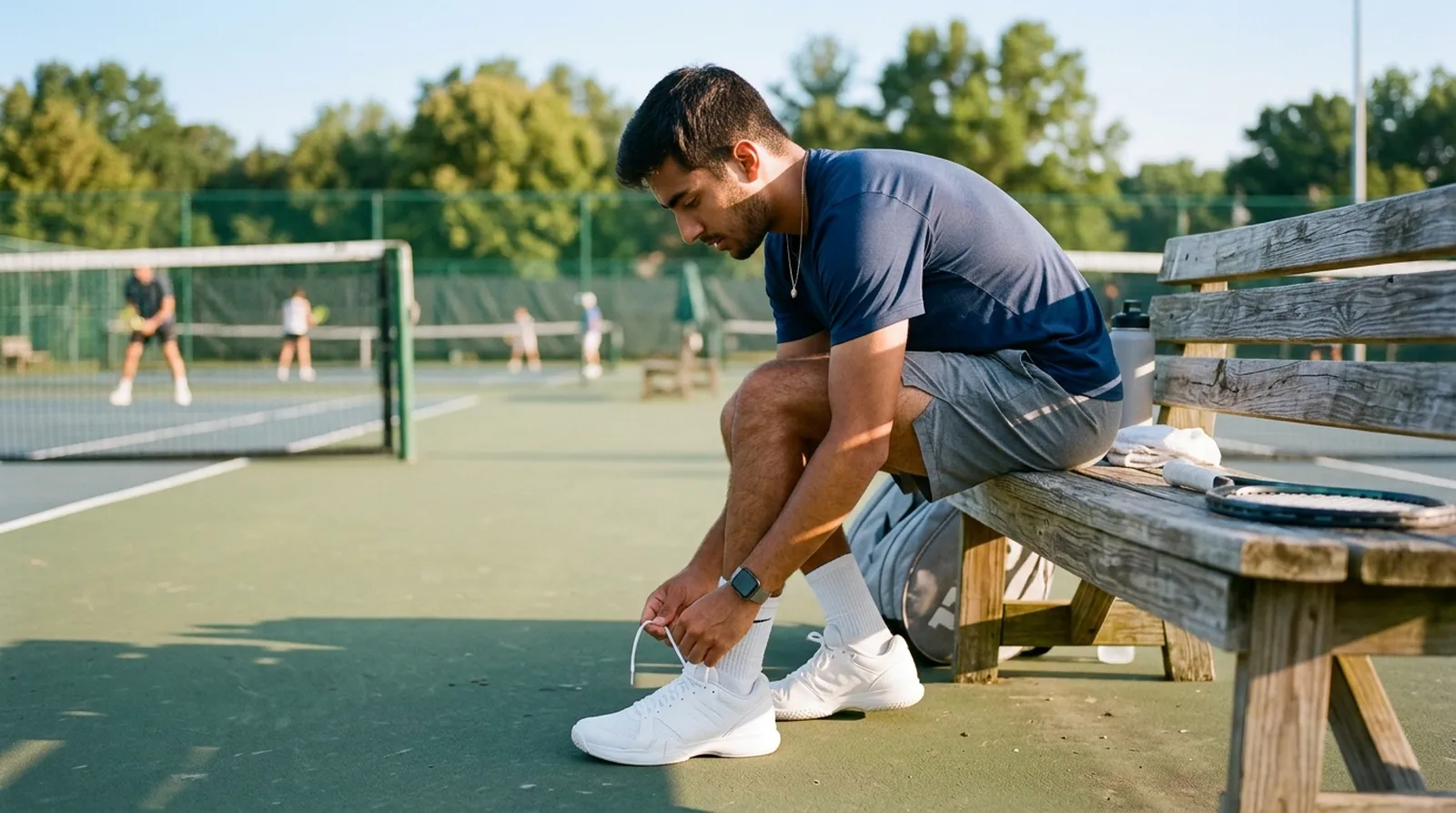
What is the most comfortable tennis shoe?
The Nike GP Challenge 1.5, at 9.4/10, the best comfort score in our ratings.
It combines Air Zoom in the heel and forefoot, two pressurised air cushions that absorb impact and return part of it, with a TPU plate that stiffens the midfoot. According to the Tennis Warehouse product page, its high-abrasion rubber is denser under the inner forefoot, with a rubber guard on the inside of the toe. It scores 9.0/10 for stability and 8.6/10 for durability. Its known drawback: 456 g in a men's US 10.5, one of the heaviest shoes on the market.
Just behind, at 8.8/10, are two very different models. The Nike GP Challenge Pro relies on a widened base and a rounded, rocker-style outsole that rolls the foot from heel to toe; tests credit it with good shock absorption. The New Balance Fresh Foam X CT-Rally v2 has the thickest platform in its category: RunRepeat measures record heel cushioning.
Thick cushioning or court feel: which matters more?
Generous cushioning, but not to the point of losing contact with the ground. That is the whole debate around the CT-Rally v2.
Its very thick heel protects the joints on impact, but RunRepeat records a 13.1 mm drop, meaning a heel sitting well above the forefoot, and a platform that passes on little court feel. For a doubles player who hits from the back and moves little, that is a fair trade-off. For a senior who still comes to the net and pivots quickly, the height can get in the way of footwork.
The GP Challenge 1.5 and GP Challenge Pro strike a better balance: enough cushioning for long matches, at the height of a classic tennis shoe. If in doubt, try both in a shop and do a lateral shuffle step: the shoe that holds your foot best sideways is the right one.
Nike GP Challenge 1.5 or Asics Gel-Resolution X for your knees?
The GP Challenge 1.5 if comfort comes first, the Gel-Resolution X if you want maximum stability or a wide fit.
The comfort gap is clear: 9.4/10 for the Nike against 8.4/10 for the Asics. The Gel-Resolution X answers with lateral stability (9.3/10, the best in this guide), its Dynawall support and a full-length AHAR Plus outsole rated 9.0/10 for durability. Its heel combines Gel and FF Blast Plus Eco foam, more comfortable than the previous generation according to tests.
For knees that hurt on impact, the Nike's cushioning weighs more. For ankles that roll easily or a wide foot, the Asics takes the lead. Both are heavy: 456 g for the Nike in a men's US 10.5, 425 g for the Asics in a US 9, and 456 g for its 2E version in a US 10.5.
✓ Pros
- Highest comfort score in our ratings (9.4/10)
- Air Zoom in heel and forefoot, TPU plate
- Denser rubber and protected toe (8.6/10 for durability)
- All-court and clay versions
✗ Cons
- Heavy: 456 g in a men's US 10.5
- No wide version found
- Around €125 in Belgium
Each model is covered in detail in the Nike GP Challenge 1.5 review and the Nike GP Challenge Pro review.
Which tennis shoes come in a wide fit?
Asics, New Balance, Adidas and Babolat offer them; Nike has no dedicated width on these models.
- Asics Gel-Resolution X: 2E (wide) version, covered like the standard version by the outsole guarantee of the US retailer Tennis Warehouse.
- New Balance Fresh Foam X CT-Rally v2: D and 2E widths; the 996 also comes in 2E.
- Adidas Barricade 14: Wide version.
- Babolat SFX 4: wide fit as standard (Superior Fit eXperience), roomy forefoot, around €95.
On the Nike side, the GP Challenge Pro has a widened base for stability, which is not the same as a true 2E width. A wide foot squeezed into a narrow shoe rubs on the sides, and the upper gives out before the outsole.
For sizing, leave about a thumb's width, 0.9 to 1.3 cm, between your longest toe and the end of the shoe, according to Vionic. Try shoes at the end of the day, when your feet have swollen, with your tennis socks. If you wear an orthotic, remove the stock insole and try the shoe with yours in place.
How long does the cushioning last, and when should you replace the pair?
Between 45 and 60 hours of tennis, according to the AAPSM, the American Academy of Podiatric Sports Medicine. For a senior player, that is the figure that counts, because the cushioning usually goes before the rubber.
Let's run the numbers for a common profile: two sessions of an hour and a half a week, mostly doubles, on clay in summer. Three hours a week gives 15 to 20 weeks before the cushioning wears out, so a pair every 4 to 5 months. At two hours a week, count on 5 to 7 months. The USTA sums it up: one hour a week means at least one pair a year.
No pair is judged without the lifespan of its outsole, but for this profile the rubber is almost never the limiting factor. A recreational doubles player on clay wears an outsole far less than a baseliner on hard courts, the USTA notes. On clay, the rubber of a GP Challenge 1.5 or Gel-Resolution X will still have tread when the cushioning is already flattened. That is the trap: the shoe looks new, your knees say otherwise.
Signs to watch for:
- deep creases in the midsole foam;
- a shoe that tilts when you place it on a table;
- knees, ankles or heels that ache more after a match;
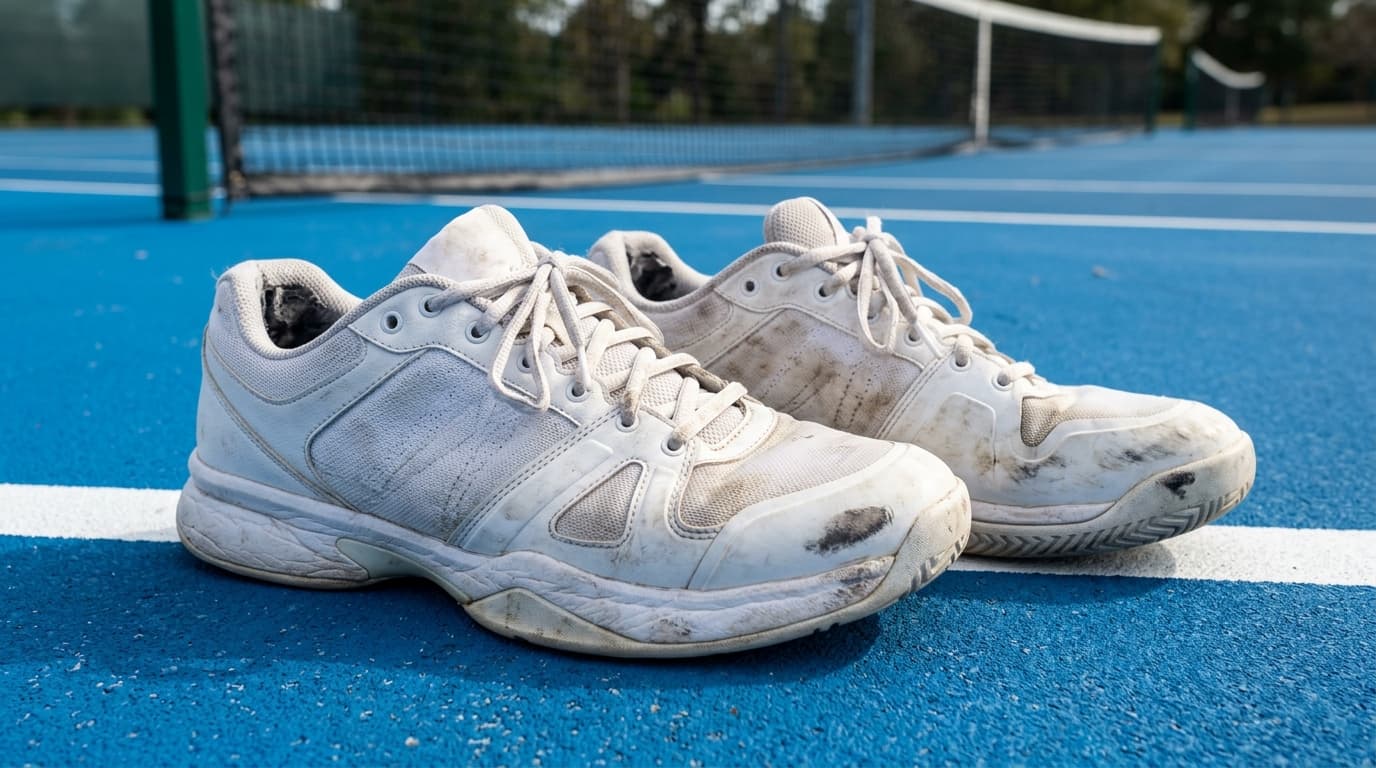
- a heel counter that folds when you pinch the back of the shoe.
The AAPSM adds an age rule: replace a sports shoe that is more than a year old, even if lightly worn, because foams dry out and break down.
Wear signs by profile are covered in the article on how long tennis shoes last.
Clay or indoor: which surface is kinder to your joints?
Clay. According to the 1995 ATP study cited by Sportzorg, the physio was called 0.20 times per match on clay, against 0.42 times on hard courts: surfaces you can slide on cause fewer injuries.
Belgium is well served: more than eight courts in ten are crushed-brick clay, according to RTBF. Take the clay version of your model for the summer; the GP Challenge 1.5, GP Challenge Pro and Gel-Resolution X all have one.
In winter, clubs play under domes or indoors, on GreenSet or carpet. On carpet you need a completely smooth, non-marking outsole: too much tread locks the foot and raises the risk of a sprain, a risk to take seriously when your knees are fragile. Many players end up with two pairs, one per season, which has the advantage of spreading the wear on the cushioning.
Which shoe for which senior player?
- Sensitive knees, no fixed budget: Nike GP Challenge 1.5, the most comfortable (9.4/10).
- Budget around €100: Nike GP Challenge Pro, widened base and rounded outsole, around €97.
- Wide feet or unstable ankles: Asics Gel-Resolution X in 2E, the most stable (9.3/10) and most durable (9.0/10).
- Easy-going doubles, cushioning above all: New Balance CT-Rally v2, bearing in mind that its high heel reduces court feel.
- Wide feet and a small budget: Babolat SFX 4, wide fit as standard, around €95.
To compare these models criterion by criterion, use the comparison tool, or let the quiz point you in three questions. The overall tennis shoe ranking and the guide on how to choose tennis shoes round out the picture.
Sources
- AAPSM, When to replace athletic shoes
- USTA, when is it time to buy new tennis shoes
- Tennis Warehouse, most stable tennis shoes
- Bespoke Unit, tennis shoes for plantar fasciitis
- Tennis Warehouse, Nike GP Challenge 1.5 product page
- RunRepeat, Nike GP Challenge Pro
- RunRepeat, New Balance Fresh Foam X CT-Rally v2
- RunRepeat, Asics Gel-Resolution X
- Tennis Companion, Asics Gel-Resolution X
- Tennis Warehouse, Babolat SFX 4 product page
- Tennis Warehouse, wide tennis shoes
- Decathlon Belgium, men's tennis shoes
- Vionic, how sneakers should fit
- Neo G, orthotic insoles
- ASICS, shoe care tips
- Sportzorg, tennis shoes and court surfaces
- RTBF, clay at the heart of Belgian tennis
Your questions
Frequently asked questions
What is the most comfortable tennis shoe for a senior player?
The Nike GP Challenge 1.5, rated 9.4/10 for comfort, the highest score in our ratings. It combines Air Zoom in the heel and forefoot with a TPU plate that stabilises the foot. It costs around €125 in Belgium and weighs 456 g in a men's US 10.5.
When is the cushioning of a tennis shoe worn out?
After 45 to 60 hours of play, according to the AAPSM, even if the outsole still has tread. Signs: deep creases in the foam, a shoe that tilts when placed on a flat surface, knees or ankles that ache more after a match. Past one year, replace it even if you barely wore it.
Which brands make tennis shoes in a wide fit?
Asics (Gel-Resolution X in 2E), New Balance (CT-Rally v2 in D and 2E, 996 in 2E) and Adidas (Barricade 14 Wide). The Babolat SFX 4 has a wide fit as standard. At Nike, the GP Challenge Pro has a widened base, but no wide version was found.
What size should I take with an orthotic insole?
Try the shoe with your orthotic in place, after removing the stock insole, at the end of the day and with your tennis socks. Leave about a thumb's width, 0.9 to 1.3 cm, in front of your longest toe. A wide-fit model often makes this easier.
Should I replace the insole more often than the shoe?
No, rather the opposite for a regular player. A standard insole usually lasts 1 to 2 years and a custom orthotic much longer, while the shoe's cushioning gives out after 45 to 60 hours of tennis. Keep your orthotic and change the shoe around it.