Buying guides
Tennis Shoes for Indoor Carpet: Which Ones to Choose?
Carpet tennis shoes need a smooth, non-marking outsole. On GreenSet, pick a hard-wearing all-court shoe. From €61, to replace after 45 to 60 hours.
Contents · 12 sections
- Key takeaways
- Which indoor tennis shoes, in short?
- Carpet or GreenSet: how do you know what you play on in winter?
- Why do you need a smooth outsole on carpet?
- Does Nike make carpet tennis shoes?
- Which smooth-outsole shoe to choose, and where to find it in Belgium?
- On GreenSet, which outsole lasts longest?
- How long does an indoor pair last?
- Which shoe for which hall?
- Sources
- FAQ
- Related articles
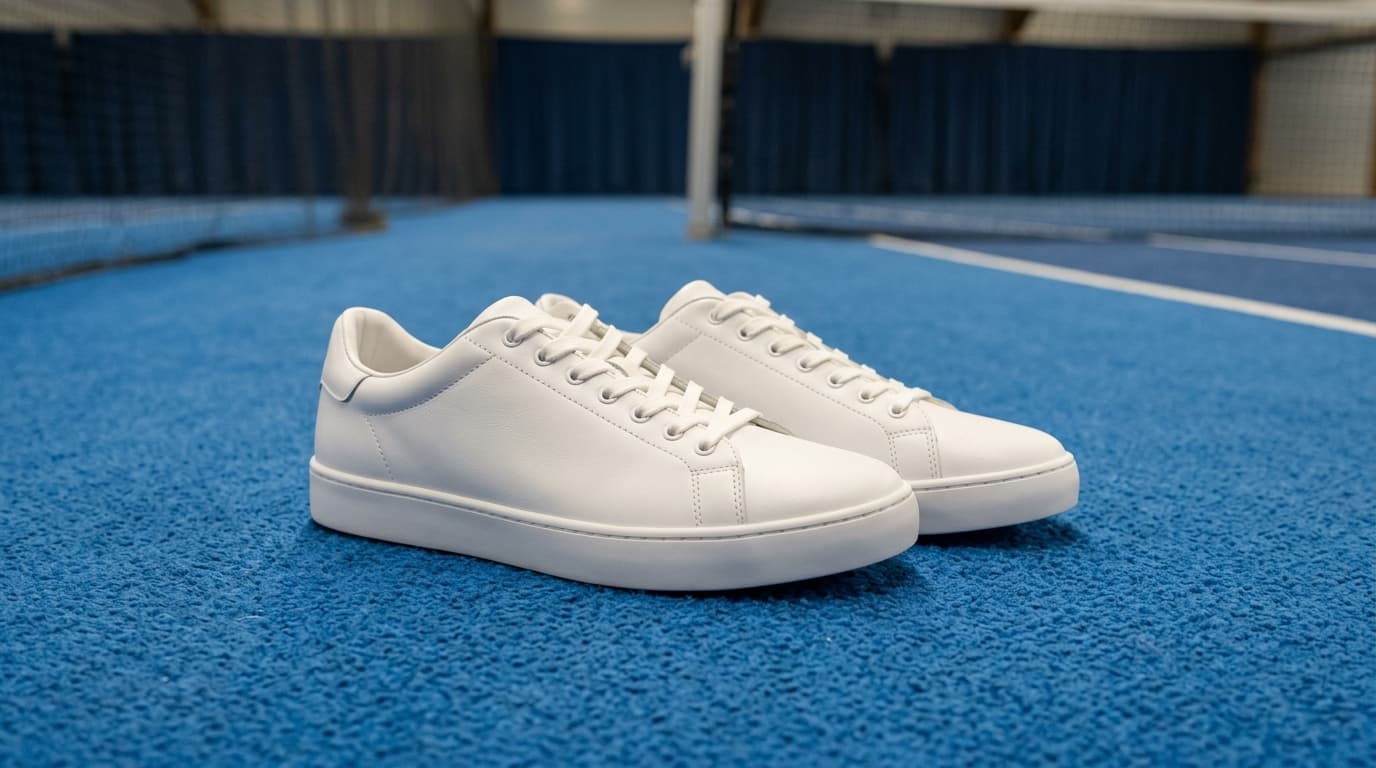
A tennis shoe for carpet has a completely smooth outsole, with no tread, and a non-marking one. It is the only rule that is not up for debate indoors. But not every Belgian hall has carpet: on GreenSet, a hard court surface, you need the opposite, an all-court version with the most hard-wearing rubber possible.
So the first step is to look at the floor. The model comes after.
Which indoor tennis shoes, in short?
Five models, sorted by floor. The Nikes open the list, and they all sit on the same side of the table.
| Model | Indoor floor | Outsole | Durability | Comfort | Average price in Belgium (June-Sept. 2026) |
|---|---|---|---|---|---|
| Nike Vapor Pro 3 | GreenSet | all-court, Hart rubber right up to the toe | 8.6/10 | 8.4/10 | around €117 |
| Nike GP Challenge 1.5 | GreenSet | all-court, high-abrasion rubber | 8.6/10 | 9.4/10 | around €125 |
| Nike GP Challenge Pro | GreenSet | all-court, hard herringbone rubber | 8.2/10 | 8.8/10 | around €97 |
| Nike Court Lite 4 | GreenSet, recreational play | all-court | 6.8/10 | 7.4/10 | around €67 |
| Asics Gel-Dedicate 9, carpet version | carpet | smooth | 5.8/10 | 7.4/10 | around €61 |
The scores are those of our editorial grid, compiled from the tests published by RunRepeat, Tennis Warehouse and Tennisnerd. I have not worn any of these pairs.
One row is missing, and I would rather say so straight away: none of the seven Nikes in our database is listed in a carpet version. The section on Nike, further down, says what exists elsewhere.
Carpet or GreenSet: how do you know what you play on in winter?
Ask the club. The question sounds naive, yet it decides the whole purchase.
In winter, Belgian clubs play under a bubble or in a hall, for example on GreenSet or on carpet with rubber granules, as L'Avenir reported about a club in Walloon Brabant. These two floors have nothing in common. GreenSet is a resin laid on a hard base, the ‘acrylic’ family in the ITF surface classification. Carpet is a textile covering, a family of its own in that same classification.
The speed of play will not help you decide. The ITF places carpet among the fastest surfaces, at level 5 of its scale, with grass. A resin court can be fast too.
Look under your feet instead. A textile floor, sometimes loaded with small granules, is carpet. A painted floor, smooth and hard like an outdoor hard court, is a resin: an indoor hard court.
Three situations follow from that:
- your hall has carpet: you need a pair with a smooth outsole, and nothing else will do;
- your hall has GreenSet or resin: an all-court version, chosen for its rubber;
- you play in two different halls, which happens in winter league matches: two outsoles, or at least a phone call to the club you are visiting before you travel.
Why do you need a smooth outsole on carpet?
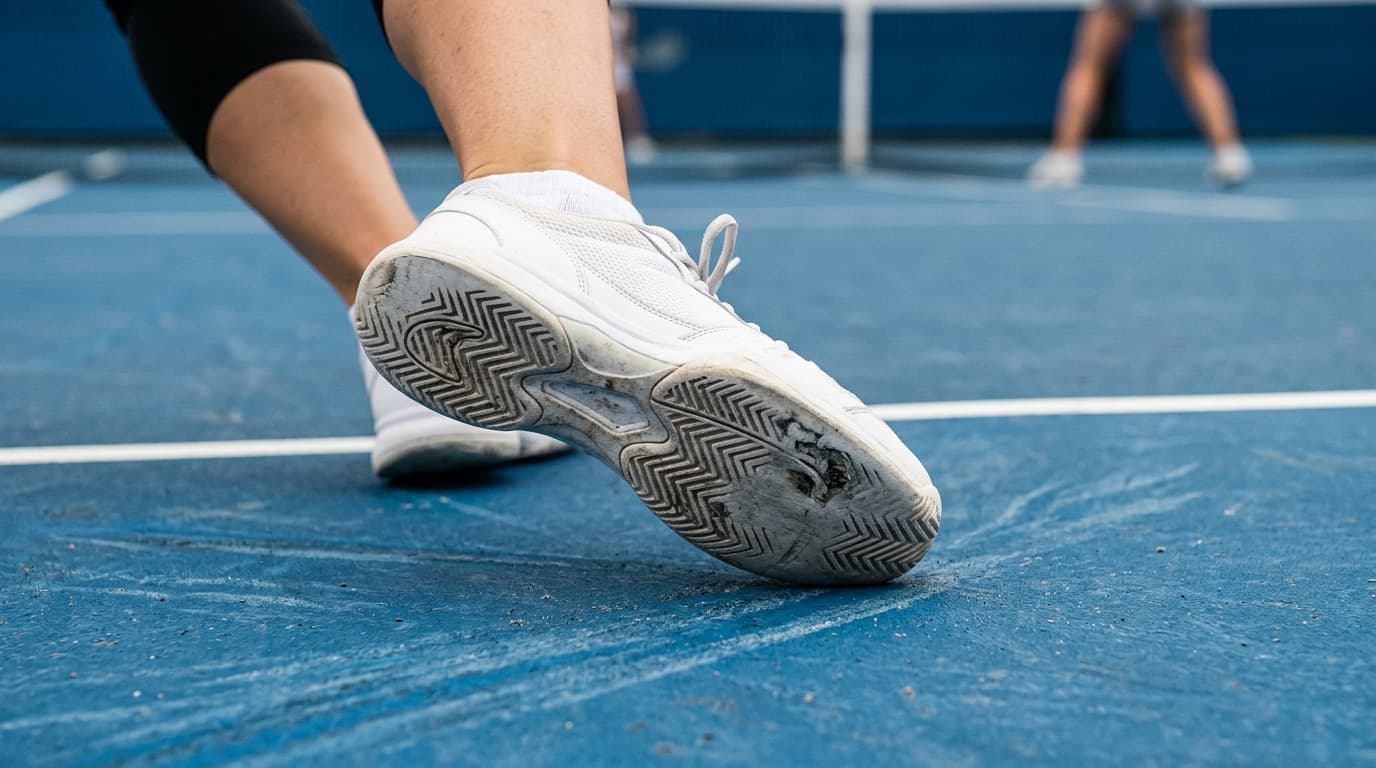
Because an outsole with tread grips too much. Decathlon Belgium sums it up like this: on carpet, you need a completely smooth outsole, with no tread, and a non-marking one. Too much tread gives too much grip, the foot locks and the risk of a sprain goes up.
The mechanism needs no diagram. On clay, the herringbone clears the clay and lets the foot slide. On carpet, that same herringbone digs into the fibres. The foot stops dead while the body carries on, and the ankle absorbs the difference.
The figures point the same way. According to a 1995 ATP study cited by the Dutch organisation Sportzorg, the physio was called 0.42 times per match on hard courts, against 0.20 times on clay. Surfaces where the foot can slide cause fewer injuries. A smooth outsole gives back to carpet what a herringbone takes away from it.
‘Non-marking’ is the other half of the rule. Rubber that leaves marks damages the covering. The wording appears on the model's product page or under the shoe.
Does Nike make carpet tennis shoes?
Not among the models we follow. The seven Nikes in our database exist in an all-court version, six of them in a clay version too, and none is listed in a carpet version.
Yet Nike has made some. Tennis Warehouse Europe lists an Air Zoom Vapor Pro 2 Carpet, one generation before the current Vapor Pro 3. I give it no score: it is not one of the 37 models on our grid, and a model from the previous generation is mostly found at the end of its run, in a few sizes. Check its availability on nike.com/be or at a specialist retailer before counting on it.
For a player loyal to Nike, the conclusion is simple to write and less pleasant to read. If your hall has carpet and that version is no longer available in your size, the right shoe is not a Nike this winter.
On GreenSet, it is the reverse: Nike has four answers, detailed two sections further down.
Which smooth-outsole shoe to choose, and where to find it in Belgium?
The Asics Gel-Dedicate 9 in a carpet version, for around €61 in average price recorded in Belgium. It is the only one of the 37 models in our database to be listed with this outsole.
It scores 6.9/10 overall, 7.4 for comfort thanks to its Gel cushioning and 5.8 for durability. That last score reflects its rubber, standard AHAR and not the AHAR Plus of the more expensive Asics. On a hard court, that would be a real flaw. On carpet, the constraint is the pattern of the outsole more than its thickness, and the price does the rest: at €61, over 45 to 60 hours, an hour of play works out at €1.00 to €1.35. The Asics Gel-Dedicate 9 review goes through its scores and its three outsoles.
Two limits to know about. Its weight is not disclosed in the sources consulted. And its support, 7.0/10 for stability, remains that of an entry-level shoe: a competitor who changes direction hard will lose out compared with their summer pair.
To widen the choice, two Belgian addresses. TennisDirect.be has a ‘tapijt’ section separate from hard court, which saves you sorting outsoles one by one. Decathlon Belgium, which sets out the smooth outsole rule, is the other retailer to look at. Tennis Warehouse Europe, for its part, keeps a ‘carpet’ category for men.
Read the title of the product page before you pay. The same model, in the same colourway, often exists with three outsoles, and only the wording ‘carpet’, ‘tapijt’ or ‘indoor’ guarantees the smooth outsole.
On GreenSet, which outsole lasts longest?
The one with the most rubber, and this is where Nike takes back the lead. GreenSet is as abrasive as an outdoor hard court: the outsole works there on every stop, with no clay to spare it.
No pair is judged without the lifespan of its outsole. On an indoor hard court, it is even the first criterion, ahead of weight.
Nike Vapor Pro 3. The hard-wearing Vapor: Hart rubber across the whole outsole, right up to the toe, 8.6/10 for durability and 8.9 for grip at 425 g in a men's US 10.5. RunRepeat rates its durability as ‘fantastic’, wear zones included. Around €117. For a league competitor, it is the most logical winter pair. See the Nike Vapor Pro 3 review.
Nike GP Challenge 1.5. Same durability score, 8.6/10, with the best comfort in our database: 9.4/10. It weighs 456 g, which is 31 g more than the Vapor Pro 3, and costs around €125. For the baseline player who strings long rallies together. Details in the Nike GP Challenge 1.5 review.
Nike GP Challenge Pro. A hard rubber, measured at 87.5 HC, which only wears down by 0.6 mm in RunRepeat's abrasion test. 8.2/10 for durability, 8.8 for comfort, around €97. See the Nike GP Challenge Pro review.
Nike Court Lite 4. The cheapest of the Nikes, around €67, for one hour indoors a week. Its durability tops out at 6.8/10: a player who slides or who plays three times a week will finish it before spring. See the Nike Court Lite 4 review.
Among the other brands, the Asics Gel-Resolution X and the Adidas Barricade 13 reach 9.0/10 for durability. The durable tennis shoes ranking orders the eight best rubbers, and the article on wear on clay and on hard courts explains why the winter pair wears out faster than the summer one.
How long does an indoor pair last?
One winter for most players. Two pairs for those who play four hours a week.
The calculation starts from the cushioning. The AAPSM, the American academy of podiatric sports medicine, considers that a midsole is worn out after 45 to 60 hours of tennis, whatever the state of the rubber. The indoor season runs from October to March, which is about 26 weeks.
| Indoor rhythm | Hours over the winter | Pairs needed |
|---|---|---|
| 1 hour a week | around 26 h | 1 pair, half worn in March |
| 2 hours a week | around 52 h | 1 pair, worn out by spring |
| 4 hours a week | around 104 h | 2 pairs |
On GreenSet, the rubber can give out before the foam if it is soft: that is what separates a Court Lite 4 from a Vapor Pro 3. On carpet, outsole wear depends on the covering, and none of the sources consulted publishes a measurement. Go by the cushioning, and by your knees.
That leaves storage. The AAPSM points out that foam and rubber dry out and degrade even without being used, and advises replacing a sports shoe that is more than a year old. An indoor pair half worn in March will not be new in October.
The price that matters is the price per hour of play. On the basis of 45 to 60 hours:
| Model | Average price | Cost per hour of play |
|---|---|---|
| Nike Vapor Pro 3 | €117 | €1.95 to €2.60 |
| Nike GP Challenge 1.5 | €125 | €2.10 to €2.80 |
| Nike GP Challenge Pro | €97 | €1.60 to €2.15 |
| Nike Court Lite 4 | €67 | €1.10 to €1.50 |
| Asics Gel-Dedicate 9, carpet version | €61 | €1.00 to €1.35 |
Which shoe for which hall?
- Carpet hall, whatever your level: a model with a smooth outsole. Asics Gel-Dedicate 9 in a carpet version, around €61.
- Carpet hall and loyal to Nike: look for an Air Zoom Vapor Pro 2 Carpet in your size, with no guarantee of finding it.
- GreenSet, winter league matches: Nike Vapor Pro 3, 8.6/10 for durability, around €117.
- GreenSet, long rallies and knees to look after: Nike GP Challenge 1.5, 9.4/10 for comfort.
- GreenSet, tight budget: Nike GP Challenge Pro, around €97, or €1.60 to €2.15 per hour.
- GreenSet, one hour a week: Nike Court Lite 4, around €67.
✓ Pros
- Hart rubber right up to the toe, 8.6/10 for durability
- 8.9/10 for grip and 8.8 for stability
- 425 g in a men's US 10.5
- Around €117 in Belgium, or €1.95 to €2.60 per hour of play
✗ Cons
- All-court version: not suitable for carpet
- Comfort of 8.4/10, behind the GP Challenge 1.5
- No outsole guarantee identified in Belgium
The question of the two seasons is covered in do you need two pairs of tennis shoes in Belgium. The overall ranking and the competition ranking set these models against the rest, and the best value ranking places the Gel-Dedicate 9 and the Court Lite 4. To sort by criterion, use the buying guide or the comparison tool. The six basic criteria are in how to choose tennis shoes.
Sources
- Decathlon Belgium, men's tennis shoes
- Decathlon Belgium, how to choose tennis shoes (NL)
- ITF, surface types
- ITF, surfaces classified by pace
- Sportzorg, tennis shoes and court types
- L'Avenir, TC Bosquet and its covered courts
- TennisDirect.be, carpet (tapijt) shoes
- Tennis Warehouse Europe, men's carpet tennis shoes
- Tennis Warehouse Europe, Nike Air Zoom Vapor Pro 2 Carpet
- Tennis Warehouse Europe, Asics Gel-Dedicate 9
- RunRepeat, Nike Vapor Pro 3
- RunRepeat, Nike GP Challenge Pro
- AAPSM, when to replace athletic shoes
Your questions
Frequently asked questions
Which tennis shoe do you need on carpet?
A shoe with a completely smooth outsole, with no tread, and a non-marking one, according to Decathlon Belgium. Too much tread grips too much: the foot locks and the risk of a sprain goes up. The Asics Gel-Dedicate 9 exists in a carpet version, for around €61 in Belgium.
Can you play on carpet in all-court or clay shoes?
No. The herringbone of a clay or all-court outsole grips too much on carpet, which locks the foot. On GreenSet, an indoor hard court, an all-court version is the right choice instead. Ask your club which floor it has and which outsole it accepts.
Does Nike make carpet tennis shoes?
None of the seven Nikes in our database is listed in a carpet version. Nike has made some: Tennis Warehouse Europe lists an Air Zoom Vapor Pro 2 Carpet, a previous generation. Check its availability and your size on nike.com/be before counting on it.
Which indoor tennis shoes last longest on a hard court?
Those whose rubber scores 8.5/10 or more for durability on our grid. At Nike, the Vapor Pro 3 and the GP Challenge 1.5 are at 8.6/10, the GP Challenge Pro at 8.2. At Asics, the Gel-Resolution X is at 9.0, like the Adidas Barricade 13.
Which shoes for winter league matches?
On GreenSet, the Nike Vapor Pro 3: 8.6/10 for durability, 8.9 for grip, 425 g, around €117 in Belgium. On carpet, you need a model with a smooth outsole, whatever your level. The floor of the hall decides before the player's ranking does.
How much does a pair of indoor tennis shoes cost?
Around €61 for an Asics Gel-Dedicate 9 in a carpet version, €67 for a Nike Court Lite 4 and €117 for a Nike Vapor Pro 3, in average prices recorded in Belgium between June and September 2026. Over 45 to 60 hours, that makes €1.00 to €2.60 per hour.